Get Full Government Meeting Transcripts, Videos, & Alerts Forever!
Get email alerts on the Traffic Calming Policy Adoption topic
No spam. Unsubscribe anytime.
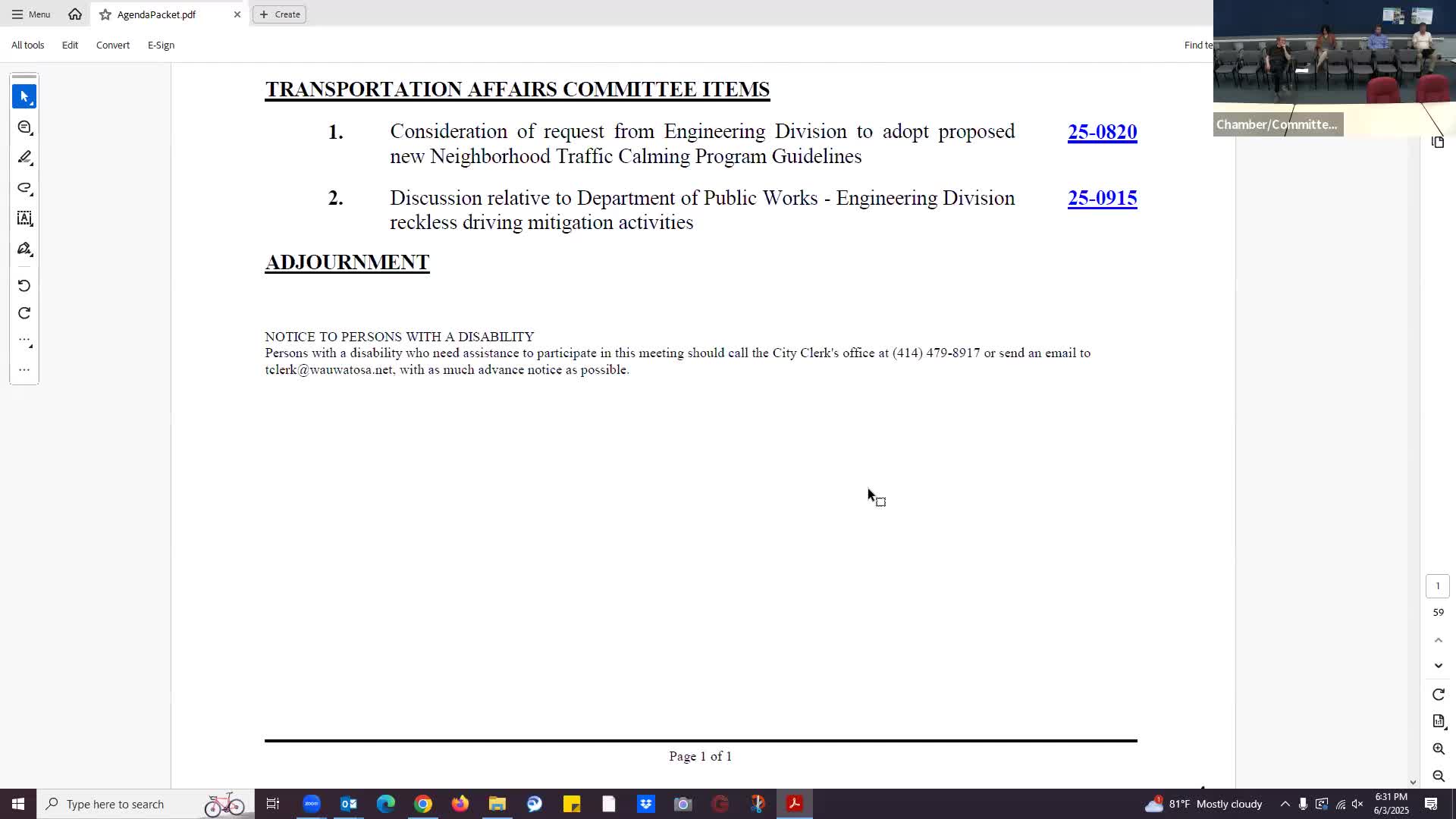
Wauwatosa committee adopts new neighborhood traffic-calming guidelines, 6-0
Summary
The Wauwatosa Transportation Affairs Committee approved new neighborhood traffic-calming guidelines and asked staff to administer the policy using vehicle-registration-fee funding; the measure passed 6-0 with a commitment to minor redline edits and ongoing reporting.
The Wauwatosa City Transportation Affairs Committee voted 6-0 to adopt new neighborhood traffic-calming guidelines on a motion by Alder Lewis, seconded by Alder Foley. The committee approved the policy with the understanding that staff will incorporate minor redline edits and return updates to the committee and Common Council as needed.
The policy replaces an earlier, lengthier document and changes how requests are submitted and prioritized. Mike May of Traffic Engineering, who led the staff presentation, said the new guidelines are “very user friendly” and easier for staff to administer. May described eligibility requirements and a points-based ranking system that will determine which locations are prioritized for design and construction.
Under the new rules, any individual may submit a traffic-calming location; the applicant must provide contact information to act as a sponsor for follow-up. Staff will screen submissions for minimum qualifications — based on measured speeds, excessive-speed percentages and crash history — before collecting detailed data. Qualifying requests will be scored once annually and the top projects will move into design and construction as budget allows.
May said the program will use the city’s vehicle registration fee as the primary funding source, removing the previous requirement that affected neighborhoods pay directly. “It’s no longer about a neighborhood’s ability to pay,” May said, describing the change as a way to “level the playing field” and direct money to locations with the greatest documented problems first.
The scoring system gives weight to speed metrics, crash severity, traffic volume and proximity to schools, parks, safe routes to school and greenways. For crashes, staff proposed 25 points for a fatality, serious-injury crash or any crash involving a pedestrian, bicyclist or scooter; five points for each minor injury; and two points for property-damage-only crashes. Speed criteria include a qualifying marker when the 85th-percentile speed measures 6 mph or more over the posted limit; excessive-speed qualifies if 10% or more of measured speeds exceed the posted limit by 10 mph.
Committee members stressed the need for a data-driven approach and for staff discretion to manage cost-effective solutions. Mayor and several Alders said they prefer a policy that staff can apply without returning to the council for every decision, while retaining an appeal path. Director Simpson (Public Works) described an appeals process to the director and then to the Board of Public Works for disputes about point allocations or eligibility.
Alder Lewis moved approval and Alder Foley seconded. The committee voted in favor 6-0. Staff said they will return to Transportation Affairs with the ranked list of projects — typically in May each year after a year’s worth of data collection — and include priority updates in the budget process for implementation.
Committee members noted that some top-ranked projects could require interjurisdictional coordination, for example a long segment on Grantosa Parkway that borders the City of Milwaukee. May said such projects might require more time and coordination and would not necessarily consume the entire year’s budget in the first implementation cycle.
The committee approved the guidelines with the explicit understanding that staff would incorporate minor clarifications suggested by Alders and that the policy would be reviewed and adjusted if needed based on early program experience.