Get Full Government Meeting Transcripts, Videos, & Alerts Forever!
Get email alerts on the Urban Forestry topic
No spam. Unsubscribe anytime.
Titusville commission urges action on urban-forest plan, recommends focusing Landscape Trust Fund on trees and staffing
Summary
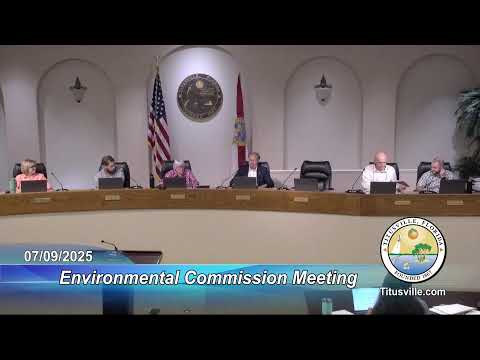
At its July 9 meeting the Titusville Environmental Commission pressed for rapid implementation of an urban forest management plan, recommended directing the city’s Landscape Trust Fund toward tree planting and a dedicated urban-forest staffer, and discussed the consultant proposal and community planting plans.
The Titusville Environmental Commission on July 9 urged the city to move quickly from assessment to implementation of an urban forest management plan and recommended that the Landscape Trust Fund be focused on planting, staffing and implementation rather than decorative projects.
The discussion followed a public presentation about local storm‑resilient plants and a consultant proposal for an "urban forest management plan" (the consultant named in recent council materials as Eocene Environmental Group). Commission members and members of the public emphasized canopy losses since 2021, the need for an on‑staff urban forester, and use of existing mitigation funds to pay for planting and long‑term program staff.
Why it matters: commissioners said the city’s tree canopy has declined amid development and that a plan without dedicated staff and predictable funding will remain paper. The commission discussed a Landscape Trust Fund balance of roughly $208,000 (reported by staff in April) and the prospect of using that fund, Tree City USA allocations and grants to support planting programs and a staff position.
Commission discussion and consultant work Commissioners described the consultant proposal as a next step after a canopy assessment. The proposal would use recent aerial data to quantify canopy loss since 2021, recommend priority planting areas and performance indicators, and identify responsible parties and a timeline for implementation.
Member Browning said the commission should break the work into manageable pieces and focus funding on large canopy trees as the most effective way to reduce heat and energy use. Browning said the group should "eat the elephant 1 chunk at a time" by defining focused priorities and returning a short recommendation to council. He also urged the commission to condense its draft trust‑fund language into a one‑ or two‑page recommendation the commission could send to the city.
Several commissioners and members of the public told the panel that implementation—not another assessment—must follow. Kaye (member) told the commission, "We must have staff to implement it," arguing the plan needs a dedicated staff member or crew to carry out planting, pruning and maintenance. Members discussed the Tree City USA expectation that a community document at least $2 per capita annually for city trees and the fact that various revenue streams (mitigation fees, general fund contributions and grants) would likely be combined to fund the program.
Public presentations and local initiatives Before the trust fund discussion, Kim Gibbs of Brevard County gave a public presentation titled "Stormscaping in Central Florida," describing which native trees and shrubs proved most wind‑resistant after recent storms and recommending group plantings, right‑plant/right‑place design and proper arborist pruning. Gibbs and other speakers encouraged the commission to integrate storm‑resilience into the city plan.
Case Nance (public) noted the council accepted a proposal from Eocene Environmental Group; in public remarks she summarized the consultant scope (use of aerial images, canopy targets, community engagement, and staff responsibilities) and urged the commission to press for implementation. Citing the consultant schedule in the proposal, commissioners said the final plan and recommendations to council could appear this winter (around December or January, per the consultant timeline discussed).
Funding details and next steps Commission discussion included past fund movements: staff said a now‑sunsetted "landscape enhancement" program left about $65,000; the city applied $50,000 of that to match an urban‑forest grant and transferred roughly $15,000 into the Landscape Trust Fund, which staff listed at about $208,000 in April. Commissioners asked that the trust fund language be revised so the fund could be used for urban‑forest planting and to support a staff position, rather than only general "beautification."
The commission also discussed Tree City USA reporting requirements (the standard asks communities to document at least $2 per capita annually for planting, care and removal of city trees) and encouraged staff to pursue additional grant funding and partnerships to support a strategic street‑tree planting program, tree giveaways and targeted plantings in neighborhoods with low canopy.
Members agreed to prepare a condensed recommendation for council that (a) clarifies the commission’s priorities for the Landscape Trust Fund, (b) affirms the need for dedicated staff to implement the plan, and (c) supports the consultant process while pressing for implementation. Member Browning volunteered to draft a short, two‑page recommendation for the commission to review and transmit to council for the next meeting cycle.
Local events and community engagement Commissioners and public speakers highlighted a community planting event scheduled for August 2 at Blue Hole Park (planned start about 9:00 a.m.) where volunteers expect to plant about 40 cypress and about 20 live oaks, and noted ongoing tree‑giveaway efforts by local volunteers.
Ending Commissioners said they expect the consultant work and the city staff follow‑up to continue through the fall and asked members to prepare goals and vision language to contribute during the consultant’s community engagement phase.