Get Full Government Meeting Transcripts, Videos, & Alerts Forever!
Get email alerts on the Traffic Safety:no Right On Red topic
No spam. Unsubscribe anytime.
Salem committee debates citywide "no right on red" ordinance; narrow votes adjust two intersections and package remains in committee
Summary
The Salem City Committee on Ordinances, Licenses and Legal Affairs reviewed Transportation Commission recommendations to add or clarify no-right-on-red restrictions at multiple intersections across Salem on June 23. Councilors approved two narrow changes and deferred the full package for further review.
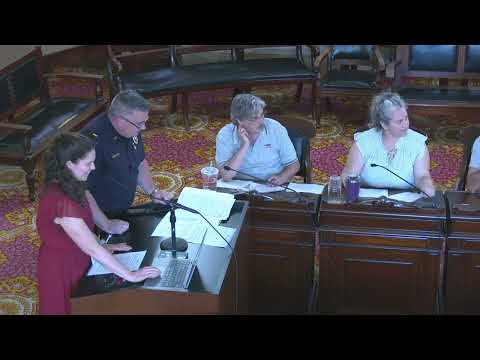
Salem City’s Committee on Ordinances, Licenses and Legal Affairs met June 23 in council chambers to review Transportation Commission recommendations to add, remove or clarify “no right on red” restrictions at intersections across the city, particularly in downtown and high‑pedestrian corridors.
The committee spent more than an hour and a half examining crash history, pedestrian counts, intersection geometry and sightlines compiled by the transportation department and the Transportation Commission. Assistant Transportation Director Christina Hodge explained that staff and the commission grouped intersections, reviewed crash data and pedestrian volumes, and considered sight distances and bicycle accommodations when assembling the recommended ordinance changes. “These are some slides that I actually helped pull together,” Hodge said, summarizing the background presented to the committee.
The discussion focused on pedestrian safety in downtown Salem — notably the Riley Plaza area, Pickering Wharf and the South Harbor/visitor center corridor — and on how restrictions might affect traffic flow, queuing and drivers’ route‑choice behavior. Lieutenant Tucker of Salem Police cited sight‑line and double‑lane approaches as common safety triggers for recommending prohibitions; “It could cause a safety issue not being able to see,” he said when describing several downtown approaches.
Councilors voiced differing priorities. Several members urged centering pedestrian safety in tourist and downtown corridors, while others warned that blanket no‑turn restrictions could cause queueing that diverts vehicles onto nearby private property (notably Pickering Wharf) or into residential streets. Councilors also raised the limits of city enforcement and the high cost of pedestrian‑activated “no turn on red” indicators used in other communities.
Votes and formal actions
- Norman Street (eastbound Norman to southbound Washington): Councilor Cohen moved to add a prohibition on right turns on red from eastbound Norman Street onto southbound Washington Street; the motion was seconded by Councilor Morsello and carried 3–1. The committee recorded the tally as 3 yes, 1 no. The motion added that approach to the draft ordinance.
- Washington at Washington (Westbound Washington to Northbound Washington): Councilor Cohen moved to remove the proposed no‑right‑on‑red restriction for the westbound Washington to northbound Washington approach (i.e., to allow right turns after a full stop). The motion, seconded by Councilor Jerslow, carried 3–1 and restored a right‑after‑stop condition at that approach.
- Congress Street at Derby Street (northbound Congress to eastbound Derby): Councilor Jerslow offered a motion to remove the proposed prohibition for that single approach (to permit right turns after stop), but the motion received no second and no formal vote was taken; the item therefore remained in the draft ordinance for further consideration.
- Final committee disposition: Committee member Allison Morcillo moved to leave the whole package in committee for further review; the motion was seconded and carried unanimously. The committee adjourned after agreeing to return to the remaining intersections in a future meeting.
Rationale and clarifications
Committee members and staff repeatedly distinguished between three types of work in the draft: (1) cleaning up old, poorly worded ordinance language so existing sign treatments are reflected in code; (2) inserting new ordinance language where signage already exists; and (3) proposing new signs and ordinance language where neither exists today. Christina Hodge and Lieutenant Tucker said several changes are “clean up” items that reconcile outdated text with current traffic patterns rather than create new prohibitions.
Staff identified several technical reasons for particular recommendations: double‑lane approaches and offset angles that reduce sight distance; pedestrian volumes at visitor stops and South Harbor; bicycle lanes that merge into travel lanes; and isolated locations where adjacent private driveways and heavy truck movements (for example near an Amazon facility on Jefferson/Colonial) complicate turning movements. In one case staff noted that recent painted buffered bike lanes prompted a rehearing of the First Street at Traders Way approach.
Public‑interest and enforcement limits
Councilors emphasized enforcement constraints and the limits of local authority: several members asked whether pedestrian‑activated signals or illuminated “no turn on red” lights could be used at high‑volume tourist locations, and staff said such systems exist but are “shockingly expensive.” Councilors also urged staff to coordinate any sign changes with signal timing adjustments; staff said signal timing has not been coordinated yet for the full package but acknowledged that some intersections (for example the North/Federal/Bridge ramp area) show detector/timing issues that merit separate attention.
Where the committee landed
The meeting produced two narrow, recorded changes to the draft ordinance (the Norman Street prohibition addition and the Washington/ Washington removal) and left the full package in committee for additional study. Several downtown spots that generated the most debate — including the Congress/Derby/South Harbor corridor, Riley Plaza (Bridal/New Derby/Washington), Pickering Wharf cut‑through concerns, and Colonial/Jefferson near the hospital and Amazon driveway — remain on the list for future committee review. Staff said corridor‑level planning (Jefferson Avenue study) and potential concept designs for more extensive rebuilds are separate projects that could influence future ordinance decisions.
Next steps
The committee did not set a firm return date for the item. Staff and the Transportation Commission will prepare follow‑up materials requested at the meeting: clearer pairing of repeal/insert language by intersection, crash‑by‑collision summaries where available, pedestrian count peak vs. off‑season clarification, and an annotated list showing which changes are “clean up” versus new signage. The committee’s decision to keep the package in committee means no citywide ordinance change has yet been adopted.