Get Full Government Meeting Transcripts, Videos, & Alerts Forever!
Get email alerts on the Zoning Middle Housing topic
No spam. Unsubscribe anytime.
Nashville planning staff unveil Phase 2 zoning text to enable "middle housing," attainability bonus and expanded DADU overlay
Summary
Planning staff presented draft text amendments to Metro's zoning code that would add two new residential districts (RN, RL) to allow middle-scale housing, enable a state-authorized attainability bonus for rental units, expand detached accessory dwelling units (DADUs) and launch a countywide infrastructure assessment to guide later rezoning.
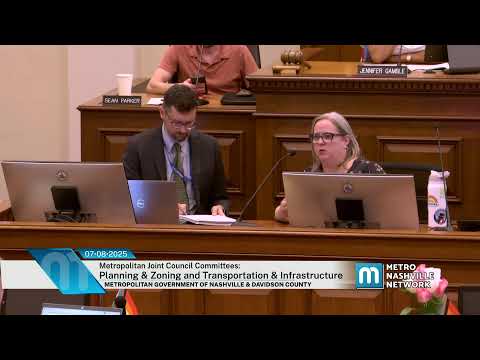
Planning and zoning staff on Tuesday presented Phase 2 of a multi-year housing and infrastructure study, proposing new zoning text to create two residential districts aimed at “middle housing,” an attainment bonus limited to rental units under state law and an expansion of detached accessory dwelling units (DADUs).
The Planning Department’s presentation, delivered by Greg of the planning department, laid out a three-part text amendment (Tasks 2a, 2b and 2c) intended to improve clarity in Metro’s zoning code, create districts scaled for house‑scale and low‑rise/multiplex housing, and add incentives to produce some attainable rental units within market‑rate buildings. "The goal is to improve the function and clarity of the zoning code for residential buildings and to improve the compatibility between new construction and existing neighborhoods," Greg said.
Why it matters: Planning staff said the changes aim to help Nashville meet housing targets in the Unified Housing Strategy while preserving neighborhood character. The text amendments would create (1) a Residential Neighborhood (RN) district for house‑scale forms (single‑family, duplexes, house courts and similar types) and (2) a Residential Limited (RL) district that would also allow courtyard flats and low‑rise multiplexes. Staff said the districts and associated building‑type standards are intended to steer form and scale while keeping entitlements clearer for neighbors and builders.
Staff framed the work as the second of four phases. Phase 1 assessed the existing Metro zoning code and infrastructure impacts; Phase 2 focuses on text changes to the zoning and building code; Phase 3 will propose a rezoning framework and strategic mapping to align zoning with Nashville Next’s growth‑and‑preservation map and planned infrastructure investments; and Phase 4 would be a two‑year assessment of how the new districts perform once implemented. Staff said they plan a summary infrastructure report by fall 2025 and additional community engagement before mapping recommendations.
Key elements of the proposal
- New districts and building types: The RN district would cover smaller house‑scale forms (single family, duplexes, house courts, manor houses); the RL district would include those and larger middle‑scale forms (courtyard flats, multiplexes, low‑rise flats). Each district will include urban and suburban calibrations and illustrated three‑page standards showing dimensional, placement and bulk rules.
- Building‑type standards and a clearer land‑use table: Staff described a simplified residential land‑use table and a package of building‑type standards that would appear as “permitted with conditions” (PC) in the code, accompanied by graphics showing typical lot conditions (corner, interior, alley/no‑alley).
- Attainability bonus (rental only): Staff said state law limits the proposed attainability bonus to rental housing only; the bonus would be an exchange of additional entitlement (height, density or bulk) for a modest share of units at a specified area‑median‑income (AMI) level. Staff emphasized the importance of calibration (the “x for y at z% AMI” tradeoff) and said the attainable share would likely be modest in many uses (examples mentioned in the presentation included 5–15% of units when the bonus is applied).
- Changes to conventional vs. alternative standards: Staff proposed aligning and simplifying commercial and multifamily form standards, including refining conventional height‑control planes and expanding alternative standards that use a build‑to zone and stepbacks. Staff said most properties use conventional standards today (about 16,000 acres conventional versus about 1,500 acres alternative).
- DADU expansion and short‑term rental treatment: The draft recommends expanding detached accessory dwelling units (DADUs) into more RS and R districts and simplifying duplex conditions. Staff also indicated a proposed change to how short‑term rentals are treated for these units (no detail on the exact change was provided in the presentation).
Process and next steps
Staff said the text amendments would follow Metro’s standard process: public hearing before the Planning Commission, a required one‑month deferral before the commission vote, a recommendation from the commission, and then three council readings with public hearings. Staff told the joint meeting they plan to make the draft districts available for public review by the end of the month and then begin community engagement for mapping. Once adopted, the new districts could be applied through later rezoning actions; individual council members may pursue rezonings in their districts after the districts are adopted.
Questions from council members focused on scale, mapping geography and infrastructure: council members asked how the new districts would be deployed relative to Nashville Next’s growth and preservation concept map, how far an eighth‑mile buffer (660 feet) would reach from corridors, whether the attainability bonus works for smaller (20–30 unit) buildings or primarily for larger buildings, how DADU ownership and owner‑occupancy requirements would operate, and whether preexisting accessory structures could be regularized under the new rules. Staff said some details (for example, exact AMI levels and the legal nuances of ownership/financing) require additional calibration and consultation with Metro Legal.
Public engagement and uptake
Staff described a substantial engagement effort to date: Phase 1 included countywide community conversations and work sessions; Phase 2 added seven in‑person and two virtual workshops in May, office hours and practitioner sessions. Staff said materials, video and documentation are archived on engage.nashville.gov/housingandinfrastructure and promised to post the presentation slides and video link.
What was not decided
The presentation did not include any council votes or formal enactments. Staff emphasized that mapping and rezoning would come later; the draft text establishes tools and standards but does not itself rezoning parcels. The exact AMI targets, the percentage of units required when the attainability bonus is used, and many implementation details remain to be calibrated and legally reviewed.
Ending
Planning staff said the text changes are intended to be a balanced approach—adding middle‑scale options and incentives while tightening form and predictability—and that additional public review and technical refinements will follow. Council members signaled urgency about moving housing supply forward but pressed staff for clarity on mapping, financing, owner‑occupied vs. rental rules and how infrastructure capacity will be reported.