Get email alerts on the Economic Development Funding topic
No spam. Unsubscribe anytime.
Economic development partners present budgets and programs to Douglas County Commission
Summary
Representatives from local chambers, the economic development corporation, Peaslee Tech, KU Innovation Park and others presented 2026 funding requests and summarized programs for business attraction, workforce training and small-business support.
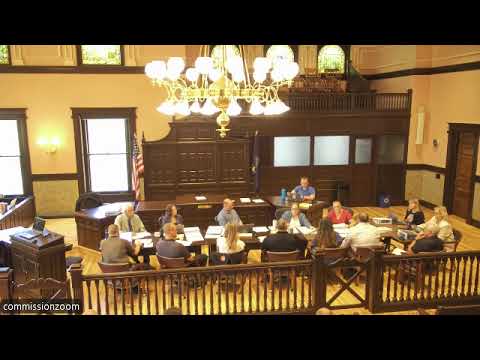
Representatives of multiple economic development organizations briefed the Douglas County Commission on July 9, presenting budget requests, program descriptions and metrics for tourism, business recruitment, workforce training and entrepreneur support.
Speakers included leaders from the Baldwin City Chamber, Douglas County Corps, the Lawrence Chamber/EDC, KU Small Business Development Center, Peaslee Tech, KU Innovation Park and the EDC. County staff prefaced the session noting commissioners may ask how public funding is leveraged and what outcomes—jobs, business formation or tax base expansion—result from the county’s investments.
Baldwin City Chamber director Dana Mullis said the Chamber seeks local support to expand tourism marketing and visitor tracking; the Chamber has a $10,000 state grant to produce a visitors guide and is working with the local recreation commission’s Placer.ai data to measure visitation. Mullis described efforts to rebuild membership and local programming after an 18‑month staffing gap.
Bonnie Lowe and Steve Kelly explained that the EDC’s arrangement with the Chamber uses a $15,000 management agreement; the EDC does not directly employ staff but attributes portions of chamber staff time to EDC work under the management agreement. Commissioners asked about fund balance presentation and accounting shifts in the EDC materials; EDC and Chamber staff said timing and accounting alignment across fiscal years and entities explained the reported negative unrestricted fund balance in one line item.
Kevin Kelly of Peaslee Tech said his organization has finished paying off its mortgage and described a bricks‑and‑trades program that produced four houses and trained roughly 140 students; Peaslee expects to build five to six houses annually going forward and contracts with many local organizations for training.
Adam Courtney of KU Innovation Park (KUIP) summarized the park’s role as a lab‑ and office‑space developer and as a provider of business services. KUIP leaders said some tenant companies have remained in the park for a decade or more and that lab space is costly and highly specialized; commissioners asked about the extent to which KUIP tenants live in Douglas County and whether successful tenants eventually move into taxable commercial space elsewhere in the county. KUIP said it is gathering more address data when it issues or renews keycards and noted the park aims to leverage public support to secure additional grant funding and private development that could return new property to the tax rolls over time.
Commissioners asked each partner how they would report outcomes to the county and how county dollars would be used to leverage additional funding. Partners described a mix of performance tracking, third‑party tools (Placer.ai) and grant-match strategies; some organizations receive county support primarily as flexible operational funding that helps them meet match commitments for other state or federal grants.
Ending: No funding decisions were made at the hearing. Commissioners requested additional written details and follow-up materials, including clearer financials for the EDC/Chamber arrangement and KUIP data on tenant county residency and multi‑year outcomes.
AI generated
The text on this page is AI generated. Summaries, highlights, analysis, and video transcripts are all produced from the original source material.
AI can make mistakes, so if you spot one, and we will fix it for everyone.
Note: the source content is unaltered by us. Any content source we link to, be it a video, an audio recording, or a document, is presented exactly as its publisher released it. That publisher is usually a government body, sometimes an individual official or another organisation.