Get Full Government Meeting Transcripts, Videos, & Alerts Forever!
Get email alerts on the Ldcfm Budget Station6 topic
No spam. Unsubscribe anytime.
Commissioners briefed on Lawrence-Douglas County Fire Medical budget options, Station 6 operating cost concern
Summary
County staff and LDCFM leaders presented budget scenarios that shift near-term cost shares, preserve core ambulance staffing in one option, and flagged an estimated $2 million annual county cost for operating a potential Station 6 expansion in 2027.
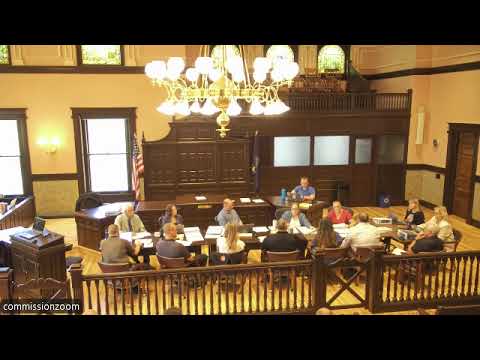
County and Lawrence-Douglas County Fire Medical (LDCFM) officials told the Douglas County Commission on July 9 that proposed budget scenarios aim to preserve core EMS operations but that a planned Station 6 expansion could add significant operating costs for the county beginning in 2027.
County staff said the proposed 2026 budget incorporates a governance-year shift that would move the county’s share of LDCFM shared costs from 36% to 38.25% for 2026 only. Staff said EMS revenue for 2026 is estimated at $3,500,000 in the proposed budget materials.
LDCFM staff summarized the so‑called “gray option,” which staff described as minimizing EMS reductions by retaining six battalion chiefs, the training lieutenant and seven 24‑hour staffed ambulances while reducing funded FTEs. The overview said the city of Lawrence’s proposed reductions would cut LDCFM FTE funded at the city from 18 to 10; staff said most of the positions potentially affected in the county share are currently vacant. “We have 10 FTEs… that relates to shutting down engine 5 and up staffing ladder 5 to 4… All 9 of those positions are currently vacant,” an LDCFM presenter said.
Commissioners pressed for clarity about Station 6, which city materials list on the capital improvement plan and that city staff have proposed be funded as part of the city CIP with an anticipated open date in 2029. County budget staff estimated the initial county cost to operate Station 6 in 2027 could be about $2,000,000 annually. “That’s about 1 mil for us,” the county presenter said when describing the county’s portion under the existing split; elsewhere staff said the full county share could be about $2,000,000 depending on staffing and governance outcomes.
Staff also discussed ambulance capital planning: the proposed budget includes a transfer to the ambulance capital reserve (fund 604) to support two ambulances anticipated for 2026; county staff said ambulance order lead times complicate budgeting because delivery can lag by two to three years. LDCFM said the system has 12 deployable ambulances in the fleet and operates seven standard 24‑hour ambulances in normal rotation, plus reserve units.
Commissioners discussed alternative staffing models. LDCFM presented two examples: a 40‑hour/week ambulance (staffed with the equivalent of three FTE positions accounting for relief factors) and a full 24/7 medic (three shifts). Staff provided rough cost figures: under the gray option a $183,000 funding shift was identified, a separate 40‑hour ambulance scenario would add about $346,000 in total county cost (county would pick up entire $346,000), and a full-time medic 6 to staff 24/7 was discussed as materially larger (presenters referenced a roughly $943,000 operating cost in the fuller staffing scenario). Commissioners asked staff to provide those figures in writing for inclusion in the packet.
Public‑safety leaders warned of service impacts if deeper cuts occur. LDCFM drew attention to standards of cover and to periods when the system has been at “status 0” — no ambulances immediately available — and said cutting apparatus or personnel would increase the frequency of those events and reduce coverage for fire suppression, technical rescue and hazardous‑materials response countywide.
Ending: Commissioners did not take action at the hearing. Staff said governance conversations with the City of Lawrence and LDCFM will continue and that county and city leaders will return to their respective bodies for direction once budget outcomes and governance decisions are clearer.