Get Full Government Meeting Transcripts, Videos, & Alerts Forever!
Get email alerts on the Firefighter Wellness topic
No spam. Unsubscribe anytime.
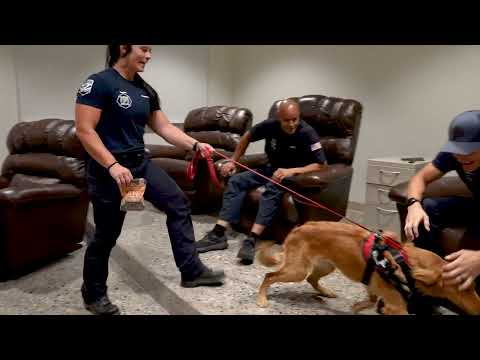
Fire department says canine therapy program now has four dogs to support firefighter mental health
Summary
Fire department staff described a multi-year canine therapy program that now has four dogs in service to support firefighters’ mental health; dogs stay on 48-hour shifts and visit crews after traumatic incidents.
The fire department said its canine therapy program now includes four dogs in service to support firefighters’ mental health and wellness, with dogs kept at stations during 48-hour shifts and deployed to visit crews after traumatic incidents.
Fire Department staff member said the program began several years ago as part of efforts to expand mental-health support for firefighters. “Mental health and wellness is one of our keystone things that we really look at,” the staff member said. “We try to do everything we can for peer counselors, EAP, just anything that our firefighters need to deal with some of the tough calls that we have.”
The staff member said the program matured over time. “Two and a half years later, it finally has materialized that we have four dogs in service,” the staff member said. The dogs are kept at stations during crews’ 48-hour shifts so they are available to visit personnel when needed.
Battalion Chief Mackenzie Hess described one of the department’s dogs and its training. “I’ve had him since he was a puppy. He’s about 5 years old now. He’s an Australian Shepherd,” Hess said. He said the dog completed basic, intermediate and advanced obedience classes and passed the Canine Good Citizen test; Hess added that he completed online training related to the program.
The department uses the Fetch Foundation for training of at least one of the dogs, the staff member said. Staff described a notification system and “triggers” that bring dogs into stations or send them to crews after a significant or traumatic incident to offer in-person, calming interaction: “It’s just that relaxation moment of patting a dog, being able to rub it behind the ears,” the staff member said. “It just seems like anytime a dog walks in the room, people just light up.”
Program officials said visits typically last about an hour or two when dogs are sent to particular crews, though exact visit times can vary and were not specified. The department did not specify funding sources or whether the program requires outside approvals.
Training and certification described by staff and Hess include weekly classes for about six months for handlers and dogs, plus the Canine Good Citizen certification. No formal board actions or policy changes were reported during the meeting; the discussion was presented as an operational update.