Get Full Government Meeting Transcripts, Videos, & Alerts Forever!
Get email alerts on the Governance Procedures topic
No spam. Unsubscribe anytime.
Sweetwater County planning staff reviews bylaws, conflict-of-interest rules and hearing procedures with new commissioners
Summary
Planning staff led an orientation for the Sweetwater County Planning and Zoning Commission covering bylaws, conflict-of-interest rules, statutory authority, and public hearing procedures.
Planning staff led an orientation for the Sweetwater County Planning and Zoning Commission covering bylaws, conflict-of-interest rules, statutory authority, and public hearing procedures.
Staff emphasized that the county derives planning and zoning authority from Wyoming statute and that the zoning resolution (not the comprehensive plan) must provide the legal basis for approvals or denials. The presenter reviewed membership rules (five members appointed by the Board of County Commissioners, with at least three required to reside in unincorporated Sweetwater County), quorum rules and a bylaw change clarifying that when only three members are present a 2-to-1 vote constitutes a majority.
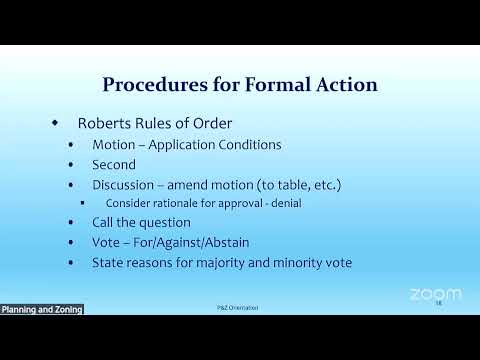
On conflicts of interest, staff advised commissioners that a financial interest that would create a personal gain requires disclosure and recusal (no vote cast), and that if only three members are present the member must declare the conflict but still participate to reach a quorum, consistent with Robert's Rules and county practice. Staff also reviewed options for advisory committees, public meeting advertising requirements (statutory newspaper publication currently required), and the distinction between tabling and postponing an item.
Staff advised that the commission is an advisory body for most land-use hearings and that final legal action is taken by the Board of County Commissioners; exceptions include certain plat authorizations. The presenter noted common reasons applications are denied (incomplete applications or failure to meet specific zoning criteria) and cautioned members to base decisions on the zoning resolution's written criteria rather than personal preference.
The orientation included procedural guidance on public comment (all comments must be channeled through the chair), site visits/recesses, executive sessions (limited to specific legal or personnel matters allowed by statute), and timelines for subdivisions and language amendments. Commissioners asked procedural questions about tabling versus postponing and about timelines when commissioners or applicants change between hearings. Staff said they will follow up on questions about publication timing and whether a parcel is landlocked when those specifics arise in future hearings.