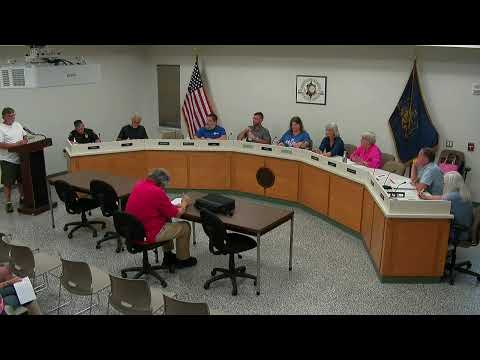
Palmyra residents, officials press stormwater fixes as Melrose development advances
Loading...
Summary
Residents and councilors at the Palmyra Borough Council meeting pressed for clearer stormwater controls and for outstanding drainage work tied to the Melrose development before a second phase proceeds; officials said the borough must meet state NPDES/MS4 requirements and that some work is under engineer review and county/ PennDOT review.
Palmyra Borough residents and elected officials on Tuesday pressed for fixes to recurring drainage problems after heavy rain and raised objections to starting phase 2 of the Melrose subdivision while phase 1 drainage issues remain unresolved.
The discussion was prompted by public comments from residents who described flooding, sediment-laden runoff and infiltration basins that remained high for days after a storm. Resident Tom Gillespie said his attempt to add a three-car garage foundered on the borough’s stormwater ordinance and the cost of an engineer-sealed plan. “It’s gonna cost you anywhere between $5,000 and $15,000,” Gillespie said he was told after a site visit, and he urged council to consider lower-cost options such as rain barrels or a “water garden in a box.”
Why it matters: Councilors and staff said the borough’s ordinance implements state and federal stormwater permitting requirements (NPDES/MS4) and that the municipality must enforce an engineered standard for projects above local thresholds. Residents said repeated heavy rain and construction runoff are straining existing infrastructure, and several urged delaying additional construction until drainage is fixed.
Council and staff discussion Borough officials and councilors described multiple, overlapping constraints: state Department of Environmental Protection (DEP) expectations tied to the NPDES/MS4 permit, local geology that limits infiltration in some places, and PennDOT review of potential fixes that would direct more water into roadway drains. Staff noted that the borough’s ordinance is based on DEP model language and that local modifications reflect Palmyra’s geology and Chesapeake Bay-area requirements.
Dave McCloskey, a resident who has followed the Melrose project, told council the planning commission should withhold approval of phase 2 until phase 1 stormwater work is resolved. “Phase 1 is not complete to satisfaction of the people who live around it,” McCloskey said, and he asked the council to advise the planning commission accordingly. Council members and staff confirmed the planning commission will consider Melrose phase 2 at its July 23 meeting.
Technical and regulatory details Staff and speakers described several specific technical points raised in the meeting: borough thresholds that trigger an engineered stormwater report (speakers cited a 500-square-foot/800-square-foot threshold in different exchanges and noted a full engineered plan is required above 5,000 square feet); the borough credits removal of existing impervious area (for example, a shed) against new impervious area when calculating compliance; and infiltration basins on site are designed for a 10‑year storm (about 4.5 inches over 24 hours), while the recent storm produced roughly 6 inches in less than 24 hours — exceeding design capacity.
Speakers also noted that county- or watershed-level plans are uneven across Lebanon County, and that PennDOT and county conservation reviews limit the borough’s unilateral options. Staff said some proposed alternatives to routing water down Grant Street were rejected by PennDOT, and that borough officials are pursuing further conversations with state and county agencies.
Costs and timelines Residents cited examples of cost estimates and repair timelines: an on-site engineer visit that produced a $5,000–$15,000 estimate for a private garage runoff plan; a quoted price of about $16,500 for injection grouting work at a separate sinkhole site; and the observation that detention basins and temporary erosion controls used during construction (silt bags, etc.) can restrict flow until final paving and final grading are completed.
Discussion versus decisions The council’s discussion recorded no formal vote or ordinance change at the meeting. Officials said the developer for Melrose has completed the plat elements required under the municipal planning code and that the remaining physical connection work (including a pipe discussed in the meeting) is the item staff and council continue to press the developer to finish. Several council members and residents urged delaying approvals for additional construction until the outstanding drainage connections and fixes are completed and inspected.
Next steps and follow-up The planning commission is scheduled to review Melrose phase 2 on July 23, 2025. Staff said they will continue outreach to PennDOT and Lebanon County conservation staff about alternative routing and about documentation of water quality metrics. Residents requested a follow-up meeting and copies of inspections and test data so neighbors can compare current water quality and flow to any baseline measurements.