Lifetime Citizen Portal Access — AI Briefings, Alerts & Unlimited Follows
NH DES details PFAS monitoring, biosolids screening plan and funding for pilot projects
Loading...
Summary
At a June 13 Legislative Study Commission meeting, New Hampshire Department of Environmental Services officials outlined steps to monitor PFAS in wastewater, develop a biosolids screening standard, use IIJA Clean Water SRF emerging-contaminants funds for pilot projects, and phase out poorly controlled septage facilities.
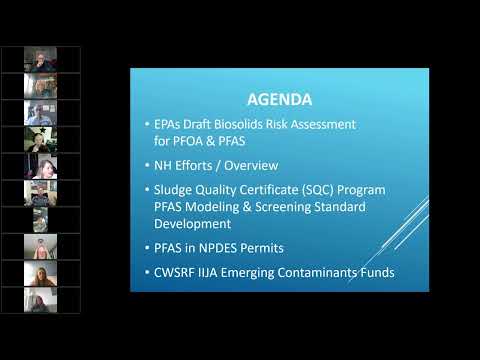
Tracy Wood, administrator of the Wastewater Engineering Bureau at the New Hampshire Department of Environmental Services, told the Legislative Study Commission on June 13 that PFAS contamination is widespread in wastewater inputs and that DES is developing a screening standard for PFAS in sludge and biosolids while expanding monitoring under NPDES permits.
Wood said EPA’s January 14, 2025, draft biosolids risk assessment found PFAS risks associated with land application, incineration and landfilling but is non‑regulatory and focused on a narrow farm-family scenario. “Wastewater treatment facilities do not intentionally use or add PFAS. They receive it,” Wood said. She told commissioners DES has focused on source identification and reduction while building a technical basis for a screening value to protect human health and the environment.
The bureau has required PFAS monitoring under its Sludge Quality Certificate (SQC) program since spring 2019 and performed influent/effluent sampling beginning in 2017. DES contracted the U.S. Geological Survey to complete a soil-and-sludge PFAS leaching study (completed in 2023) and has hired a contractor to build a PFAS sludge leaching model and recommend a screening standard that would be incorporated into rules (Env‑Wq 800) after public rulemaking.
Wood said DES contracted VerDantas (reported by DES) for the PFAS sludge model; the contract is about $300,000 with roughly a one‑year duration and an expected final report in June 2026. DES has engaged Arcadis for an independent technical peer review of the contractor’s work.
Because the current Env‑Wq 800 rules expire Jan. 1, 2026, Wood said the modeling and screening work will not be completed in time to be adopted with this round of housekeeping rule changes; DES plans a subsequent rulemaking to add the screening value once the modeling is complete.
On permitting and monitoring, Wood said EPA Region 1 is the permitting authority for point‑source discharges to surface waters and that PFAS monitoring requirements have been added to NPDES permits since a 2021 general permit for small wastewater facilities. DES is requiring influent and effluent monitoring twice a year and varying sludge sampling frequencies depending on facility type; certain industrial users must sample at least annually. Wood said EPA’s final multi‑lab validated test methods were incorporated into Region 1 guidance and that DES began receiving the first set of monitoring results on Jan. 15, 2025.
Wood described how DES is using the Clean Water State Revolving Fund (SRF) “emerging contaminants” set‑aside under the Infrastructure Investment and Jobs Act (IIJA) to fund pilot or planning projects focused on PFAS removal, leachate management and regional solutions. DES reported $935,000 available in 2022 and an annual emerging‑contaminants allotment of $2,125,000 for fiscal years 2023–2026 (subject to federal appropriation). Example projects advancing toward pilots include North Conway Water Precinct (sludge/leachate interchange), Lebanon (leachate source work and treatment pilots), Nashua (4 Hills landfill leachate pilot), Winnipesaukee River Basin Program (centrate/centrate concentration and destruction evaluation), Portsmouth (sludge minimization and PFAS destruction pilot), and a Copley Landfill Group pilot for surface/groundwater treatment.
Wood said DES is prioritizing projects that could “break the cycle” where landfill leachate increases PFAS at a wastewater plant whose sludge then returns to landfills or elsewhere. She also raised operational questions about staffing, operator training and air‑permitting requirements for certain destruction technologies and said DES is coordinating with its Air Resources division on pilot‑scale tests.
On septage, Wood said many pumped septic solids are already sent to wastewater treatment plants but that DES found some small, informal “septage facilities” operated with inadequate controls. DES shortened permit terms from 10 to five years on readoption, now requires a closure plan within one year of permit issuance or renewal, and is working to close noncompliant septage facilities so pumped septage is routed to wastewater treatment plants for proper handling.
Wood reported ongoing consumer‑product testing (about 50 products screened) that found PFAS in a range of items, including some shampoos; she said manufacturers or suppliers do not always disclose PFAS presence. “We are not going to test or treat our way out of this. We need to stop this from getting into our systems,” she told commissioners, reiterating DES’s emphasis on source‑control and industry engagement when monitoring identifies contributors.
Commission members asked about replicability of pilot technologies across tertiary and secondary plants, training needs, and opportunities to coordinate pilot work statewide. Wood said New Hampshire has relatively few tertiary plants and many individual permits are tailored to receiving waters and dilution factors, which affects the suitability and transferability of specific treatment steps.
DES plans to incorporate the modeling‑based screening standard into Env‑Wq 800 through rulemaking after the contractor’s final report in mid‑2026 and will continue to require PFAS monitoring in NPDES permits; the agency also intends to use IIJA SRF emerging‑contaminants funds to support demonstration projects that aim to reduce PFAS loads to wastewater systems.
DES materials and the SQC annual report, which summarize monitoring results, are publicly available; Wood said the agency will continue outreach and operator training as it implements monitoring and works toward a biosolids screening standard.