Get Full Government Meeting Transcripts, Videos, & Alerts Forever!
Get email alerts on the Collective Bargaining topic
No spam. Unsubscribe anytime.
OFM presents 2025–27 bargaining costs, wage and premium changes to JCER
Summary
The Office of Financial Management told the Joint Committee on Employment Relations it has published tentative agreements and arbitration awards for the 2025–27 collective bargaining cycle, outlined estimated costs and highlighted priority wage, premium and equity adjustments.
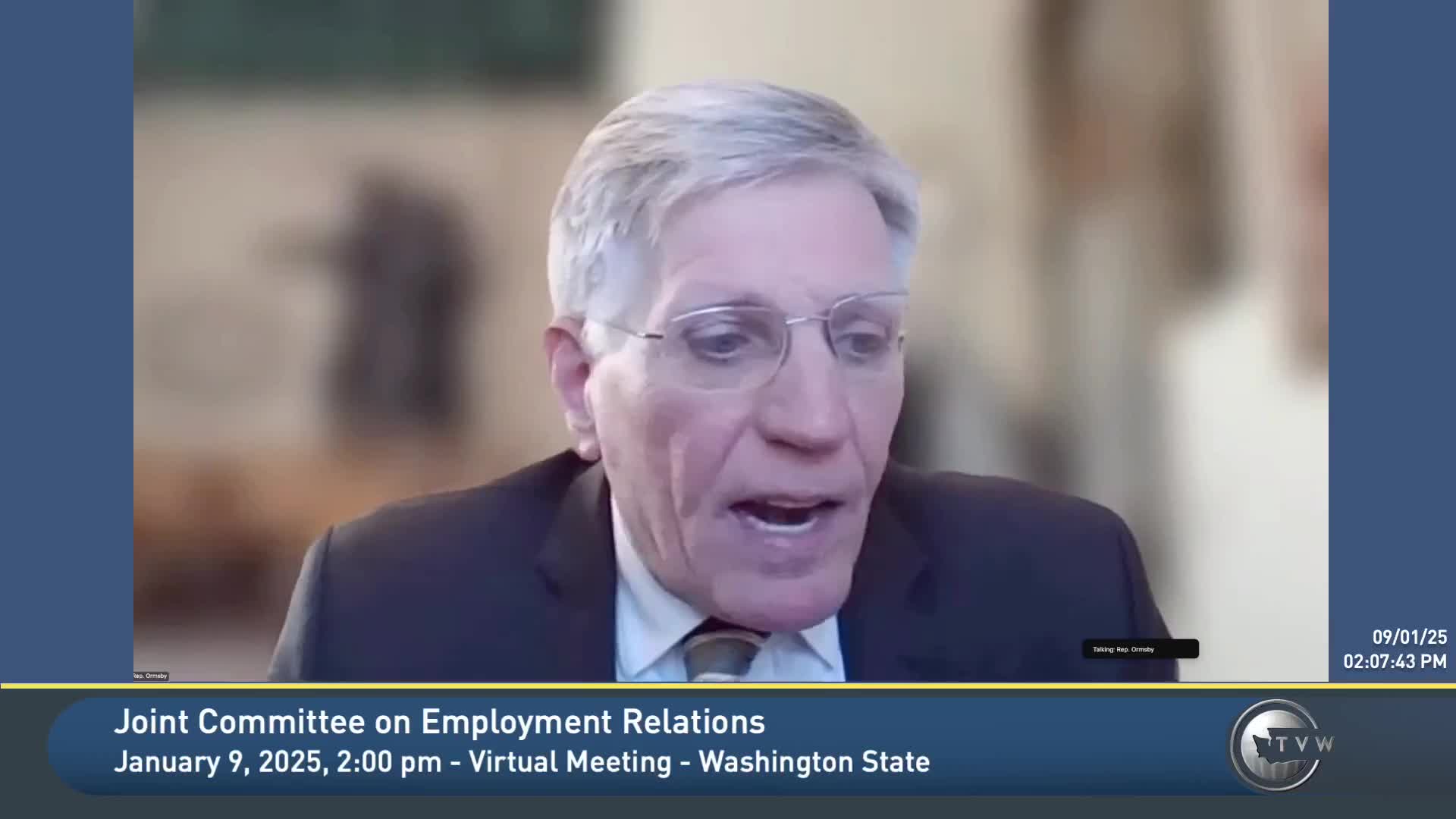
The Joint Committee on Employment Relations heard a presentation from the Office of Financial Management (OFM) on the 2025–27 collective bargaining agreements, including tentative agreements, arbitration awards and the agency's cost estimates.
The presentation matters because OFM’s financial feasibility determinations were included in the governor’s proposed budget and will determine whether the Legislature funds the contracts that, if funded, typically take effect July 1. OFM said it published the tentative agreements and interest arbitration awards on its website and provided a detailed cost roll-up for state employees, school-employee health benefits and non-state-provider contracts.
Michaela Dolman, who leads the state HR team within OFM, said the agency began its bargaining planning a year in advance and emphasized giving a general wage increase for all represented employees, targeted pay adjustments in hard-to-fill roles and premiums to address 24/7 staffing challenges. “We did caution the arbitrator to consider the financial ability of the state to pay for increased compensation,” Dolman said, referring to cases that went to interest arbitration.
OFM told the committee it bargains for slightly more than 74,000 represented employees in this cycle. Dolman noted OFM’s cost figures include Public Employee Benefits Board (PEBB) health-care costs for bargaining units (except some coalition members) and also roll up higher-education bargaining numbers so the financial-feasibility determination reflects statewide costs.
Key numeric items and contract outcomes described by OFM: - OFM said two WPEA (Washington Public Employees Association) general-government contracts covering roughly 4,000 employees reached tentative agreements but were not ratified by members and therefore were not submitted for the financial-feasibility determination. - A newly certified unit of language access providers (PERC-certified) increased the total number of represented workers compared with the previous cycle; that unit went to arbitration and the arbitrator awarded 3.5% in year one and 3.0% in year two for interpreter services, and increased block-appointment rates to $38 per hour in year one and $40 in year two. - For two general-government contracts that were decided by the same arbitrator, the awards included a 4% general wage increase over both years plus employer-targeted increases for positions identified as below market. - Ferry employees: OFM reported 12 ferry agreements (all interest-arbitration eligible) with classification, compensation and fringe benefits subject to bargaining; targeted differentials and premiums were negotiated for hard-to-staff locations such as Friday Harbor to reduce missed or late sailings. - Non-state-provider contracts: OFM said it bargained for 9,801 adult-family-home providers (directly bargained) and accounted separately for 59,898 providers for whom the state sets rates; OFM preserved a 95% ratio in the rate model and agreed to a 1.5% rebasing inflator for FY26–27 for those providers. - Family care providers: OFM said base subsidy rates were adjusted to meet statutory obligations (set at the 80th–fifth percentile of the 2024 market, per OFM’s characterization), exempt providers saw a $0.50 hourly increase (from $4.00 to $4.50), and a care-rate enhancement rose from $2,100 to $2,200 per month. - Health-cost sharing and low-income supports: OFM said it prioritized maintaining an 85/15 employer/employee health-care premium share and added a flexible spending arrangement for school employees earning $40,000 or less with a $200 starting FSA contribution.
Dolman said OFM included higher-education bargaining figures in its budget roll-up for completeness, even where those groups bargain independently of OFM. She also described the newly certified Washington Management Services (WMS) unit (Teamsters-represented Department of Corrections WMS employees) and said its organizing was enabled by a bill and ultimately certified by the Public Employment Relations Commission (PERC).
Dolman said continued bargaining is underway for successor WPEA contracts, and because negotiations remain active she did not provide further details on those sessions. She closed by directing committee members to OFM’s website for the tentative collective bargaining agreements, arbitration awards and the governor’s 2025–27 compensation summary.
Resources: OFM’s posted tentative agreements and interest arbitration awards and the governor’s 2025–27 compensation summary are available on OFM’s website, the agency said.