
Surprise outlines wildland-urban interface preparedness: hydrant reservations, Hydrant AI, drones and new tanker
Get AI-powered insights, summaries, and transcripts
Subscribe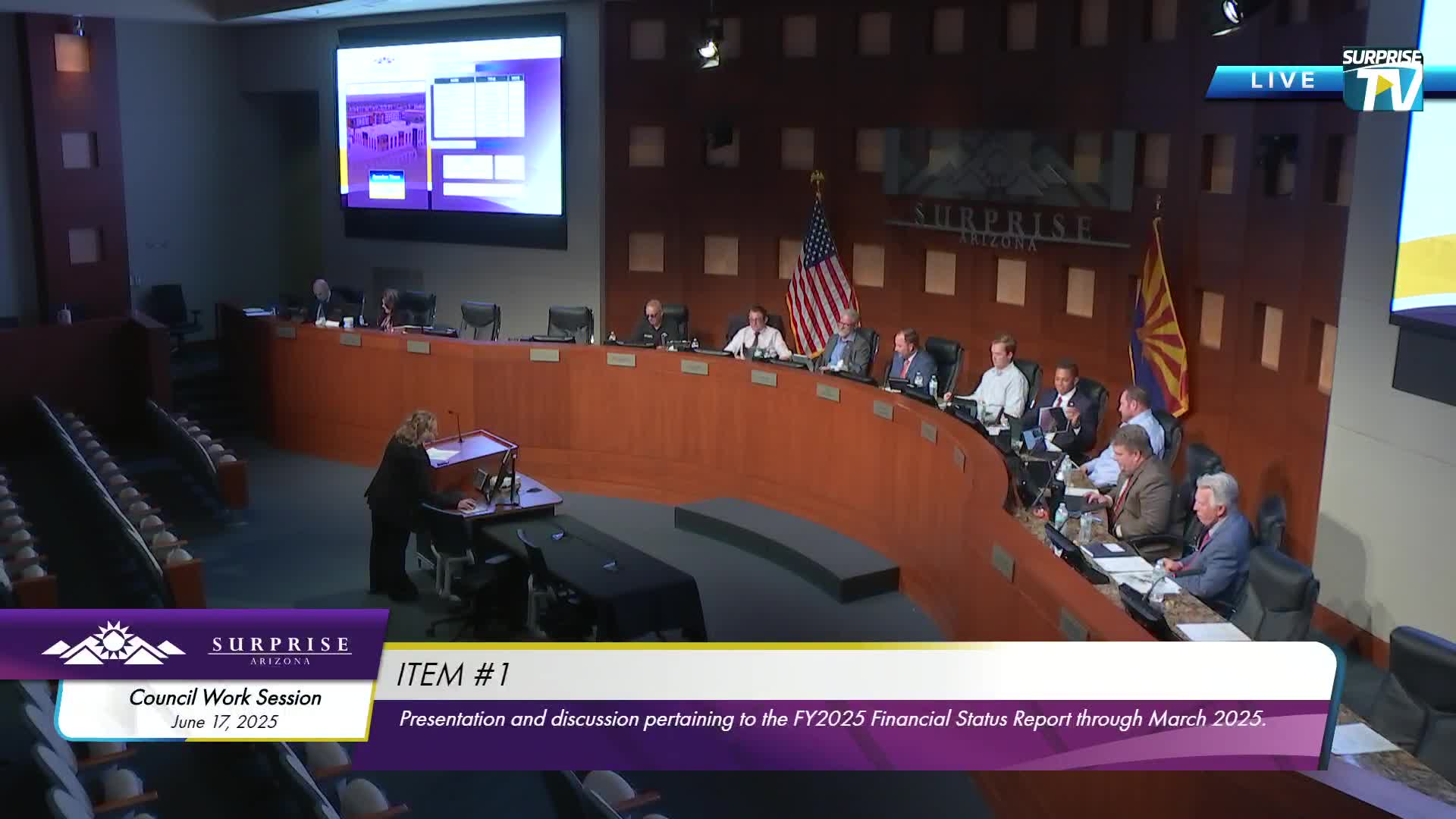
Summary
Fire and Water Department staff told the Surprise City Council on June 17 that the city is coordinating hydrant reservations, installing Hydrant AI monitors, expanding drone use, developing a WUI dashboard for responders and has purchased a 3,000-gallon tanker to improve wildland-urban interface response.
At a June 17, 2025 Surprise City Council work session, Chief Mike and Michael (Water Department representative) described coordinated preparedness and response steps the Fire and Water Resource Management departments are taking for wildland-urban interface (WUI) incidents.
“I think the big thing you guys will take away tonight, and I think what Michael and I want you to see is the strong relationship between the water and the fire department,” Chief Mike said, opening the presentation on preparedness, response and an operational dashboard developed with GIS.
Fire staff described a layered approach: public outreach and “Firewise” community work to reduce fuels around homes, expanded use of drone technology to scan risk areas quickly, and an operational shift to a larger initial response when homes are at risk. Chief Mike described a typical WUI assignment that can include multiple engines, a ladder, tenders (water trucks), two command officers, ambulance, deputy chief and a wildland resource officer to provide both firefighting and structural protection.
Michael, the water representative, explained how the water system supports firefighting: Desert Oasis water supply facility in District 1 is designed to supply “3,000 gallons per minute for 3 hours,” and the city’s interconnected supply can shift water between facilities if tanks draw down. In a simulation shown to council, the system ramped “from 4,000 gallons per minute to 7,000 gallons per minute,” and staff said most booster pumps and wells staged automatically to meet demand.
Staff showed blue-capped hydrants that are reserved for firefighting use in identified WUI zones; those hydrants will be kept from construction use so they are available for long-duration operations. Councilmember Melton confirmed the blue-capped hydrants “cannot be used by construction crews” and staff said nearby hydrants will remain available for construction needs.
Ryan Heim, water manager, and Michael described devices being installed to monitor hydrant flow and pressure. Michael said the city has implemented 10 Hydrant AI monitors at City Hall and plans to install about 30 more across the city to provide dynamic, real-time pressure and flow alerts when hydrants are used.
Chief Mike and staff also demonstrated a GIS dashboard that maps WUI areas, blue-capped hydrants, historical call locations (five years of data) and stations with brush resources. Staff said the dashboard is currently for planning and will move to Phase 2 to provide incident commanders and responding officers with live access to the data.
Councilmembers asked detailed operational questions. Councilmember Chuck asked how fast wells can refill tanks; staff answered each well currently produces roughly 1,200 gallons per minute and can push up to about 1,500 gpm, and said the system can keep up “no sweat” so long as wells are operating. Councilmember Judd asked about the types of housing in WUI areas; staff said the city is seeing both higher-density subdivisions and more-sporadic rural acreages north of Sun Valley Parkway.
Staff discussed community outreach steps — expanding Ready, Set, Go and Firewise programs, coordinating with neighboring fire agencies through automatic aid, and learning from other cities such as Scottsdale on proactive homeowner engagement. Chief Mike noted the city received a new 3,000-gallon tanker that will be stationed in Surprise (anticipated at Station 304) and will be reserved for local response, not available for large out-of-state deployments.
No formal vote or ordinance was introduced; the presentation was informational. Staff said near-term next steps include completing Phase 2 of the dashboard to deliver live data to incident commanders, expanding Hydrant AI deployment, and pursuing Firewise community outreach and targeted on-the-ground inspections in prioritized WUI areas.