
Commerce, equity office and industry warn BEAD guidance changes force a fast state refile
Get AI-powered insights, summaries, and transcripts
Subscribe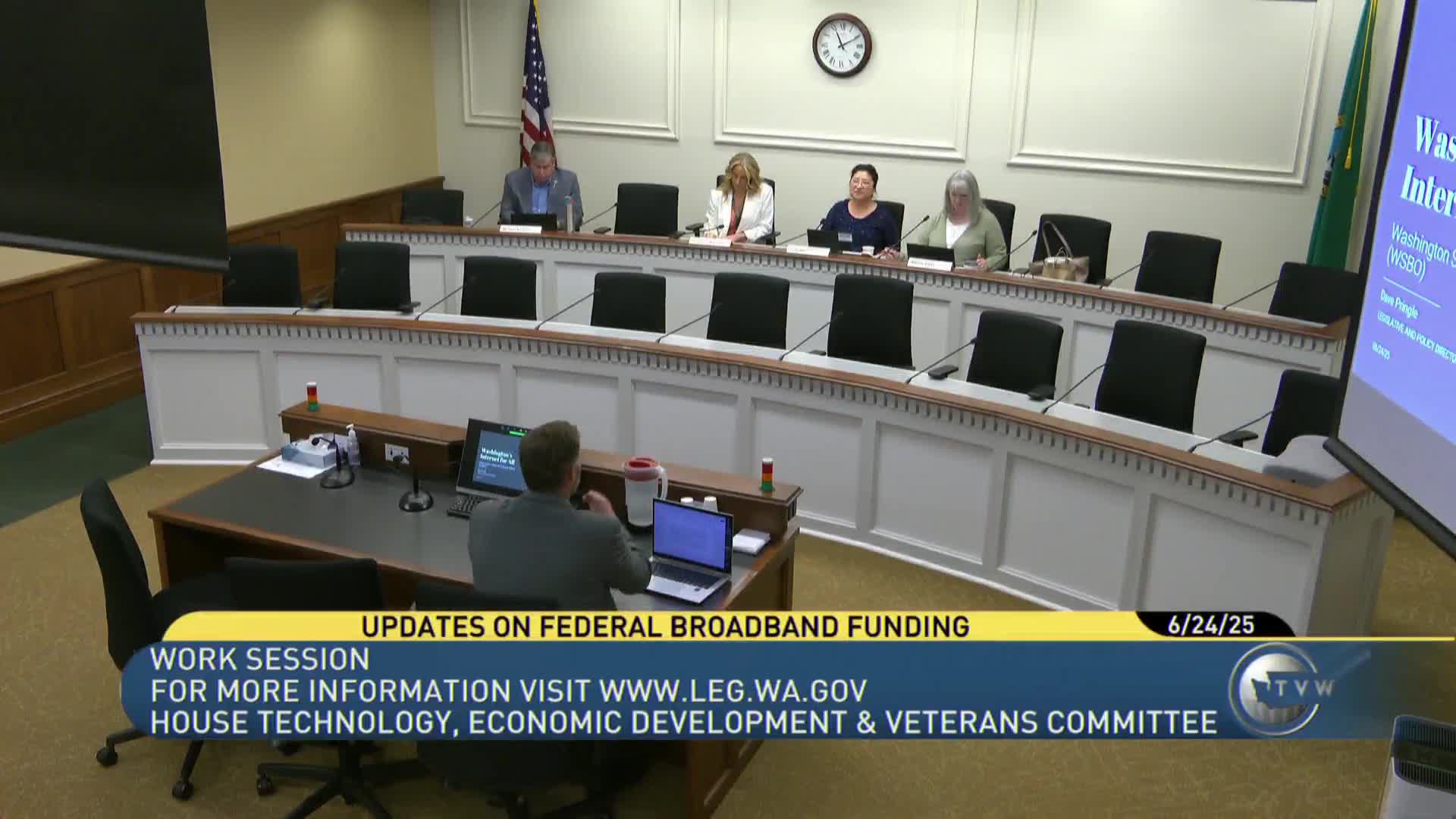
Summary
Department of Commerce officials told lawmakers that new NTIA guidance on the BEAD program requires Washington to assemble an expedited state application by Sept. 4 and that some previously emphasized criteria were removed; the state is also transitioning the Digital Equity Forum back to the Broadband Office.
Washington’s Department of Commerce on Tuesday told state lawmakers that new federal guidance for the BEAD (Broadband Equity, Access, and Deployment) program requires an expedited state application and may change which projects are most competitive, leaving officials to rework previously submitted proposals.
Dave Pringle, policy and legislative director at the Department of Commerce, said the state has roughly 30 days to help applicants update or repackage submissions and that the department aims to return a state BEAD application to the National Telecommunications and Information Administration (NTIA) by Sept. 4. "We were awarded over a billion dollars from the federal government to expand broadband," Pringle told the committee, adding that the latest NTIA guidance removes several previously emphasized elements such as labor and open‑access requirements and changes scoring priorities. He said Commerce is hosting weekly office hours with applicants as the agency and applicants adapt to the new guidance.
The change affects projects submitted during the first two application rounds; Commerce said no BEAD‑funded networks have been built yet and that four counties — Grant, Grays Harbor, Wahkiakum and Yakima — did not receive applications in the second round. Pringle said the state’s package will be subject to NTIA’s review process, which the agency expects to take up to 90 days.
Pringle also announced a leadership change at the state broadband office: director Aaron Wheeler is leaving to pursue opportunities with the Suquamish Tribe, and Commerce is arranging an interim director to shepherd the application process while recruiting a permanent director.
The committee received related updates on digital equity and industry perspectives. The Office of Equity’s Digital Equity Forum — which increased participation and is preparing recommendations for the legislature — will transition back to the Washington State Broadband Office (WSBO) after the Office of Equity’s interagency agreement with Commerce expires on June 30. Office of Equity staffers Omar Santana Gomez and Katrina Tuggle summarized outreach work that included regional coordination sessions, in‑person engagement with tribal nations and a public survey; they said the forum will deliver a full legislative report by Oct. 28, 2025. The Office of Equity noted that the state has already received $15 million in federal digital‑equity funding and will pass outreach materials and membership records to WSBO as part of the transition.
Robert Thoms, director of government affairs for Lumen Technologies, told the committee that private carriers continue to invest in fiber in Washington but face permitting, market and regulatory challenges that slow deployment. He said Lumen continues to offer an entry‑level plan at $30 tied to the now‑reduced federal Affordable Connectivity Program (ACP) and urged the legislature to streamline permitting and address copper‑theft and legacy regulatory requirements that can discourage private investment.
Committee members asked whether prior rounds of applicant work would still be usable and whether the removed federal priorities would disadvantage Washington’s goals around labor and open access. Commerce said it expects to reuse much of the work already done but must align applications with new federal scoring guidance. Officials also said they will keep engaging congressional staff and the governor’s office.
Lawmakers pressed for information about which unserved communities are at risk of being left out, and Commerce said it will provide more granular mapping and follow‑up on the four counties where no second‑round applications were filed. Officials asked for help maintaining continuity as federal rules shift and for local partners to continue matching funds where possible.
The department urged applicants and stakeholders to participate in upcoming weekly office hours and said it will post NTIA guidance and updates publicly. The state’s expedited timeline and leadership transition at the broadband office frame the next phase of Washington’s efforts to spend the BEAD award effectively and to preserve prior state investments in mapping and planning.