
Washington local and state tech leaders describe cautious, collaborative push to adopt AI
Get AI-powered insights, summaries, and transcripts
Subscribe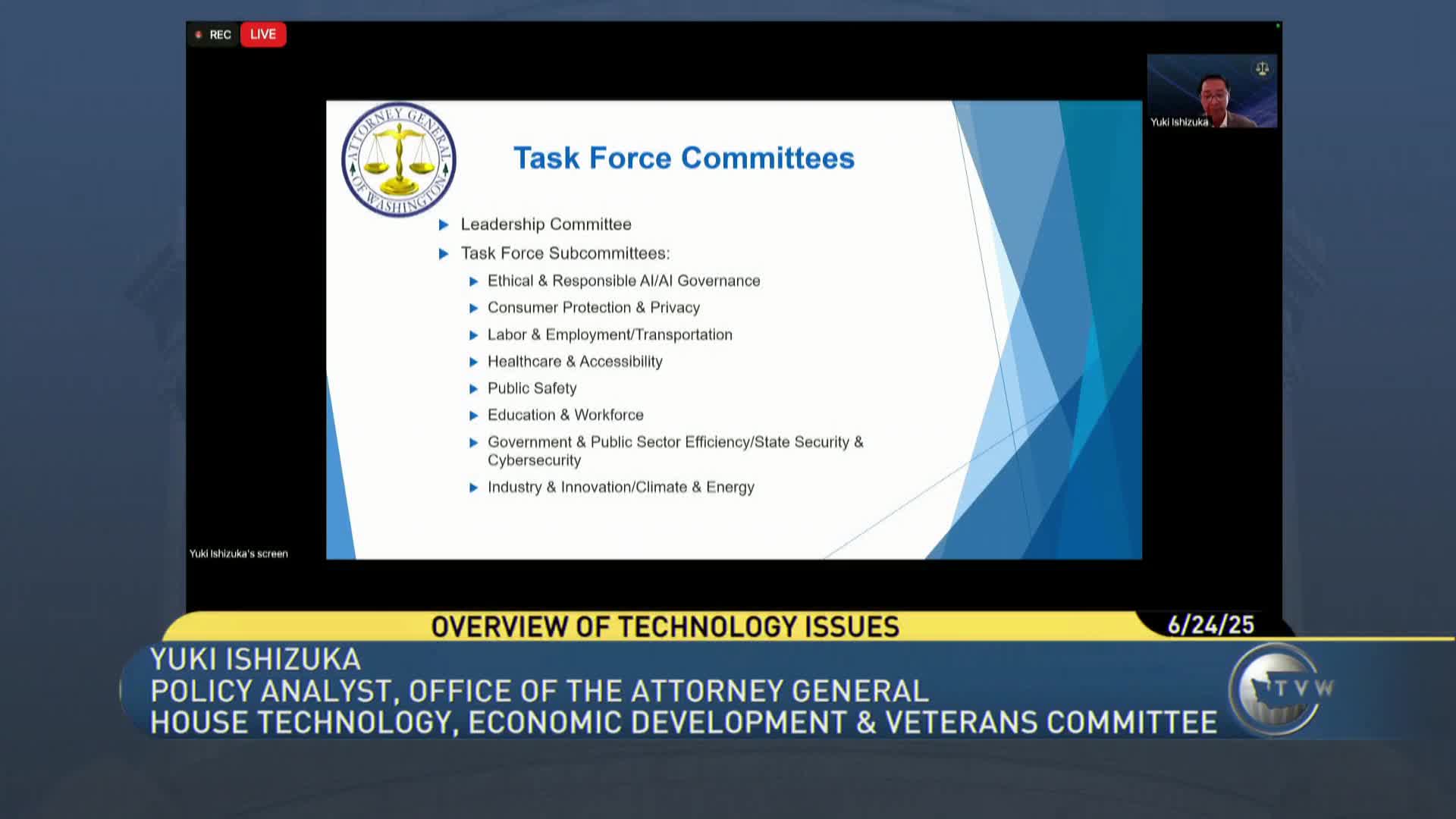
Summary
City and state technology officials told a legislative committee they are piloting AI to speed services and improve operations but are building policies, human review, data governance and sandboxes to limit bias, security and legal risks.
City and state technology leaders, a county information-security official and the attorney general’s office told a legislative committee Tuesday that Washington governments are actively piloting artificial intelligence but are pairing experiments with policies, human oversight and security safeguards to reduce risks.
The presentations before the Technology, Economic Development and Veterans Committee laid out how Seattle and the state are testing dozens of smaller AI pilots, building centralized data and review structures, and using a controlled “sandbox” environment for testing — while warning that federal action could limit states’ ability to regulate AI.
Seattle’s chief technology officer, Rob Lloyd, said the city has run roughly 40 AI pilots and treats many early deployments as learning experiments before scaling. "You can't fire the bot, but the person is responsible," Lloyd said, describing the city’s approach of using AI as an assistant while keeping people as final decision‑makers. He described using small pilots (he said many were in the roughly $10,000–$50,000 range) to learn before moving to larger, strategic investments. Lloyd highlighted uses such as robotic vision to inspect pipes and automated support to speed public‑records handling and customer-facing permitting interactions.
State technology officials described a coordinated, statewide approach. Nick Stille, the state's chief technology officer at Washington Technology Solutions (WATECH), said WATECH has folded AI risk guidance into existing privacy and security review processes and established a sandbox that now includes more than 15 participating agencies. "If you want to identify and explore risk, you have to test a bit," Stille said, describing a controlled environment where agencies can experiment before deploying AI to the public.
WATECH deputy director Mark Quimby noted that many uses of AI are not generative models and that machine‑learning and deep‑learning systems remain important tools for problems such as wildfire detection. WATECH officials emphasized the dependency of AI on data quality and said they are working to ensure procurement and contracts require transparency about how models are trained.
Justin Roche, information security manager for Spokane County, described a different stage of adoption in his jurisdiction and the security choices the county made after staff began using public generative tools. Spokane standardized on a single enterprise generative product (Roche said the county chose Microsoft's Copilot family for its integration and security controls) and paired it with policy that requires human review. "AI‑generated content will be reviewed and validated, verified by a human before use with absolutely no exceptions," Roche said. He also warned that AI lowers the cost of producing malicious tools and that deep‑fake and automated phishing threats are already being used by criminals.
The attorney general’s office representative to the state AI task force, Yuki Ishizuka, outlined the task force’s structure and timeline: eight subcommittees are developing recommendations, an interim report is due Dec. 1, 2025, and the final report is due July 1, 2026. Ishizuka also cautioned lawmakers about a provision in a Senate budget reconciliation package that would block states from enforcing AI regulations for 10 years. "In the absence of meaningful federal action, states must be allowed to address the potential harms of AI to protect its residents," Ishizuka told the committee.
Committee members pressed presenters on vendor transparency, training data, the role of human reviewers, liability when an automated recommendation is wrong, and public‑records implications of government use of AI. Lloyd and WATECH officials said procurement language and policies are being used to require explainability and to prohibit high‑risk uses unless they undergo extra review.
What was discussed at the session — dozens of small pilots, a multi‑agency sandbox, new procurement language, and the AI task force’s ongoing recommendations — signals that Washington’s governments are using experimentation plus policy to balance potential efficiency gains with concerns about fairness, security and accountability. The task force and state agencies plan continued outreach and public reporting as recommendations and deployment rules are developed.
Lawmakers asked for follow‑up on several items, including how agencies are documenting AI use for public‑records requests and how procurement language will require training‑data transparency. Officials said they will provide more details to legislators and that formal requirements will be phased into procurement and review templates as WATECH and local governments complete their pilots.