Get Full Government Meeting Transcripts, Videos, & Alerts Forever!
Get email alerts on the Public Art Mural topic
No spam. Unsubscribe anytime.
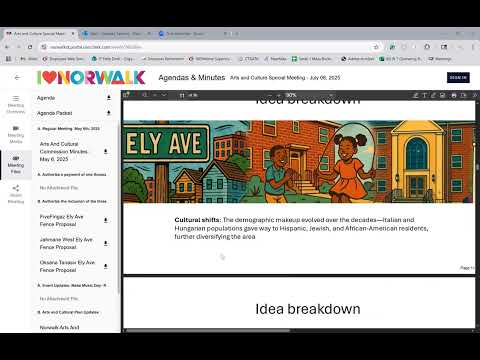
Norwalk arts commission OKs three Ely Avenue fence proposals for public survey
Summary
The Norwalk Arts & Cultural Commission voted to release three artists' concepts for a public survey to select an Ely Avenue fencing mural. Commissioners allowed each artist one opportunity to revise before the survey goes live next week.
The Norwalk Arts & Cultural Commission on July 8 approved sending three submitted proposals for the Ely Avenue fencing mural to a public survey, with each artist allowed a short revision window before the survey is published.
The move follows presentations from the three shortlisted artists — 5 Fingers, Jermaine West and Oksana — who described concepts emphasizing local history, community participation and durability. Commissioners discussed materials, installation details, and community-engagement plans during roughly 40 minutes of discussion before voting to release the proposals for public comment and selection.
Commission Chair Brian Casper said the commission would publish the public survey after allowing artists a brief revision period. Sabrina (staff member) confirmed in the meeting that the commission aims to release the survey “in a week” to give the public “at least, like, a month” to vote.
Why it matters: the fence runs along a neighborhood corridor with long-standing businesses and sites residents recognize. Commissioners repeatedly emphasized community involvement in execution and concerns about materials and longevity, since the finished work will face weather, vegetation and maintenance demands.
Most substantive points and how they were addressed
Materials and longevity: The three artists proposed different approaches. 5 Fingers proposed painted plywood panels framed and sealed with UV coating and tar at edges; he told the commission he expects a usable life of roughly 10–15 years for treated plywood and that UV coatings on other projects had lasted “about 5 or 7 years” without significant fading. Commissioners pressed on edge protection and mounting so panels would not delaminate or sit on the ground where mower and weed‑eater damage could occur.
Oksana proposed 4-by-8 DuraBond metal sheet panels, estimating roughly 115 panels for the run and saying she had consulted installers and contractors on primers, coatings and graffiti‑resistant topcoats; she said those metal panels would be more durable and could last “couple decades, if not more.”
Community participation: Each artist described a community element: 5 Fingers offered studio-based painting sessions and a QR code linking to oral-history content; Jermaine West proposed a ‘‘fabric of the city’’ patchwork approach with library‑led community sessions and the potential to record neighborhood stories; Oksana proposed school partnerships where children would add finishing touches such as painted butterflies or flowers.
Content rules and business imagery: Commissioners asked about depicting local businesses in murals. Melissa Matuska raised concerns about promoting active businesses and suggested generic labels (for example, “grocery” or “bodega”) if a depiction could be read as commercial advertising. 5 Fingers acknowledged some landmarks (Florio’s, Burton Brothers) are historical references and said he would fact‑check the current status of those businesses.
Design authenticity: Commissioners praised elements of each proposal but asked 5 Fingers to make his design read more like his established work; he asked for two days (later agreed as up to a week) to revise. Jermaine and Oksana were also given the option to make revisions based on feedback.
Process and timeline
- The commission voted separately to approve each artist’s proposal for release to the public survey and allowed a short revision window (artists asked for two days to a week; staff recommended one week to allow survey preparation). - Sabrina (staff member) said the intent is to publish the survey approximately one week after the meeting so the public has a month to vote; the commission will use the public result to form its recommendation to Common Council.
What the vote covered (formal actions)
The commission approved all three artists’ concepts to move forward to a public survey, each approval carried by roll call (ayes from Chair Brian Casper and commissioners Bob Abriola, Melissa Matuska, Steven Rust, Nori Gruden and Naomi Clark). The approvals include an explicit permission for each artist to submit a single revision before the survey is released.
Next steps and points for staff
- Staff will set a revision deadline for the artists (one week from the meeting) and publish the public survey once revisions are received or the deadline passes. - Staff and artists must finalize installation details (panel heights to allow maintenance, framing, edge protection, and exact materials) so respondents and Common Council have a clear scope and cost estimate.
The commission’s vote sends the three proposals to the public for preference polling; the public’s selection will be part of the commission’s formal recommendation to Common Council.