Get Full Government Meeting Transcripts, Videos, & Alerts Forever!
Get email alerts on the Valley Center Spur Study topic
No spam. Unsubscribe anytime.
MPO to compile record and scope alternatives for Valley Center Spur multimodal crossing
Summary
Staff proposed a focused study to compile existing work, analyze alternatives and conduct targeted engagement for the Valley Center Spur crossing—an area with limited pedestrian accommodation and railroad/highway interactions—and TTAC recommended a literature review followed by a possible site visit.
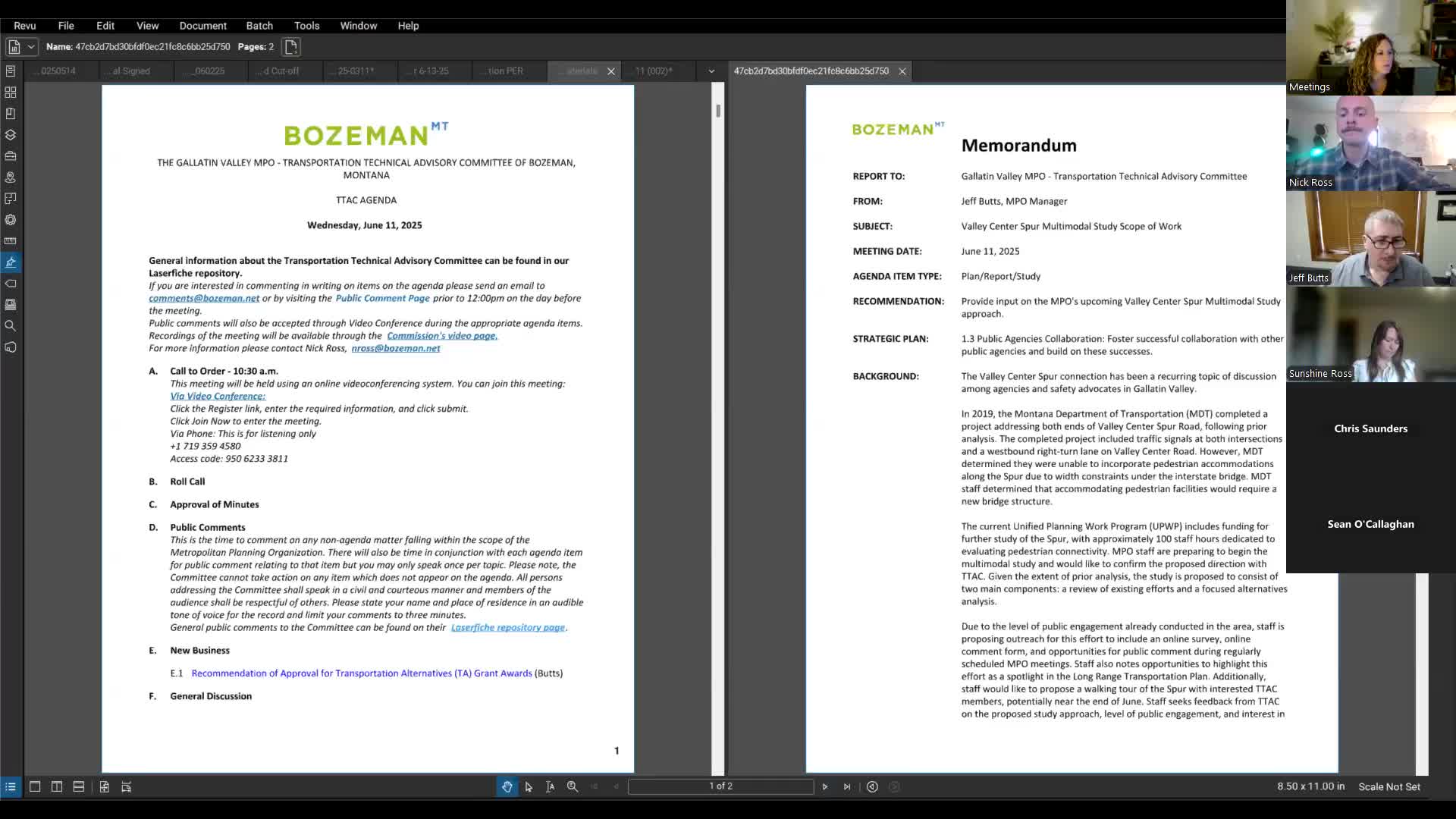
The Galton Valley MPO staff presented a proposed scope for a focused multimodal study of the Valley Center Spur crossing, a constrained crossing of Interstate 90 and railroad lines between Bozeman and Belgrade that lacks safe pedestrian facilities.
Why it matters: Valley Center Spur is the only non‑city interstate crossing in the triangle between Bozeman and Belgrade and is identified by community members as a barrier to multimodal connectivity. The site’s design constraints, including railroad operations and abutment geometry, complicate adding sidewalks or shared‑use paths.
Jeff Butts, MPO manager, described a three‑phase approach he proposes: (1) review existing studies and documentation to establish the current record and what work has been done with MDT and the railroad; (2) develop and evaluate alternatives (e.g., sidewalk fitting options, pedestrian signals, refuge islands, retaining solutions behind abutments) with an eye to structural constraints and railroad preemption issues; and (3) targeted community engagement including a TTAC site visit and a brief public survey. Butts said he preferred a measured site visit for TTAC members rather than a large public field event.
Committee members supported first compiling existing plans and engineering records. Chair Nick Ross said the MPO could serve as a “clearing house” to assemble and clarify the multiple viewpoints—city, county, MDT and the railroad—so the committee and public have a shared understanding of the technical issues. Members asked structural and operational questions: Brandon Jones asked whether abutments were concrete pads or vegetated slopes; Butts reported concrete stub walls on the abutments and that slope walls appeared to be graded. Members also noted the risk of vehicle preemption conflicts where vehicle queues could be trapped by both pedestrian signals and railroad crossings.
Several TTAC members expressed willingness to join a site visit in summer weather. The committee did not take formal action; staff will compile existing plans and return a proposed study scope and schedule. No public comments were submitted on the item during the meeting.