Get Full Government Meeting Transcripts, Videos, & Alerts Forever!
Get email alerts on the Transportation Technology Strategic Plan topic
No spam. Unsubscribe anytime.
NVTA committee forwards Transportation Technology Strategic Plan, approves eight strategies and action plan
Summary
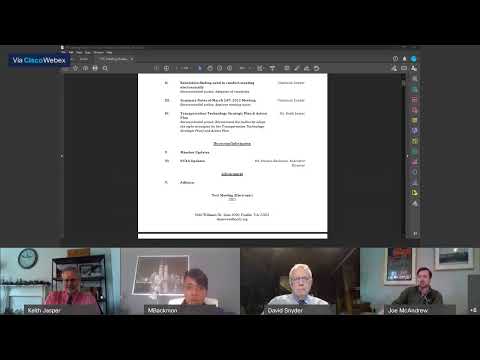
The Northern Virginia Transportation AuthorityTransportation Technology Committee voted to forward the Transportation Technology Strategic Plan to the full authority and approved the plan—s eight strategies and an associated action plan, while directing staff to produce white papers and provide monthly progress reports.
The Northern Virginia Transportation AuthorityTransportation Technology Committee voted to forward the Transportation Technology Strategic Plan (TTSP) to the full authority and approved the document—s eight recommended strategies and an associated action plan, committee members said during a meeting in which they also directed staff to develop white papers and provide monthly implementation updates.
The committee—s approval followed presentations from staff who described the TTSP as "a living document" intended to guide how technology is incorporated into the region—s long-range planning and short-term programming, and to help Northern Virginia jurisdictions respond to rapidly evolving transportation technology.
"We we are requesting that you, approve, or recommend that the authority approve the 8 TTSP strategies," said Keith, a staff presenter, summarizing the recommended action to the committee. Mackenzie, a staff analyst, presented illustrative case studies applying the TTSP to electric and autonomous shuttles and to personal electric autonomous vehicles, calling the examples "illustrative and not necessarily what the final analysis of these technologies will be when they do enter the region."
Committee discussion focused on the potential benefits identified by staff—including proactive planning, coordinated deployment, greater consistency of technology investments, and public education—as well as on equity, funding constraints, and safety. Members raised the possibility of adding the word "incentives" to a strategy that already references pricing mechanisms; staff said they could consider that change in advance of the authority meeting.
"I have, a concern about the word incentive," said Mayor Rishel, asking whether including incentives would create a pretext to use regional revenues for activities that the committee—and staff—said may be restricted under the Code of Virginia. Staff acknowledged the legal constraint noted in the meeting that regional NVTA revenues cannot be used for operations and maintenance under the current state code, and said the TTSP action plan would identify permissible roles and potential external funding partners.
The committee voted unanimously to forward the TTSP document to the full Northern Virginia Transportation Authority for consideration, then voted to recommend approval of the eight strategies and to approve the TTSP action plan. Mayor Rishel moved to forward the document; the motion was seconded and passed by voice vote. A subsequent motion to recommend the strategies and to approve the action plan also passed by voice vote.
Staff described next steps that would follow committee approval: inclusion of technology considerations in the TransAction long-range plan and in scenario analysis for the next TransAction update; development of white papers to examine key policy options (including incentive and pricing approaches); and a shift from proposed six-month formal reviews to monthly public reporting via the executive director—s report to the authority so members and the public receive more frequent updates.
Monica, a staff member, described the effort as "truly transformative," noting the TTSP work began in 2019 and that staff intend to seek authority action on the plan and action plan in May. Mackenzie and Keith said the TTSP will remain a living document and that any substantial changes identified later would return to the authority for approval.
Committee members encouraged broader use of the TTSP material by MPOs and state agencies. Staff said they are pursuing outreach, including a planned session submission to the American MPO conference, and that they will refine the TTSP wording and supporting materials ahead of the authority meeting.
The committee—s action leaves the TTSP and the action plan positioned for full authority consideration, while directing staff to provide the analysis, public engagement materials and monthly reporting necessary to implement the strategies within the limits of state law.