Get Full Government Meeting Transcripts, Videos, & Alerts Forever!
Get email alerts on the Transportation Technology Plan topic
No spam. Unsubscribe anytime.
NVTA technology committee endorses updates to Transportation Technology Strategic Plan and pushes outreach
Summary
At its Nov. 30, 2022 meeting, the Transportation Technology Committee of the Northern Virginia Transportation Authority reviewed recent updates to the authority’s Transportation Technology Strategic Plan and discussed next steps to move the plan from guidance to implementation.
At its Nov. 30, 2022 meeting, the Transportation Technology Committee of the Northern Virginia Transportation Authority reviewed recent updates to the authority’s Transportation Technology Strategic Plan and discussed next steps to move the plan from guidance to implementation.
The committee’s staff lead, Mackenzie Love, said the inaugural eight strategies and action plan for the TTSP were adopted by the authority in May 2021 and “the primary focus of the TTC’s work is now transitioning from development of that plan to guiding its implementation and ongoing updates.”
Why it matters: The updates expand the plan’s coverage of connectivity, automation and decarbonization, and add a new strategy focused on transit innovation; those changes affect how jurisdictions and project sponsors frame technology components of future regional proposals.
Committee members heard that the authority approved a set of substantive TTSP updates in November. Love told the committee that the board-expanded strategy 4 to “enhance operations of the multimodal transportation system through connectivity and automation,” broadened strategy 8 to include technologies that reduce greenhouse gases and improve resiliency such as hydrogen propulsion and vehicle-to-grid (V2G), and added a ninth strategy titled “enhanced mobility in the region through innovation in emerging technologies in transit.” Love said staff will integrate the adopted changes into the TTSP document over the winter and publish the updated plan on NVTA’s technology updates web page when complete.
Staff described three items added to the TTSP technology timeline during 2022: federal approval of the National Electric Vehicle Infrastructure (NEVI) program, work by the Virginia Department of Environmental Quality on a first statewide greenhouse-gas inventory, and an update to the Virginia Energy Plan. Love also reported that the TTSP has informed the TRANSACTION long-range plan update and that the TTC’s recent endorsement of the TTSP revisions was forwarded to the authority.
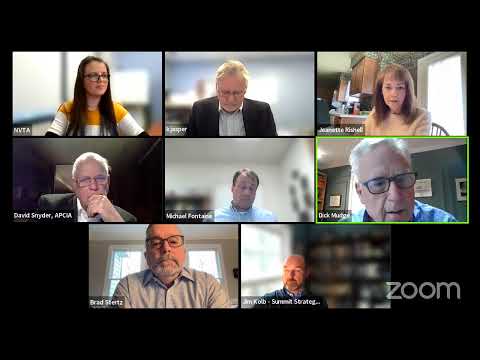
Committee members raised implementation questions and suggested outreach. Brad Sturch, director of government affairs for Audi and co‑founder of Partners for Automated Vehicle Education (PAVE), asked about electric‑vehicle charging and how the regional power grid will handle rapid EV deployment, saying, “Has there been a look at how the energy grid, particularly in Northern Virginia, will be prepared for really a coming onslaught of electric vehicles?” Love replied that the topic has been discussed in previous sessions, and staff has heard from a Dominion Power representative at industry conferences; she said staff can invite power‑sector speakers to future meetings.
Members welcomed the rollout of “lunch‑and‑learn” sessions designed by staff to share pragmatic, near‑term lessons about technology deployments. Love said the program has hosted two 45‑minute virtual sessions—one on a connected automated shuttle pilot in Merrifield and another on microtransit preparation by OmniRide—and a third session on mobility hubs is planned.
The committee also discussed planning for NVTA’s eighth annual Northern Virginia Transportation Roundtable, typically held in March. Love presented four proposed roundtable topics—federal funding and innovation, electrification, bus rapid transit and traffic signal technology—and asked members for speaker recommendations; members suggested including federal agency representatives, electric‑utility speakers, and outside experts on advanced driver assistance systems (ADAS) and smart intersection pilots.
Membership changes were noted as part of the TTC’s transition from plan development to implementation. Love introduced new or incoming committee members present by name and role, including Brad Sturch (Audi/PAVE), Chris Bast (director, EV infrastructure investments, Electrification Coalition), Mike Fontaine (associate director, Virginia Transportation Research Council) and Supervisor Walter Alcorn (Hunter Mill District, Fairfax County Board of Supervisors), and said staff are refreshing membership to support implementation.
The committee’s outreach and education activities have included coordination with the Federal Highway Administration and participation in practitioner listening sessions; Love said lessons from NVTA’s work were “well received” and that staff will continue coordination with operations teams at VDOT and local signal managers.
Next steps: staff will finish integrating the November updates into the TTSP over the winter, publish the updated document, continue the lunch‑and‑learn series, and begin outreach and speaker recruitment for the March roundtable. Committee members were invited to send speaker suggestions and ideas by email to the staff lead.
Ending: The committee closed with agreement to schedule quarterly meetings in 2023 and a request that members forward any materials or speaker names to staff.