Get Full Government Meeting Transcripts, Videos, & Alerts Forever!
Get email alerts on the Cost Overruns Policy topic
No spam. Unsubscribe anytime.
NVTA staff urge caution on creating a formal policy to fund project cost overruns
Summary
Staff told the Northern Virginia Transportation Authority committee that creating an equitable, auditable policy to fund project cost overruns would be complex and could transfer risk to the authority; the committee asked staff to return with draft language by year-end.
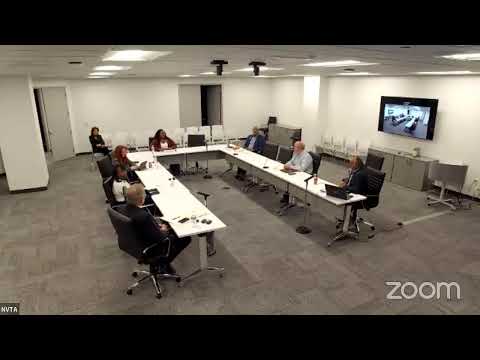
NORTHERN VIRGINIA — Staff for the Northern Virginia Transportation Authority told an Authority advisory committee on Tuesday that drafting a formal policy to pay cost overruns on previously approved projects would be legally and administratively complex and could shift financial risk from local project sponsors to the Authority.
The discussion, led by Mike Longhi, the Authority’s chief financial officer, followed committee and full Authority meetings this summer where staff recommendations to deny additional NVTA funding for two resubmitted projects drew extended debate. "My job is to manage risk," Longhi said. "My bias, I'll be upfront with you, is no," he added when asked whether the Authority should adopt a policy to fund overruns.
The matter matters because state law requires NVTA to rank and select projects using congestion-reduction relative to cost; changes to project costs after selection could alter those statutory evaluations and the fairness of funding decisions. Longhi and other staff walked committee members through prior work done in 2015–2016, including an advisory-panel review and an October 5, 2016 Authority action that placed approximately $8,600,000 into a contingency reserve that was not later made available pending an explicit policy. Staff told the committee they previously estimated about $24,000,000 in cost overruns at that time and now face the possibility of substantially larger overruns — Longhi cited a present-day, order-of-magnitude estimate of up to roughly $1 billion "give or take $100 to $200 million" if every unresolved overrun were funded.
Staff described three practical obstacles to creating a policy that would fund overruns. First, the Authority’s standard project agreement (SPA) includes a process for a project sponsor to notify the CEO and CFO and for the CEO/CFO to make a recommendation to the Finance Committee, but Longhi said that process has rarely, if ever, been invoked. "If a project sponsor experiences a cost overrun, they're supposed to let the CEO know about it and give details," Longhi said. Second, staff warned that meaningful review of sponsors' contingency assumptions would require additional technical capacity and consultant support; NVTA staff currently lack the capacity to parse detailed cost estimates and contingency breakdowns for dozens of projects. Third, staff said using Authority funds for overruns could create equity questions — for example, whether localities should be required to exhaust their 30 percent local-distribution funds before seeking Authority support, and how to treat agencies that do not receive 30 percent local-distribution funds (staff cited PRTC as an example).
Committee members raised questions about inflation, supply-chain delays, phasing projects to reduce risk, and whether the Authority could limit funding to projects that had reached specified design milestones (for example, 30–70 percent design). Longhi described tradeoffs: requiring more disclosure and staff review would slow projects and raise costs, but not acting could leave successful projects at risk of not being completed. He also noted that the contingency reserve set aside in 2016 was later folded back into the Authority’s regional revenue fund when a policy was not adopted.
No formal Authority action was taken at the advisory committee meeting because the committee did not have a quorum. The advisory committee and staff plan additional briefings with the Technical Advisory Committee and the Planning and Programming Committee; staff said they expect to return to the Authority with draft policy language by December. The committee discussed meeting scheduling options for November to allow members input on draft text.
The meeting transcript shows the committee debated multiple design choices — whether any Authority assistance should be retroactive, whether transfers between projects should be allowed, and whether funding should be limited to later design phases or exclude right-of-way and utility-relocation costs until projects meet minimum design thresholds. Staff repeatedly emphasized the statutory constraint around evaluating projects on congestion-reduction relative to cost and the practical limits of NVTA’s staffing and revenue stream.
Longhi summarized the practical consequence of an open funding commitment: "If we were to fund that billion, you're gonna go essentially three years and not establish any new capital projects," he said, describing current biennial funding programs at roughly $650 million to $700 million. Committee members who spoke ranged from expressing openness to a narrow "circuit breaker" approach to others who said they could not in good faith support an Authority-funded cost-overrun program without clearer limits.
The advisory-level discussion will continue. Staff said they will present draft policy language to the Authority later this year; any change to practice would require committee review and Authority approval before funds could be committed.