Get Full Government Meeting Transcripts, Videos, & Alerts Forever!
Get email alerts on the Nvta Funding Policy topic
No spam. Unsubscribe anytime.
NVTA committee signals it will not fund routine project cost overruns, leaves narrow petition route
Summary
Members of a Northern Virginia Transportation Authority advisory committee discussed a draft policy that would generally bar funding for project cost underestimates and overruns while allowing a tightly restricted petition process for rare, extraordinary circumstances.
The Northern Virginia Transportation Authority (NVTA) Planning and Programming Advisory Committee discussed a draft policy that would generally not fund project cost underestimates and overruns, while leaving a limited petition process for truly extraordinary circumstances, committee members heard at the meeting.
The issue matters because staff warned the Authority could face roughly $1,000,000,000 in underestimates or overruns ("give or take $200,000,000") if it opened broad funding for overruns, and because the Authority is weighing how to reconcile that risk with a large backlog of reimbursement requests approaching $2,000,000,000.
Authority staff recapped prior work on the topic dating to 2015–2016, when an advisory panel recommended against maintaining a contingency reserve for overruns and the Authority later moved those monies back into the regional revenue fund. Authority staff said the draft now being vetted would: (1) adopt a general position against funding underestimates and overruns; (2) disallow transfers between already approved projects going forward; and (3) provide a petition avenue that could be used only in the rarest circumstances and only as part of the Authority's six-year program update, which occurs on a two‑year cycle.
"Don't ask us. But if you really feel you have to ask us, they're leaving an avenue for that question to come up," said the Authority chief financial officer, describing the staff approach that preserves a petition process but sets a high bar for its use.
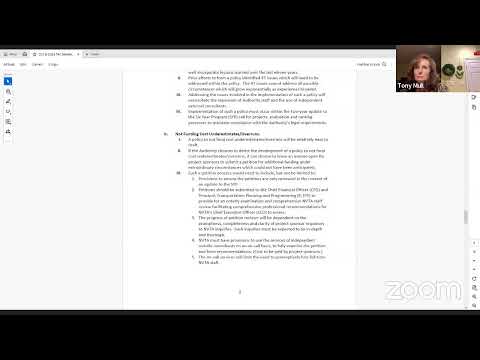
Under the staff outline discussed by the committee, petitions would be submitted to the CFO and the principal of transportation planning and programming, vetted as part of the two‑year six‑year program update cycle, and then reviewed through the normal committee and Authority processes (PCAC, PPC, and the Authority). Staff said petition reviews would be complex and would depend on the promptness and completeness of submissions. The draft also contemplates the use of on‑call independent consultants paid by the project sponsor to limit the Authority's need to hire additional full‑time staff; staff estimated funding petitions could require about four additional staff positions and roughly $1,000,000 a year in consultant costs if the Authority chose to fund overruns routinely.
Committee members pressed staff on how to define "extraordinary circumstances." "I'm not quite sure how... one would determine what's extraordinary and what isn't," said Board Member Waukenshaw, noting that some might argue recent inflation is extraordinary but that members at the Authority meeting were reluctant to treat inflation as a qualifying reason.
Council Member John Steely offered examples that he thought might qualify, such as an abrupt change in federal requirements or a federal department decision that materially affected project funding or project staffing requirements. The CFO responded that the draft policy would not attempt to list every scenario; rather, staff would evaluate petitions on a case‑by‑case basis and consider whether a funding loss was due to a broad budget cut or targeted at an individual project.
Board Member Cunningham emphasized that inflation would affect most projects and said the Authority had already built probability of recession into its revenue estimates. "Inflation would hit all projects," Cunningham said, arguing that because inflation is system‑wide it may not meet the standard for an "extraordinary" exception.
Staff also told the committee that the Authority expects many petitions, if allowed, to be complex; that petition processing would be blended with the two‑year project evaluation; and that petition-related consultant costs would be borne by the project sponsor. Staff noted the Authority previously considered but dismantled a contingency reserve in 2016 and that the current draft aims to avoid creating an open-ended liability.
No formal vote on the policy was taken by the committee. Staff said the draft policy is being vetted internally, that staff would meet with the technical advisory committee, and that they hope to return a draft to the committee (potentially in December) for further review.
The meeting began with approval of minutes from June 20, 2024, and October 23, 2024; members voted to approve those minutes. The committee adjourned after the discussion and a brief NVTA update.
Looking ahead, staff said they would return with a written draft policy and that any petition process would be constrained to the biennial six‑year program update to ensure compliance with the Authority's update cycle.