Get Full Government Meeting Transcripts, Videos, & Alerts Forever!
Get email alerts on the Cost Overruns And Petition Policy topic
No spam. Unsubscribe anytime.
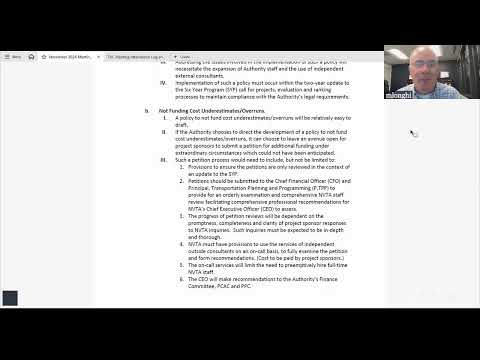
NVTA staff recommends narrow petition process and no routine funding for project cost overruns
Summary
Northern Virginia Transportation Authority staff told the NVTA Technical Advisory Committee on Nov. 20 that a draft policy will start from a presumption that the Authority will not fund project cost underestimates or overruns and will allow a narrowly defined petition process for “unique and extraordinary” circumstances.
Northern Virginia Transportation Authority staff told the NVTA Technical Advisory Committee on Nov. 20 that a draft policy will start from a presumption that the Authority will not fund project cost underestimates or overruns and will allow a narrowly defined petition process for “unique and extraordinary” circumstances.
Lanhee, an NVTA staff member who presented the proposal, said the petition path would be designed to be rare and would align with the Authority’s two‑year update to its six‑year program: “the petition would have to come in in a way that coincides with the 2 year update to the secure program so that we're not looking at any of these. It's kind of a 1 off,” Lanhee said.
Why it matters: NVTA funds capital projects across multiple jurisdictions in Northern Virginia, so absorbing broad cost risk for a single project would require the Authority to reallocate regional funds across unrelated local capital programs. Staff told the committee that the policy aims to avoid shifting that systemic risk to the Authority and to limit requests for additional Authority funding.
Key details discussed at the meeting included that petition reviews would be handled by the Authority’s chief financial officer and principal for transportation programming and planning, and that NVTA could hire independent outside consultants to help evaluate petitions. Lanhee said the cost of any outside review would be borne by the project sponsor.
Committee members asked for examples of qualifying circumstances. Lanhee said the policy will not list specific scenarios but gave two examples discussed previously at the Authority: previously unknown burial grounds and a sudden loss of federal funding attributable to actions beyond a project sponsor’s control. He added that if a federal funding cut were due to a sponsor error or violation it would not be eligible.
Armand, a Technical Advisory Committee member, asked whether NVTA will encourage larger contingency amounts in project budgets given the potential for tariff changes after the presidential election. Lanhee responded that contingency levels are set by project sponsors at application and that NVTA does not set project‑level contingency standards: “it really is a choice of project sponsor.”
Other procedural points raised at the meeting: the finance committee will participate in petition reviews (it does not review ordinary project applications today), project transfers will no longer be eligible under the “no funding overruns” posture, and standard project agreements remain contracts that obligate sponsors to complete projects and secure any additional funding required.
Staff said a draft policy will be presented to the full Authority in February and noted an earlier 2015‑16 advisory panel study (attached to the staff report) that identified 47 issues that would need addressing if the Authority were to adopt a policy of funding overruns. At the Authority meeting referenced by staff, members expressed a clear consensus to not fund underestimates and overruns and to keep the petition process limited; the TAC discussion on Nov. 20 reviewed and provided feedback on that approach.
No formal TAC motion or vote on the proposed policy was recorded during the Nov. 20 meeting; the item remained a staff proposal to be considered by the Authority.