Get Full Government Meeting Transcripts, Videos, & Alerts Forever!
Get email alerts on the Brt Action Plan topic
No spam. Unsubscribe anytime.
NVTA committee hears positive survey results for regional BRT plan but dedicated lanes prompt concerns
Summary
Northern Virginia Transportation Authority staff and consultants reported broadly favorable survey responses to a proposed 28-line Bus Rapid Transit (BRT) network, while local elected officials and staff raised questions about dedicated lanes, local traffic impacts and next steps for outreach and local planning.
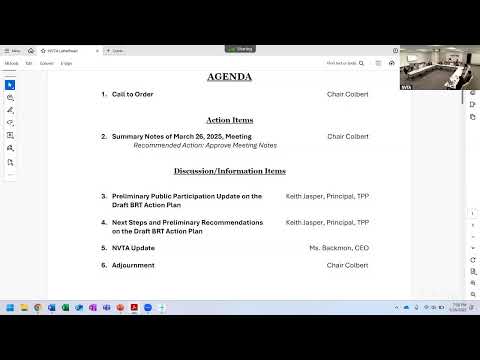
Northern Virginia Transportation Authority staff and consultants updated the Planning Coordination Advisory Committee on May 28 about public engagement for a draft Bus Rapid Transit action plan that lays out a 28-line regional vision and solicited public comment and surveys across Northern Virginia.
The committee heard that consultants from WPA Research conducted 10 pop-up events and fielded a regionwide survey between April 18 and May 19, receiving 587 survey responses and more than 4,600 direct interactions at events; 27% of pop-up interactions were conducted in Spanish, the consultants said. "We received nearly 600 surveys, 587 surveys from across Northern Virginia," Billy, a consultant with WPA Research, told the committee.
Why it matters: NVTA staff and consultants said the action plan is intended as a blueprint to guide future funding and local planning, not a binding commitment to specific street changes. The presentation framed the plan as a regional alternative to heavy rail expansion that can be advanced sooner; staff told the committee the plan will be considered for endorsement by NVTA committees in the coming months before any project-level funding decisions are made.
Survey findings and public reaction
Consultants said the quantitative results were broadly positive. About 63% of respondents said the proposed network goes to "all or most" of the places they need to go; 72% said they would be "very likely" or "extremely likely" to consider using the BRT system. Consultants cautioned that stated intent typically factors down in practice and offered an expected realized-adoption estimate of about 29–31% of those who said they would consider using the system.
Respondents prioritized speed and reliability: dedicated lanes and other features that allow BRT to travel quickly were the most-cited top characteristic, and reliability and on-time performance rated highly across groups. Consultants also reported differences by age and rider type: younger respondents (under 35) were more likely to say the network would reach the places they need, and current transit riders were more likely than nonriders to say they would use BRT.
Local concerns about dedicated lanes and design flexibility
Committee members and local elected officials asked repeatedly about dedicated lanes and local traffic impacts. Several speakers emphasized that dedicated lanes are central to delivering the fast, frequent, reliable service that defines BRT but said the trade-offs for local traffic and right-of-way need clear explanation. "It has to be fast, frequent, and reliable. If it's not fast, frequent, and reliable, it's not really BRT," Keith, an NVTA presenter, said at the meeting.
Consultants and staff said analysis to date uses assumptions about bus-priority measures for evaluation but does not commit jurisdictions to a particular street treatment. They described the plan as a high-level, 30,000-foot blueprint: local jurisdictions would make the final decisions about lane allocation, corridor design and any right-of-way changes if and when a specific line is advanced for funding and design. Staff said detailed modeling and local design work would be required before any construction.
Outreach, next steps and coordination
Presenters recommended that jurisdictions consider the BRT map and station (mobility hub) locations during comprehensive-plan updates and suggested coordination across agencies to support future funding applications. NVTA staff said the plan will move through the authority's approval process with committee reviews in June and July; they stressed that approval of the action plan itself carries no automatic funding commitment.
Several committee members urged more local outreach and education, including jurisdiction-level work sessions, design charrettes, and demonstration or video examples of BRT service to help residents visualize trade-offs such as lane changes and station design. Consultants said they would continue to analyze open-ended comments from the engagement and provide additional materials to jurisdictions.
Ending
The committee did not take formal action on the BRT action plan at the May 28 meeting; staff said the plan is expected to return for committee endorsement in the coming weeks and that any project-level funding would be considered later through NVTA's established funding cycles. Committee members recommended additional local outreach and closer coordination on route descriptions, branding and technical project descriptions before jurisdictions submit individual funding requests.