
Virginia Marine Resources Commission denies petition to require terrapin bycatch reduction devices; asks staff to study recreational pots
Get AI-powered insights, summaries, and transcripts
Subscribe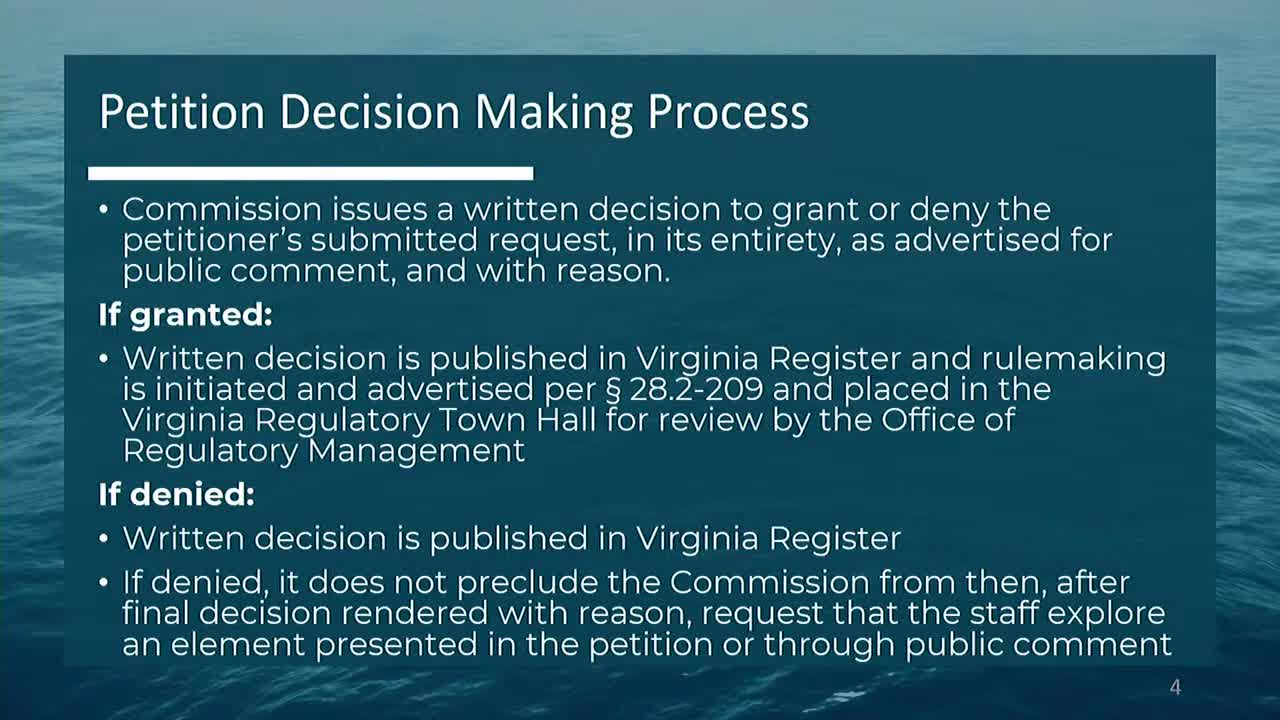
Summary
The Marine Resources Commission on June 24 denied a petition to require bycatch reduction devices (BRDs) on all licensed commercial and recreational crab pots within 150 yards of shore, but directed staff to study requiring BRDs for recreational pot fisheries.
The Marine Resources Commission on June 24 denied a petition asking the commission to require bycatch reduction devices, or BRDs, on licensed commercial and recreational blue crab pots within 150 yards of the mean low water shoreline.
Petitioners — the Center for Biological Diversity, the Virginia Herpetological Society and William M. Rosenberg — asked the commission to adopt or amend regulations to require rectangular BRDs no larger than 4.5 by 12 centimeters on each funnel of a crab pot in nearshore waters, and proposed a three‑year retrofit grace period. The petition sought the requirement in waters “less than a 150 yards from shore at the mean low watermark, including man made lagoons, creeks, coves, rivers, tributaries, shallow bays, inlets, and nearshore harbors,” and included draft regulatory language and citations to portions of the Code of Virginia cited in the petition materials.
The commission invited a 10‑minute petitioner presentation followed by public comment and a five‑minute rebuttal. William Rosenberg, who identified himself as “a biologist at Ohio University,” summarized research showing steep terrapin vulnerability and presented experimental results he said showed a 4.5×12 cm BRD reduced terrapin captures by about 80% without reducing legal crab catch. “The BRD is a very simple, cost effective mechanism to reduce terrapin bycatch,” Rosenberg said.
Speakers from Virginia Institute of Marine Science (VIMS) and William & Mary described terrapin life history, low population growth rates and strong site fidelity. Randy Chambers, director of the environmental lab at William & Mary, told the commission he had used commercial‑style crab pots to study terrapins in Virginia and said BRDs produced “a tremendous decrease in terrapin bycatch.” Staff noted VIMS recommended initiating rulemaking and suggested tailoring any requirement to recreational pots would give more “bang for your buck.”
Commercial watermen and recreational crabbers strongly opposed a mandatory requirement for commercial pots. Speakers representing the Virginia Watermen’s Association and several individual commercial watermen warned of higher gear costs, decreased catch of larger (“money”) crabs, pressure‑washing and maintenance problems, and enforcement difficulty if the rule covered unlicensed two‑pot recreational users. Several speakers showed examples of plastic and wire BRD products and disputed some study conclusions based on their on‑water experience.
After public comment and petitioner rebuttal, Associate Commissioner (Acting Member) Preston moved to deny the petition in its entirety; Commissioner Headley seconded. The commission voted to deny the petition 7–0. Commissioner White then made a motion, seconded by Commissioner Hand, directing staff to revisit the recreational pot fisheries (both the two‑pot unlicensed use and the five‑pot licensed recreational category) to assess whether a recreational‑only BRD requirement is feasible; that motion carried 7–0.
The commission’s written decision on the petition will be posted to the Virginia Register of Regulations and Virginia Regulatory Town Hall as required for petition rulemaking. Staff said a denial of the petition as written does not prevent the commission from asking staff to explore elements raised in the petition or in public comment.
Why it matters: the petition addressed a recurring conservation conflict between an at‑risk species (diamondback terrapin) and a long‑standing nearshore crab fishery. The commission denied the broad, coastwide petition for now but instructed staff to return with a focused review of the recreational sector, leaving the door open to targeted regulatory change or education and incentive programs.