Get Full Government Meeting Transcripts, Videos, & Alerts Forever!
Get email alerts on the Homelessness Shelter topic
No spam. Unsubscribe anytime.
Wausau committees advance five‑year contract with Bridge Street Mission for year‑round emergency shelter amid funding and faith‑based concerns
Summary
Finance and Public Health & Safety committees recommended a contract with Bridge Street Mission to operate a year‑round emergency shelter. The contract includes nondiscrimination language, sets a first‑year city cost near $350,000, and ties construction and opening timelines to external funding; county participation remains uncertain.
Two Wausau City Council committees voted to advance a contract with Bridge Street Mission to operate a year‑round emergency shelter, despite objections from some alderpersons about the mission’s faith‑based affiliation and the proposal’s five‑year term.
The committees’ action moves the proposed contract to the full council for final consideration. The agreement would fund the mission’s planned emergency shelter buildout — an 8,200‑square‑foot space the mission says will be designed to serve as a shelter — and contemplates a city contribution of roughly $350,000 in the first year.
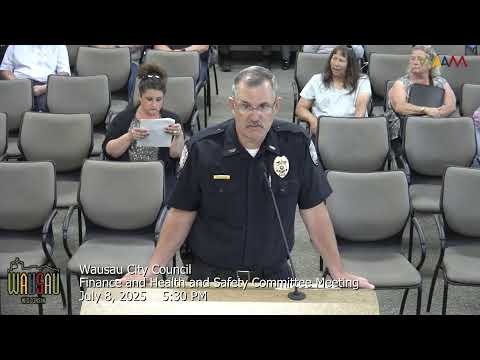
The chief of police, speaking to members of the finance and public health committees, said the city has limited alternatives and emphasized immediate safety concerns. “What I need to see is how do we keep them safe. And we only have 1 option,” the chief said, arguing that without a contract the city could lose year‑round shelter capacity and see more people sleeping outdoors this winter.
Committee members and staff described how the mission’s plan differs from other local services. The chief and other speakers noted that Catholic Charities’ previous emergency shelter operation used about 3,000 square feet and served roughly 30 people; Bridge Street Mission’s day‑shelter plans could serve up to 120 people per day, committee members said. The chief said the city’s current monthly shelter spending is about $30,000 — roughly $360,000 a year — and that Bridge Street Mission’s requested first‑year payment of $350,000 was comparable to current local costs.
Bridge Street Mission’s executive director, Craig Vincent, was cited by committee members for the organization’s experience; city staff and committee members said the mission’s written proposal contains a nondiscriminatory admission policy for the emergency shelter portion of the program and separate spaces for guests with higher intoxication or behavioral needs.
Some alderpersons expressed concerns about the mission’s faith‑based identity and whether that could deter people with prior trauma or from certain communities from using the shelter. Alder Lukens and others said constituents had raised such concerns and asked for a shorter contract or additional protections. “People have raised concerns about religion and trauma,” Lukens said. She proposed delaying action to allow more review; that motion to lay the item on the table in finance was defeated 2‑3.
Supporters argued the city had already struggled to find any alternative provider. Alder Larson and others said volunteer staffing and local experience argued in favor of moving ahead quickly. Larson said the contract’s timeline and funding certainty are necessary for the mission’s funders and contractors to start construction; the contract includes a June 1, 2026 benchmark for construction completion and a provision allowing the city to exit the agreement if the space is not built by that date, committee members said.
Tracy Durante, the city’s outreach coordinator who has been operating the temporary shelter, told the committees she would welcome a qualified nonprofit taking over fulltime operations and said the additional capacity would allow her to focus on outreach work. “If they are chosen to be an option for a year‑round shelter, great. I will look forward to being able to get back to my daily duties,” Durante said.
Committees discussed funding and county participation. Speakers said Marathon County previously allocated up to $200,000 for shelter in 2025 and that further county support would require action in the county’s budget process. City staff said the contract would likely create a budget line for 2026 that the city could fund by levy, remaining ARPA dollars (if any), grants, or a county partnership; no final funding source was identified in committee.
Committee votes: in finance, a motion to postpone (lay on the table) the contract failed 2‑3; a subsequent motion to move the contract forward passed 4‑1. The Public Health & Safety Committee later voted to recommend the contract to the full council, with committee members recording one opposed. As a result, the item will appear on the full council agenda for final action.
The contract text was provided to committee members the day of the meeting; several members said they wanted more time to review it. Committee members also added that the agreement includes reporting requirements: the provider must attend public health and safety meetings at the chair’s request (up to six times per year) to answer questions about operations. Committees discussed the possibility of a standing annual review before each budget cycle to assess utilization and costs.
Next steps: the contract recommendation goes to the full Wausau City Council. County participation and the mission’s ability to secure construction funding are unresolved; committee members warned that delays could postpone the shelter opening and leave the city without year‑round capacity.
Ending: Committee discussions focused on balancing immediate shelter capacity and safety with longer‑term concerns about provider suitability, oversight and budget impact. The council will consider the contract at its next meeting.