Get Full Government Meeting Transcripts, Videos, & Alerts Forever!
Get email alerts on the Emergency Shelter Bridge Street Mission topic
No spam. Unsubscribe anytime.
Wausau council approves emergency-shelter contract with Bridge Street Mission amid nondiscrimination debate
Summary
The Wausau Common Council approved a five-year contract with Bridge Street Mission to provide emergency night shelter services after extended public comment and committee review. Council members and residents debated nondiscrimination protections, a 60-day guaranteed bed policy, and the contract's five-year term; the measure passed 8-3.
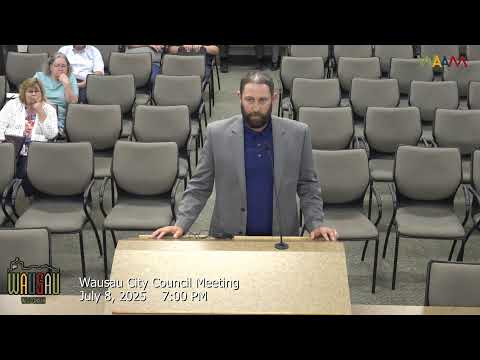
The Wausau Common Council voted 8-3 on July 8 to approve a joint finance and public health-and-safety resolution authorizing a contract with Bridge Street Mission to provide emergency night shelter services for the city.
The vote follows weeks of outreach, two RFP cycles and a joint committee review; council members and public commenters pressed for clearer nondiscrimination language, limits on religious activity, and shorter contract terms before the approval.
The contract approved by the council includes a nondiscrimination clause that, according to a council summary read into the record, requires the provider to “provide emergency night shelter services under this contract on a nondiscriminatory basis regardless of faith, gender, [or] lifestyle” and states that “no beneficiary of service under this contract shall be required to participate in any explicitly religious activity.” The resolution (file 25-0704) passed finance and public health-and-safety earlier in the day by 4-1 votes.
Public commenters urged caution. Jay Kronenwetter, an attorney and Wausau resident, criticized the contract draft’s employee protections and said the Mission’s publicly stated hiring practices could leave staff without federal civil-rights remedies. “I don’t think anyone who respects workers’ rights or labor in general should vote a penny to that contract,” Kronenwetter said, urging the council to delay approval and add nondiscrimination conditions.
Several residents and service providers said the Mission’s proposed 60-day guaranteed bed policy is too short for people facing barriers such as criminal records or housing-related evictions. “In the proposal that the Mission has given you, there’s only a 60-day limit… It’s not enough time,” said Christy Scheidel, a formerly unhoused resident who said she now is temporarily housed.
Police Chief Barnes and other city staff defended the contract language and the urgency of securing shelter capacity before winter. Barnes told the council the 60-day guarantee means a person entering the night shelter is assured a reserved bed for 60 days while receiving case management and referrals; extensions are possible if progress is being made. He also said the draft contract is negotiable and that legal staff would finalize language with the provider.
Council members expressed differing priorities. Alder Rasmussen, who moved the resolution, emphasized the safety imperative: “You don’t have to love the provider, but what you have to hate more is the idea of people having nowhere to go in February.” Several alderpersons echoed concerns about the contract’s five-year term and last-minute packet delivery; Alder Lukens and Alder Killian said they could not support a long-term contract without more time to review and stronger written safeguards.
City staff gave operational details in the meeting: Bridge Street Mission’s day center capacity is described as 120 people, and the night shelter overflow capacity was described as 75; the city’s funding would support emergency night shelter services while the Mission privately funds the build-out for the facility. Staff said two RFP cycles were published for roughly three weeks to a month each with no alternate proposals meeting the RFP requirements.
Council members also discussed oversight and accountability. Public-health-and-safety committee members said the committee will receive monthly data and an annual review of the contract’s performance, and staff said the city attorney would work with the Mission to tighten contract language as needed before final execution. Council members warned that postponing approval could jeopardize the Mission’s fundraising and construction timeline.
The approved resolution authorizes city funds for emergency night-shelter services and requires the provider to comply with applicable nondiscrimination laws and the contract’s nondiscrimination clause. A prior motion to postpone reconsideration and send the item back to committees failed on a 5-6 vote earlier in the meeting.
Council members and public commenters repeatedly called for clear, enforceable contract language spelling out who is eligible for shelter, what counts as a religious or voluntary program component, and how the city will review compliance. Chief Barnes said staff and the city attorney will continue negotiations with the Mission to address outstanding concerns before signing the final contract.
Implementation notes: staff said the Mission is pursuing roughly $1 million in private fundraising to complete build-out; the city’s funding commitments were described in public comment as totaling several hundred thousand dollars in the near term and potentially up to $1.25 million over multiple years, figures cited by a public commenter. The council vote authorizes the next step needed for the build-out to proceed and for the Mission to accept emergency night-shelter funding from the city.
The council’s action marks a transfer of emergency-night-shelter operations from temporary, city-run facilities to a private nonprofit provider under a city contract. The council did not vote tonight on any amendments that would change the length of the contract or the 60-day guaranteed-bed policy; those details remain subject to negotiation between staff and the provider before final contract execution.