Get Full Government Meeting Transcripts, Videos, & Alerts Forever!
Get email alerts on the Rezoning 39 Multifamily topic
No spam. Unsubscribe anytime.
Plan Commission recommends rezoning 56 acres north of State Road 39 for multifamily; residents raise traffic, drainage and notice concerns
Summary
The La Porte Plan Commission voted to recommend that the City Council rezone a 56‑acre property north of State Road 39 from B‑3 Highway Commercial to R‑3A Low‑Rise Multifamily Residential, with petitioners describing a phased plan that could yield about 200 units in phase one and a potential buildout of a little over 400 units.
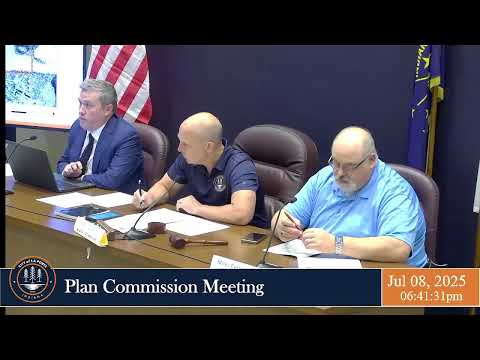
The La Porte Plan Commission voted to recommend that the City Council rezone a 56‑acre property north of State Road 39 from B‑3 Highway Commercial to R‑3A Low‑Rise Multifamily Residential, a change the petitioners said would allow multifamily development and that staff said generally aligns with the county land development plan. Commissioners passed a favorable recommendation by voice vote; the council will consider an ordinance at subsequent hearings.
Developer representatives Mike Sullivan and Ryan Metz of Lincolnshire Investment presented a concept they described as a "big house" design that, in initial phases, could create about 200 apartment units and, at full buildout, "a little over 400 units." Sullivan said the proposal would downzone the entire parcel to R‑3A to allow multifamily and create a residential buffer along Highway 39. The petitioners told the commission the 56 acres contain roughly 20 to 25 acres of buildable land after accounting for wetlands and other constraints. Metz said, "those 3 locations are lower. They'll remain wetlands. Yes. And the trees within them will also stay."
David Heinold, city staff, briefed the commission that the request would rezone the site from the B‑3 Highway Commercial District to the R‑3A Low‑Rise Multifamily Residential District and that staff found the proposed rezoning appropriate for the surrounding residential area and generally compatible with the "La Porte County land development plan strategic goals and objectives." Heinold noted the property includes several wetlands, natural gas pipeline alignments and overhead wires, and an existing turn lane serving nearby manufacturing. He also said that rezoning hearings are advisory and that the commission's recommendation will go to the city council for an ordinance process.
The public hearing drew a number of residents who raised concerns about notice, traffic, stormwater drainage, pipelines and project specifics. Diane Carpenter, a nearby property owner, told the commission that mailed notices gave her a "very negative feel," saying, "No company name on this the the envelope addressed to me, no return no, company name on the return, postcard, No company name on any of the papers until the fifth day I turned 1 over and there was a name. No cover letter." Alan and Kathleen Lang submitted written comments requesting the petition be sent to council with a recommendation of denial or without recommendation, saying that the seven‑day notice they received (dated July 1) gave adjacent owners insufficient time to evaluate the proposal. Other residents asked about setbacks, parking (one commenter noted a figure of 1.7 spaces per unit on the plan), lighting and pedestrian paths.
Jose Rosario, owner of the Weincoop Farmstead (listed in the national register), urged transparency and deeper information for affected property owners. Bert Cook, executive director of the La Porte Economic Advancement Partnership, urged the commission to consider the broader choice of future land uses, arguing rezoning to residential would be preferable to leaving B‑3 zoning that allows "a hotel and 24 hour truck stop" without additional review. Cook said, "I would not feel right about putting a truck stop on that property, but they could build that today without any action by you or the city council."
Residents also highlighted infrastructure risks: commenters noted existing flooding in low areas on or near the property, the presence of at least one natural gas pipeline and another oil pipeline (transcript references to Enbridge and Vector), and concerns about a single access point onto State Road 39 and its traffic safety. Several speakers asked where stormwater from new roofs and pavement would be directed and whether local roads and utilities could handle additional trips from hundreds of units. Petitioners and staff responded that specific engineering, stormwater, setback and utility details are handled in later design and site review steps if zoning is approved.
After public comment closed, commissioners reiterated that the hearing addressed only the zone map change, not final site design or permits. One commissioner summarized the choice as whether the long‑term use of the property should remain highway commercial (with the uses B‑3 permits) or transition to residential, noting the rezoning step is the first of several review stages. A motion to send a favorable recommendation to the city council carried on a voice vote; commissioners recorded "Aye" and no opposing votes were recorded in the transcript.
Next steps: the city council will review the recommended rezoning and, if it proceeds, will consider an ordinance over two meetings, which provides further opportunities for technical review and public comment on traffic, stormwater, setbacks and other engineering matters raised at the hearing.