
Roseville police propose 5‑year staffing plan, ask council to add officers, supervisors and records support in 2026
Get AI-powered insights, summaries, and transcripts
Subscribe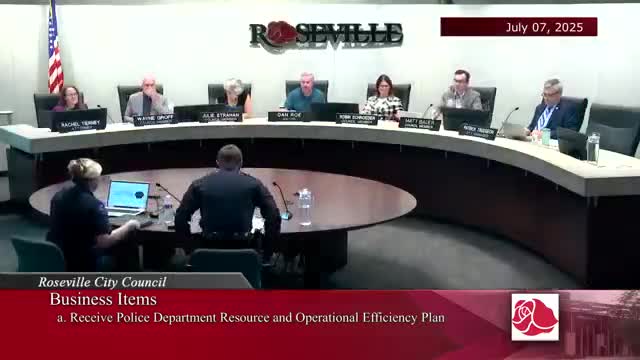
Summary
At the July 7 Roseville City Council meeting police leaders presented an external operational efficiency report and asked the council to approve staffing and records/property-room support in 2026, citing rising calls, heavier report burdens and facility constraints. They submitted a COPS grant application and outlined a phased five‑year plan.
At the July 7 Roseville City Council meeting, the Roseville Police Department presented a consultant-backed operational efficiency report and asked the council to fund front-line and support positions beginning in 2026.
The request follows a multi-month study the department described as a holistic review of operations. Police leaders said increased call volumes, heavier report-writing requirements and aging facilities have stretched staffing and support functions.
Police Chief (name not provided) said the study "did a really good job of taking a holistic view of the department" and that the department prepared a phased five-year implementation plan. He told the council, "My job is to support the men and women that work in this agency that answer 911 calls." Deputy Chief Adams told the council, "Our sergeants are the most important piece of our police department." Both officials described watch-level staffing shortfalls and the supervisory burden that removes sergeants from street supervision and mentorship duties.
What police want in 2026
- Add one patrol officer to each of four patrol teams (four patrol officers total). - Add two supervisory sergeant positions to increase on‑shift supervisory redundancy. - Add a records/property-room staff position (a records/property supervisor or combined support position) to address backlog and evidence/property capacity.
Police officials described phase‑2 and phase‑3 items to follow in later years: an additional detective, expanded digital evidence management, a dedicated training manager and additional analyst support to separate investigative analytics from administrative analytics.
Why police say the hires are needed
Chief and Deputy Chief Adams pointed to rising workload and complexity. The presentation showed the department's average daily incidents rising from roughly 100 per day in 2017 to about 122 per day recently, with summer spikes above 150 on some days. The consultants and department data also documented a large increase in report-writing workload: "reports written increased by about 38% between 2021 and 2024," the presentation said, and that extra paperwork creates downstream demand on detectives, evidence/property staff and the city attorney's office.
The department cited one localized example: calls to a development identified as the Oasis/Harbor increased from 2 calls during construction years to more than 600 calls in 2024. The department also cited arrests tied to increased enforcement at the Rosedale Center: "arrest in 2023 was 26. Arrest the following year was 235," and department slides said they had "already surpassed over 300 arrests so far this year, just in year to date." The department framed that as a positive enforcement result that also increases property/evidence and records workload.
Facility and operational issues
Chief said station space is constrained and dated — the building "was built 27 years ago" and lacks room for interview rooms, lockers and offices. He gave one example: "in the women's locker room, we are out of lockers." The department has shifted some staff and worked with other city departments to find interim space but said a long‑term facility plan and additional staff are part of the same readiness challenge.
Supervisory case advanced by deputy chief
Deputy Chief Adams showed that on many nights minimum staffing and officers' seniority fall to very junior levels and that sergeants are routinely pulled into non‑supervisory duties (training, recruitment, field training), which reduces their ability to mentor and supervise in the field. The deputy chief said there were more than 1,000 hours in 2023 and 2024 each year when a supervisor was not on the street for some shifts; he said additional sergeants would provide redundancy and reduce risk.
Records and evidence needs
The presentation emphasized that the city records/property team has not scaled with modern requirements. Department slides compared Roseville's two-records‑tech staffing count to other comparable agencies (many of which had more than two staff) and noted that if one records tech had long‑term leave the operation would be severely impacted. The evidence/property room is at capacity, the police said, and the proposed 2026 records support position was intended to serve both records and property-room duties.
Budget and next steps
Police staff said the city has submitted a COPS grant application that would partially fund four of the patrol officers; the grant outcome will not be known until the fall. Department leaders and finance staff also told council members that firm cost estimates are still being developed with finance and that the request will be considered as part of the 2026 budget process. The chief said the department tried to prioritize only the most critical hires in 2026 to fit likely budget constraints.
Council reaction and unanswered questions
Council members praised the study and asked about operational details, training, IT and facility timing. Council members noted the 2026 personnel asks will show up in budget deliberations and sought more specifics on costs and implementation timing. Finance Director Michelle Petrick and City Manager Pat Trojgen were on hand to note that budget modeling and debt/service timing will be part of future budget discussions.
The council did not take an immediate vote on the staffing requests. Police leaders said they will return with implementation details, and the department's requests will be evaluated through the city's 2026 budget and levy process.
Ending
Police leaders closed by urging council support for a phased plan that privileges officer wellness and operational sustainability; Deputy Chief Adams said the plan would improve mentorship, reduce operational risk and give officers predictable breaks and supervision. "Don't forget about that we're people," Chief said near the end of the presentation. The council's budget and levy decisions this year will determine which 2026 hires move forward.