Get Full Government Meeting Transcripts, Videos, & Alerts Forever!
Get email alerts on the Eec Systems Training topic
No spam. Unsubscribe anytime.
EEC holds virtual systems training for contract providers on KinderWade and CCFA
Summary
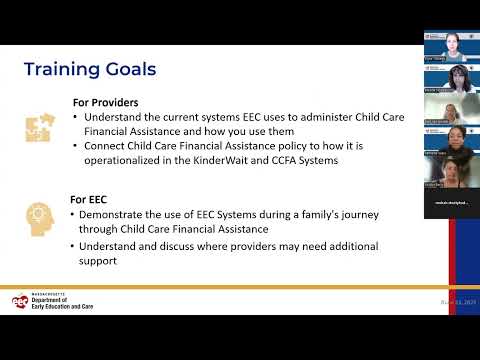
The Department of Early Education and Care ran a full-day virtual training for its contract provider network covering the KinderWade wait‑list system, Child Care Financial Assistance (CCFA) workflows, authorizations, placements, change reporting, closures, attendance and billing.
The Department of Early Education and Care (EEC) conducted a full‑day virtual training for contract providers focused on EEC’s KinderWade wait‑list system and the Child Care Financial Assistance (CCFA) application, Department staff said during the session.
EEC’s Priority Access Manager Elise Tibbetts opened the session and framed it as a systems training intended to “give you the how to, use these systems” for child care financial assistance, while Bethany Glass, director of childcare financial assistance, said attendees would hear from multiple EEC teams responsible for policy, program integrity and product systems.
Why it matters: EEC staff told providers the two systems together manage the family journey from initial wait‑list intake (KinderWade) through eligibility determination, authorization and ongoing administration in CCFA. Staff emphasized accurate data entry, shared records and common procedures so funding offers, documentation and billing flow correctly across systems.
What EEC demonstrated - KinderWade: Brenda Hodzowich and other EEC staff led a demo of wait‑list intake steps, including soft eligibility screening, capturing priority access codes, and printing a confirmation notice. Staff instructed providers to place every family that seeks a contract seat on the state wait list (with two narrow exceptions for DTA and DCF referrals). EEC repeated that families must not be rejected from the wait list because of citizenship status alone, and that families have 15 days to respond to a funding‑availability notice.
- CCFA: Presenters from EEC’s product and systems team (Kristen Berry and others) showed how to import a KinderWade household into CCFA, add household members, record parent activities and income, submit document checklists, and create authorizations. EEC demonstrated the required secondary‑approval step (another staff member must approve or return the authorization) and then how to add placements that match the authorization start and end dates.
- Change reporting and referrals: EEC walked through temporary and non‑temporary changes — for example, adding a newborn to a household requires a non‑temporary change so the child becomes a beneficiary on the authorization. Staff showed how to enter DCF and DTA referrals and explained that referral‑based authorizations are generated from the referral, not from family income fields.
- Closures, substitute care and attendance: The training covered how to add approved closures (holidays, professional development days), submit flexible‑closure requests that can include substitute care assignments, and record no‑transportation or partial closures. Attendees were shown attendance entry screens and color‑coded codes for enrolled days, explained absences and unexplained absences. EEC staff reiterated that parent fees still apply for explained absences unless the family has an approved break in care or the placement is otherwise terminated.
- Billing: Presenters demonstrated ledger generation for a provider, how to review pending invoices, apply reconciliations and create payment vouchers. EEC staff pointed providers to the invoice extract and service‑month extract reports for auditing billed amounts and to a slot‑utilization report for contract monitoring.
Key process points EEC highlighted - Soft eligibility and priority codes: Family Access Administrators (FAAs) must run a soft eligibility screening, capture priority codes (families may have multiple codes), and counsel families when codes are sensitive. Priority codes do not automatically guarantee a seat; they are one factor FAAs use when filling seats. - Funding availability notices and records retention: Providers should send funding availability letters (the training demonstrated how from KinderWade), call families to confirm receipt, and keep copies of notices. EEC staff said providers must retain funding notices in records consistent with program guidelines discussed in the session (staff referenced multi‑year retention expectations during the demo). - Secondary approval: A different staff member must perform the CCFA secondary approval step before an authorization moves to “approved” status and placements are added. EEC recommended approvers review all submitted documentation rather than approving mechanically. - Reinstatements and terminations: If a family is removed from the wait list for non‑response, the transcript showed a 30‑day window for reinstatement of the prior application date if the family calls back; other reasons (for example, ineligibility) result in a new application date when readded. Providers were told to document terminations and to provide a removal notice and request‑for‑review form when applicable.
Quotes from presenters (selected and attributed) - Elise Tibbetts, Priority Access Manager, EEC: “Welcome to the contract provider core services training, for EEC systems. So today’s training, we’ll be walking through the different EEC systems that you use, to drive the work that you do with families around child care financial assistance.” - Kristen Berry, family experience product owner: “I’m going to be delving into the system and the details around how to use KinderWade using a scenario based approach.” - Brenda Hodzowich, financial assistance unit: “When you reach out to the family to offer funding, the status gets changed to pending because now they have a funding availability notice that has been sent to them.”
What EEC asked of providers - Keep family contact information current and enter preferred communication methods in KinderWade so notices reach families. - Enter clear notes on family records so other FAAs or approvers can pick up a case without recreating the family history. - Build closure and professional‑development schedules into provider records in CCFA in advance, and use the flex‑closure request workflow when substitute care is needed.
What EEC offered next - EEC will post the slide deck and a recording of the session; staff said regular CCFA drop‑in help sessions will be available for follow‑up technical assistance.
Ending note: training orientation and follow‑up EEC staff presented hands‑on, scenario‑based demos and repeatedly emphasized documentation, consistent data entry across KinderWade and CCFA, and the secondary approval requirement. Providers with specific policy questions or file‑level questions were directed to their family access specialist or to EEC’s subsidy management mailbox for follow‑up.