Get Full Government Meeting Transcripts, Videos, & Alerts Forever!
Get email alerts on the Land Use Zoning topic
No spam. Unsubscribe anytime.
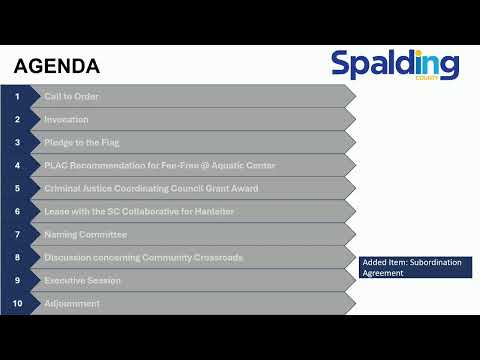
Commissioners debate 'community crossroads' commercial zoning and green-space goals ahead of comp-plan update
Summary
County staff reviewed nine 'community crossroads' identified in Spalding County’s comprehensive plan and commissioners debated commercial zoning limits, inconsistent ordinance enforcement, and green-space preservation ahead of a comp-plan update due next year.
Dr. Ledbetter, staff member, presented a staff review of the comprehensive plan’s designation of nine “community crossroads” across Spalding County and asked the Board of Commissioners for feedback on how commercial zoning should apply at those locations.
Staff said the crossroads designations are meant to create limited commercial opportunities (to avoid spot zoning) at specified intersections; they identified that two crossroads — the 362 at Bond Road and Hollandville Road at 362 — currently lack substantial commercial development, while the others have varying degrees of commercial activity. Dr. Ledbetter said the county’s crossroads policy is intended to allow low-intensity gateways, community gateways, or employment gateways rather than broad commercial expansion.
Commissioners raised multiple concerns in public discussion. Several commissioners said the county’s ordinance limits contiguous commercial parcels at an intersection to two businesses, but that the practical record shows inconsistencies: some intersections already have three or more businesses (gas stations, dollar stores, small strip malls), and staff interpretations have varied. A commissioner asked how the community development office should interpret the ordinance when a past approval or the presence of existing businesses appears to conflict with the written limit.
Commissioners also discussed the timeline for the comprehensive plan update: staff said the five-year update is due in October of next year, and that the county can make minor updates sooner but larger changes require review through the Georgia Department of Community Affairs (DCA). One commissioner urged that the board clarify its policy publicly and ask staff, including David (community development staff referenced in the discussion), to explain any prior interpretation of the ordinance so that future decisions are consistent and transparent to the public.
A separate but related thread of discussion focused on green-space preservation. One commissioner proposed exploring a policy goal (for later consideration during the comp-plan update) to preserve a set percentage of the county’s land mass as agricultural/residential (AR-1) to protect tree canopy and open space as development continues. Commissioners acknowledged trade-offs between tax revenue, development, and preserving the county’s rural character and asked staff to incorporate those community values into the next comp-plan update process.
Staff told the board that the crossroads conversation would inform decisions expected at the board’s upcoming meeting on the fourteenth, and that public discussion now would help frame the formal decisions during the comp-plan update cycle.