
Riverside LAFCO hears competing views on countywide study of special-district boundaries; no vote taken
Get AI-powered insights, summaries, and transcripts
Subscribe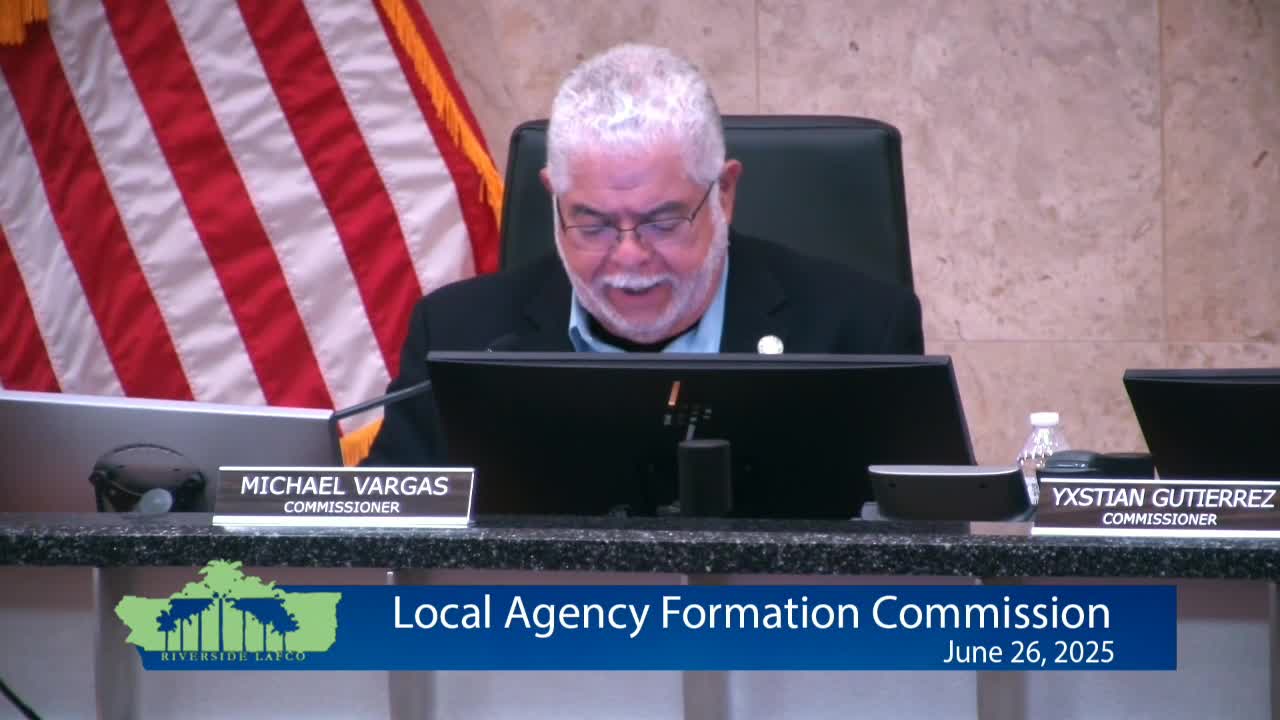
Summary
The Riverside Local Agency Formation Commission on June 26 discussed whether to pursue a countywide study of special-district boundaries and potential consolidations, hearing competing views from special-district representatives, cemetery trustees and commissioners.
The Riverside Local Agency Formation Commission on June 26 discussed whether to pursue a countywide study of special-district boundaries and potential consolidations, hearing competing views from special-district representatives, cemetery trustees and several commissioners. No formal action was taken; commissioners gave staff direction to consult with stakeholders and consider revisions to the municipal service review process.
Jeremy Zetwitty, speaking for the Special Districts Association of Riverside County, urged caution and asked LAFCO to clarify scope and cost before launching a broad study. "We respectfully request that LAFCO clarify what the estimated cost of such a study would be," he said, adding that any countywide effort should avoid duplicative expense and should build on existing MSR work.
Trustee Marco (Coachella Valley Public Cemetery District) told commissioners that cemetery districts had just completed recent MSRs and that a broad, immediate consolidation push could be disruptive. "We're larger than all other cemetery districts combined... It will be fiscally catastrophic" for his district to absorb others, he said, describing cultural and program differences among districts.
Commissioner Steve Sanchez said the question of consolidation should be studied by an objective third party because agencies under review will likely resist proposals to merge. "The entire purpose of a third-party consultant making that analysis is to have a non-biased outcome," he said, noting the recent Palo Verde situation as an example of why oversight questions matter.
Speakers on all sides recommended building on the MSR process rather than creating a separate, resource-intensive study. Gary (LAFCO staff) and Crystal (LAFCO staff) noted MSRs already ask questions about service efficiency, boundaries and potential for consolidation and that MSRs are required by state law at least every five years. Crystal told commissioners the MSR determinations include operational-efficiency considerations and that the cemetery-district MSR completed a few months earlier did not recommend dissolutions or consolidations.
Public speakers and some commissioners urged LAFCO to prioritize focused reviews where evidence suggests potential gains rather than a sweeping countywide study. The Special Districts Association asked that any study include cities and the county as well as districts to identify meaningful efficiencies.
Commissioners suggested practical next steps: meet with the Special Districts Association and cemetery districts, refine MSR questionnaires to probe efficiencies and duplication more deeply, and return with cost estimates and a proposed timeline. One commissioner suggested a six-month outreach and review period as a pilot timeline for cemetery districts, though commissioners agreed that scheduling and scope should be developed with stakeholder input.
The discussion produced no motion to initiate a countywide study. Staff were directed to engage with the Special Districts Association and affected districts, review the MSR questionnaire and report back with recommendations and cost estimates for any further work.