
Board adopts CEQA findings for county wildlife-management plan to allow contracts with USDA Wildlife Services
Get AI-powered insights, summaries, and transcripts
Subscribe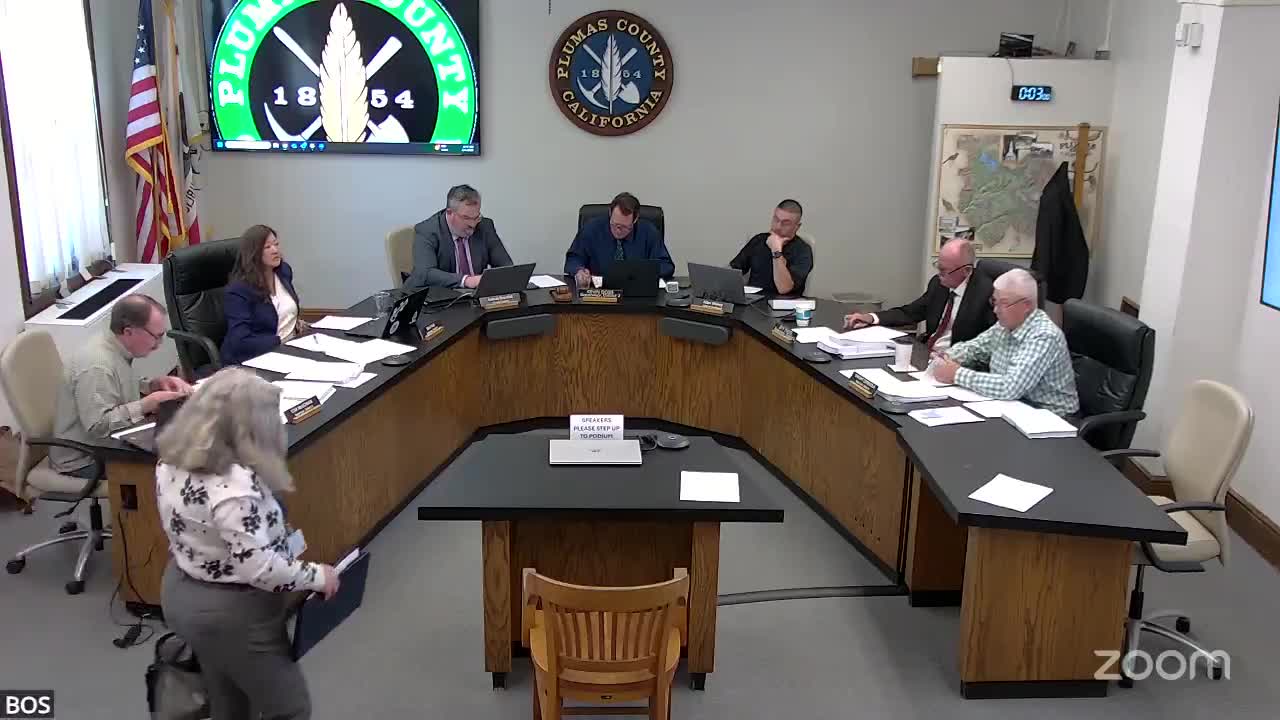
Summary
The Plumas County Board of Supervisors voted June 17 to adopt CEQA findings for a statewide wildlife-management plan, allowing the county to pursue a contract with USDA APHIS Wildlife Services to provide local depredation response, hazing and technical assistance.
The Plumas County Board of Supervisors on June 17 adopted a resolution accepting the environmental review documentation prepared for a statewide wildlife-management plan, allowing the county to proceed toward a contract with the U.S. Department of Agriculture’s Animal and Plant Health Inspection Service (USDA APHIS) Wildlife Services to provide local wildlife‑management assistance.
County staff presented a letter of support from the Plumas and Sierra County Cattlemen’s Association, dated June 16, asking the board to move forward so ranchers and rural communities could access local wildlife services for nuisance and livestock depredation issues. “The adoption of the resolution is necessary for Plumas County to contract with the U.S. Department of Agriculture, Animal Plant and Health Inspection Services, APHIS, Wildlife Services,” the letter said.
Board discussion and public comment focused on how the plan would be implemented locally, what actions are and are not permitted under the plan, and past litigation. County counsel explained that a prior lawsuit by Project Coyote had required the county to pause certain wildlife control activities until an environmental review was completed; the statewide CEQA document and its supporting analyses were prepared by state and federal partners with public scoping and comment.
County staff described operational uses for local wildlife services, including predation investigations, public education, nonlethal hazing (for example, beanbag rounds or audio deterrents) and targeted removal of problem animals deemed public nuisances under applicable law. Staff cited recent local examples where wildlife services helped address public-safety risks or disease concerns, including a state park closure related to plague vector control and an aggressive bear incident described in public comment.
Speakers: Peggy Corbett, president of the Plumas and Sierra County Cattlemen’s Association, presented the association’s support letter; county counsel summarized the legal background and public‑scoping history. Members of the public raised both support (ranchers and employers seeking depredation assistance) and caution (concerns about endangered species protections and appropriate oversight).
The board approved the resolution by roll-call vote. County staff said the action clears a procedural barrier and positions Plumas County to contract with USDA APHIS Wildlife Services to provide local field assistance, subject to the terms of any future contract and applicable state and federal laws regarding protected species.
Why it matters: Ranchers and rural residents identified livestock losses and aggressive wildlife encounters as recurring problems; county-based access to Wildlife Services provides a route for technical assistance, depredation investigation and—where allowed—selective removal of animals judged public nuisances. Supporters said the program will improve local response time and technical capacity; opponents cautioned that any lethal control is constrained by state and federal endangered‑species rules and noted the prior Project Coyote litigation.
What’s next: Staff may proceed with contract negotiations and program design consistent with the adopted CEQA findings and all applicable state and federal protections; the board’s action does not, by itself, authorize any lethal action beyond what the law allows and what a future contract would permit.