
Lake Placid planners review parks, trails and land‑use rules as development interest rises
Get AI-powered insights, summaries, and transcripts
Subscribe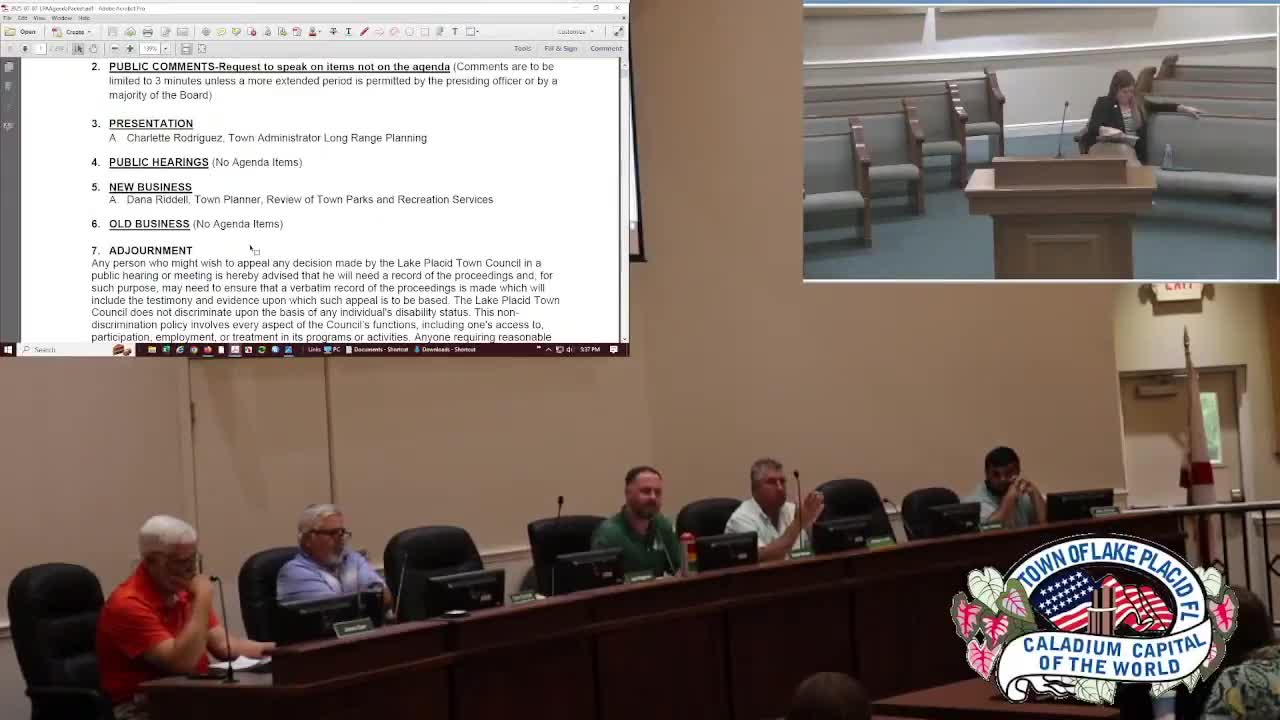
Summary
Town Administrator Rodriguez opened the July 7 meeting of the Lake Placid Local Planning Agency by thanking members for their work and asking the board to consider the town’s long‑term identity as planning and development interest increases.
Town Administrator Rodriguez opened the July 7 meeting of the Lake Placid Local Planning Agency by thanking members for their work and asking the board to consider the town’s long‑term identity as planning and development interest increases.
Town planner Dana Riddell then led a detailed presentation on parks and recreation, the town’s recreational facilities inventory and how the Lake Placid Regional Plan Overlay (LPRP), the town’s comprehensive plan and the county parks master plan interact. Riddell said the town currently exceeds the commonly used service standard of 10 acres of parks per 1,000 residents, reporting 44.87 acres on her inventory versus a required 23.6 acres for the town’s population of about 2,360.
Riddell said the meeting’s purpose was to prepare the local planning agency for an upcoming evaluation and appraisal report (EAR) process run by the Central Florida Regional Planning Council and for interlocal service boundary agreement (ISBA) conversations with Highlands County. She warned there are inconsistencies between county and town rules that affect how and where the town can require multi‑use paths, parks and related developer contributions.
Key issues raised included: - Level of service and developer obligations: Riddell described a tension in practice between the town’s stated 10‑acre per 1,000 population standard and how prior developments were conditioned. She said some recent developments provided on‑site neighborhood parks and a separate payment for community parks, while the town’s land development code applies park standards principally through the planned development (PD) process. - Fee‑in‑lieu practice and formula gaps: Riddell said the county engineer (Mr. Langford) has advised using a 110% “grant in aid” threshold — essentially 110% of estimated construction cost — when calculating a fee in lieu of constructing required facilities. Riddell noted the county lacks a consistent formula for park fee calculations and that the town’s land development regulations do not currently contain a standard formula. - Code coverage and implementation gaps: Riddell said the chart specifying neighborhood park acreage rates appears only in the PD section (citing “section 154‑27.1”) so projects that do not go through PD are not held to the same standards. She described this as a weakness that can allow different outcomes depending on a project’s regulatory path. - Multi‑use paths and jurisdictional limits: The presentation highlighted that the comprehensive plan refers to multi‑use paths along collector and arterial roads, but the town’s land development regulations reference only collector roads. Riddell noted the town does not maintain collector roads (they are county‑maintained) and that arterial roads such as US 27 are under FDOT jurisdiction, limiting the town’s ability to unilaterally require paths in some locations. - Accessibility and inclusivity: Riddell and others urged adding accessibility and universal‑design language into future updates. Riddell read policy 3.2 from the comprehensive plan, which states the town “shall adopt design criteria to ensure that parks, open spaces, and recreational facilities are accessible for the elderly, the handicapped, and others with special mobility needs.”
Several board members and members of the public pressed for concrete next steps. Board chair Dustin Woods and planners discussed the idea of adopting the Highlands County Parks and Recreation Master Plan by reference to improve coordination and grant eligibility. Riddell suggested the town pursue a grant to fund the EAR work and a rewrite of the land development regulations to fix implementation problems rather than attempting a unilateral rewrite by staff.
Public commenters and council members voiced impatience with the pace of past projects. Resident Pam Fentress said a multi‑use path project has been discussed for more than 25 years and warned that setting unrealistically high standards (for example, a 5‑acre community park requirement per 1,000 residents) could prevent development: “Low density will not be able to afford all these recreations, these paths, these amenities.” Councilwoman Hayes and others said utilities and allowable density are key levers to encourage development and should be considered alongside PD rules.
Board discussion identified four recurring policy areas to examine in greater depth: utilities and connection policy; allowable residential density; the role and triggers for the planned‑development (PD) requirement in the LPRP; and parks/trails funding and implementation tools. Multiple members asked staff to bring a future agenda item that explains the PD process, the code triggers that require a PD, and scenarios showing when a typical local business or property owner would need to pursue PD review.
Riddell said the Central Florida Regional Planning Council will perform a formal EAR analysis for the county first and then for the town; she urged board members to join stakeholder calls and said staff can distribute calendar invites for those meetings. Riddell recommended the board consider adopting the county parks master plan by reference and requested direction on whether the town should require a formula for fee‑in‑lieu contributions.
Votes at a glance: the agency approved the meeting agenda at the start of the session and later approved a motion to adjourn. (Individual roll‑call tallies were not fully specified in the transcript.)
The board did not make any binding changes to the comprehensive plan or land development code at the meeting. Staff said formal changes will await the EAR process and any grant‑funded analyses; the agency asked staff to return with focused presentations explaining the PD process and suggested remedies for streamlining development while preserving town character.
Looking ahead, staff and the board flagged grant funding and the EAR timeline as the immediate next milestones and suggested the board review the Highlands County Parks and Recreation Master Plan and the town’s trails and paths documents before the next meeting.