
Consultant presents draft maps showing three Asian-majority and one Latino-majority district; public urged to submit maps
Get AI-powered insights, summaries, and transcripts
Subscribe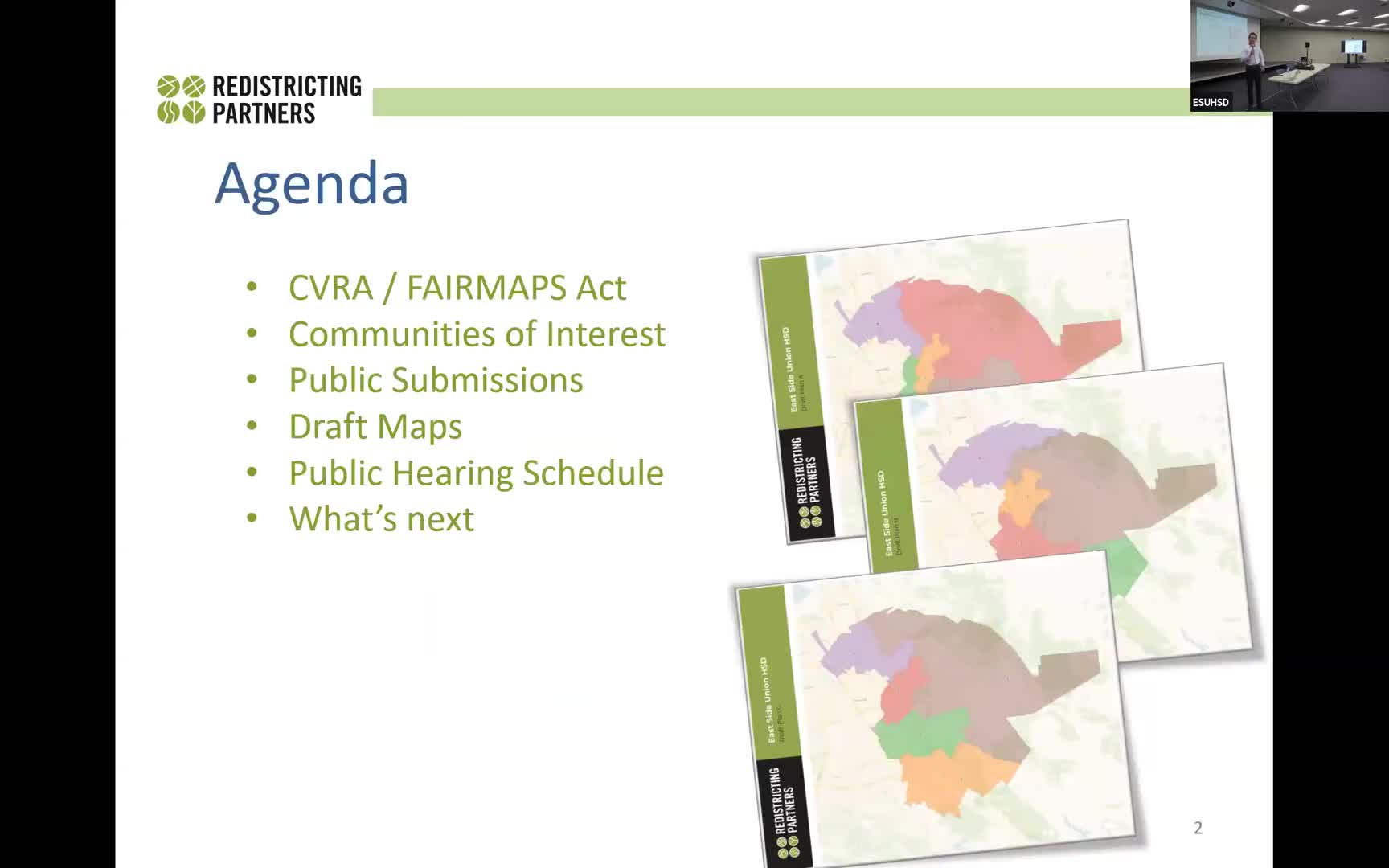
Summary
Paul Mitchell, owner of Redistricting Partners, presented three draft maps to the East Side Union High School District and urged residents to submit maps using the districting tool, saying the California Voting Rights Act focuses on converting at-large elections where racially polarized voting is shown.
Paul Mitchell, owner of Redistricting Partners and the districting consultant for the East Side Union High School District, walked residents through the districting process and the mapping tool and presented three draft maps drawn from public submissions. “The California Voting Rights Act … is really narrowly tailored to one thing, and that is agencies that are in at-large elections,” Mitchell said, describing legal criteria such as equal population, contiguity, compactness and communities of interest.
The consultant said the district’s total population is about 46% Asian and 35% Latino on the decennial census, while the citizen voting-age population (CVAP) is roughly 47% Asian and 29% Latino. “The ideal population of each district is around 107,000,” Mitchell told the room, and he explained that all three draft maps (A, B and C) came from public map submissions and were adjusted for census block assignment and population balance.
Why it matters: The California Voting Rights Act (CVRA) can require agencies using at-large elections to switch to geographic districts when there is racially polarized voting. District lines determine which voters choose each trustee and can affect who can viably run and win in local contests.
Mitchell showed heat maps of ethnic and language concentrations and explained his use of language and ACS data to locate Vietnamese, Chinese (Mandarin/Cantonese) and Filipino (Tagalog) population centers. He said the draft maps each include a Latino majority-minority district in the central/southern core and multiple majority-minority Asian districts (with northern Chinese-Filipino concentrations and mid-southern Vietnamese concentrations). Mitchell cautioned that line drawing must avoid illegally “packing” or “cracking” protected groups and that race cannot be the predominant criterion for drawing districts.
Members of the public and board members asked how the districting tool treats communities of interest beyond race. Mitchell said the Districtr tool allows overlays for attendance areas, ethnic CVAP, and basic socioeconomic proxies (renter-occupied housing, median income) and that additional socioeconomic maps could be shown for reference. He encouraged residents to draw maps in the tool, noting, “you can just move things around and when you click save, you now get to name your map and save it as a new map.”
Teacher and long-time educator Medipanahir told the board that representation must reflect lived experience and remove barriers so working parents and current teachers can serve. “Representation isn’t about filling a seat. It’s about giving voice to the people who know what it means to stretch a paycheck,” Medipanahir said, urging policies to enable broader participation.
Trustee Manuel Herrera, a member of the East Side Union High School District board, said he is “a severe skeptic of the so called evidence of racially polarized voting in this district” but said he supports the districting process because it can increase accessibility for candidates. Herrera described the current board’s demographic mix and said he values the incumbents’ ties to the district, while acknowledging the process is proceeding under the CVRA claim.
Several audience members asked whether the area could be drawn to produce two Latino majority districts; Mitchell and other speakers explained the legal trade-offs of packing and cracking and that the spatial concentration of Latino CVAP may make creating a second majority-minority Latino district impracticable under the federal and state standards. Mitchell said the board will consider public maps and could have a live line-drawing session at a later hearing; any final plan must be published and unchanged for seven days before adoption and the full districting process requires five hearings.
Next steps: The consultant encouraged residents to submit maps using the Districtr tool and said the next formal hearings will refine public submissions into a proposed plan for the board to consider. No formal action or vote on a final map occurred at this meeting.