
Council sends $2.5M paving appropriation to finance committee amid calls for a comprehensive road plan
Get AI-powered insights, summaries, and transcripts
Subscribe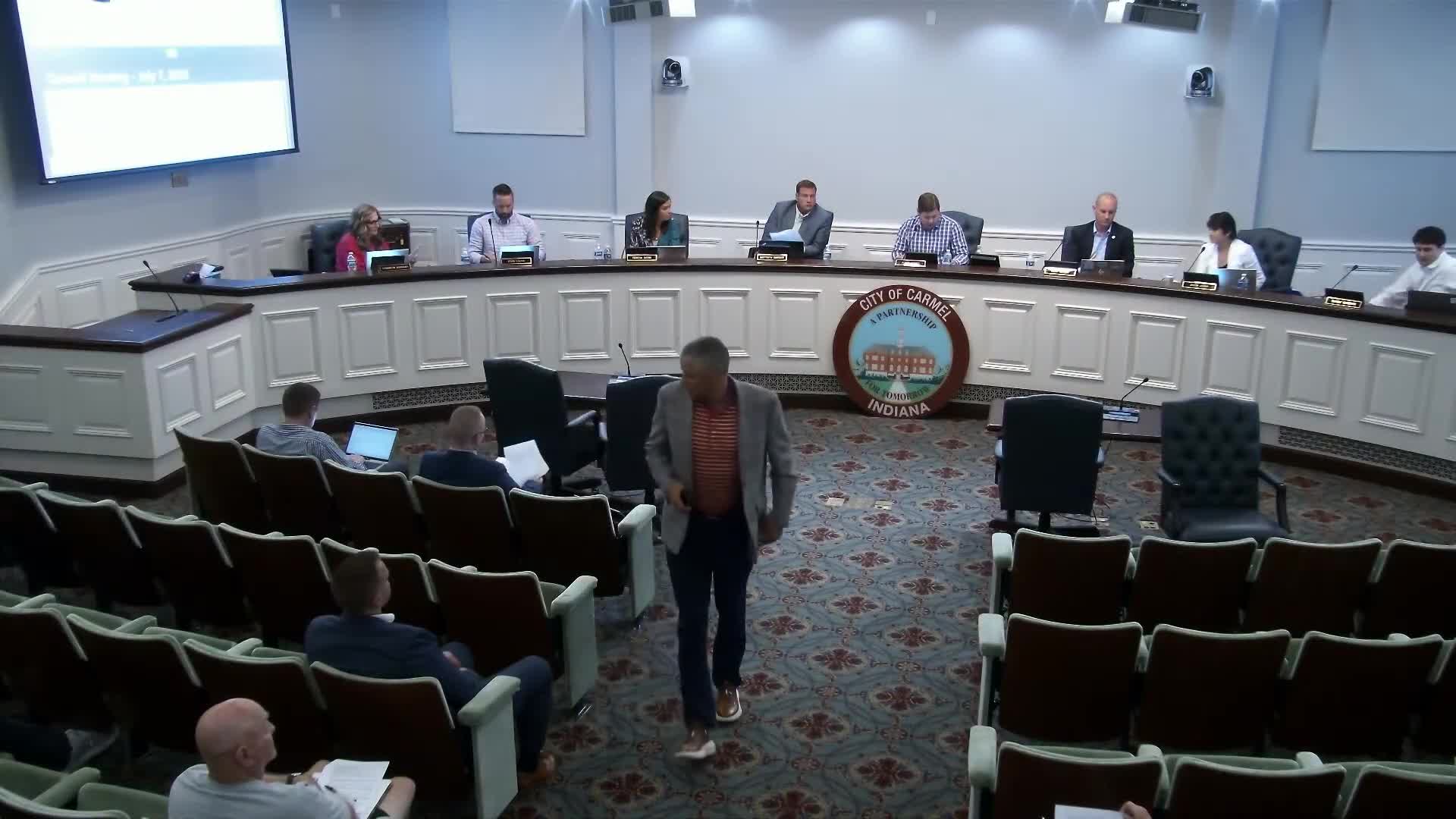
Summary
Council opened a public hearing on a proposed $2,526,702 appropriation for street repaving and moved the item to the finance committee after lengthy debate on maintenance strategy, staffing and whether to draw on other city reserves or bond proceeds.
The Carmel Common Council on July 7 introduced an ordinance to appropriate $2,526,702 from the general fund for street repaving and opened a public hearing, then sent the proposal to the finance committee for further study after extended debate about long-term road funding and maintenance strategy.
City staff explained the appropriation would be part of a larger paving program and that the bid package already awarded would allow the city to reach roughly $8.5 million of paving this year if additional funds were secured. Staff said the city closed the previous fiscal year with larger-than-expected reversions and that the requested $2.5 million was the remaining portion of a previously discussed $3.6 million.
Councilor Tom Snyder urged a broader approach, urging the council to fund a capital asset management plan and to coordinate road repaving with stormwater and other underground repairs rather than continuing piecemeal overlays. “If we were to take just the roads that are rated poor and mill and overlay just those, that is $23,000,000,” Snyder said, arguing the city’s historic $5 million annual paving practice was no longer adequate.
Engineering and street staff told the council they had awarded $6.9 million in contractor work and could expand scope to about $8.5 million if the council provided additional funding; staff said timing mattered because construction season is underway. Brad Pease, director of engineering, said landscaping and site finishing on recent roundabout art and other projects remained in follow-up work and that some concrete repairs had to be coordinated with upcoming construction.
Councilors pressed staff on capacity, inspection and prioritization. One staff member said the city currently has about 69 street-department employees and noted a 2023 consultant study that estimated a city with Carmel’s responsibilities could need 107–180 street staff depending on service levels.
After an extensive public discussion and technical briefing from staff, the council voted to send the appropriation ordinance and related questions to the finance committee for further analysis of long-term capital funding, while Land Use would review specific road and corridor needs. The council did not appropriate the $2.5 million at the July 7 meeting.
Councilors asked staff to return with clearer options for sustainable annual funding levels (one staff projection estimated a 10-year target near $9.5 million per year to sustain a 70 PCI score), the feasibility of using bond proceeds for long-lived reconstruction (not short overlays), and the capacity to complete larger contracts this construction season.