Get Full Government Meeting Transcripts, Videos, & Alerts Forever!
Get email alerts on the Udc Rewrite Work Session topic
No spam. Unsubscribe anytime.
Bozeman Commission narrows priorities for Unified Development Code rewrite; staff to return June 24 with mass-and-scale recommendations
Summary
Bozeman commissioners on June 3 narrowed near-term priorities for the Unified Development Code rewrite, asking staff to return June 24 with detailed recommendations on building mass and scale and to research watershed, tree and natural-resource proposals for later code changes.
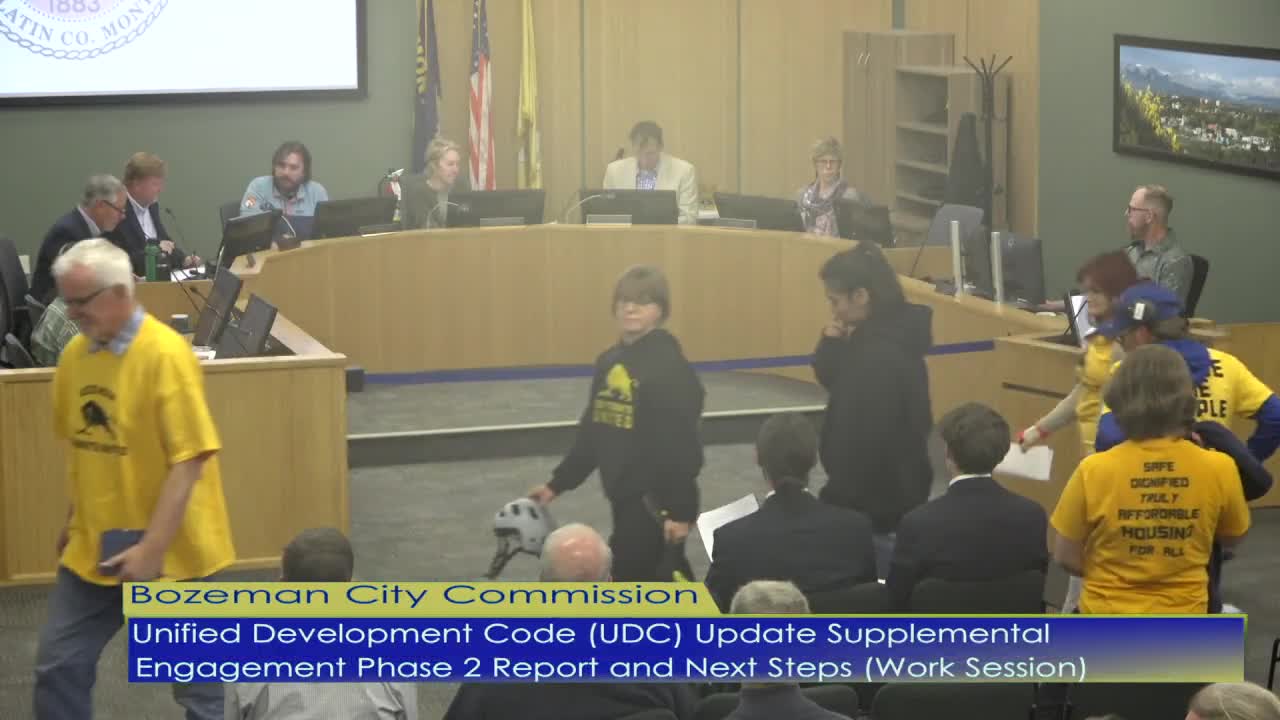
Bozeman commissioners used a June 3 work session to give staff prioritized direction on the city’s long-running Unified Development Code (UDC) rewrite. Staff said they will return for a focused work session on June 24 and then pursue additional sessions on zoning districts, environmental protections and transportation-related items.
Deputy Mayor Morrison opened the discussion by asking commissioners which of five broad topic areas should be carved into near-term work sessions. Commissioners directed staff to bring a detailed presentation on “bulk, mass and scale” — including floor-area-ratio (FAR), lot coverage, height, stepbacks and zone-edge transitions — at the June 24 meeting, and to include the parcel-assembly question (whether to discourage large consolidated assemblages that create out-of-scale buildings) as part of that same conversation.
Commissioners wanted clarity on zoning districts and allowed uses in a separate session, including whether certain residential districts should allow small-scale commercial uses, how many dwelling units should be permitted in historic residential districts, and how nonconforming buildings would be treated if zoning changes are implemented. Staff signaled it can present proposed district rules, show where nonconforming buildings would result, and then incorporate any city-initiated zone-map amendments after the commission finalizes zoning text.
On environment and natural resources, commissioners asked staff to review specific written recommendations from the Gallatin Watershed Council and the Open Channels Working Group and to identify “code cleanup” opportunities and any visionary language that could raise legal or implementation issues. Commissioner Bode asked staff to assess the parts of those memos that suggest aligning local code with Montana law on ditch and water-course alterations and whether requiring ditch-owner consent could be misused; staff said they would research legal constraints and practical verification processes.
Commissioners also asked staff to examine suggested edits from the Bozeman Tree Coalition for boulevard-tree protections and to report which edits are legally and administratively feasible. Several commissioners favored handling broader private-property tree protections through the city’s Urban Forestry Management Plan update this summer and then translating parts of that plan into code in a later step to avoid rushed rulemaking.
The commission asked staff to analyze options for requiring an ecological or natural-resource inventory at development milestones (annexation, site plan, subdivision), including who would prepare such inventories (applicant, city staff, or contracted specialists), likely cost impacts and thresholds for triggering the requirement (e.g., parcel size or project type). Staff noted that wetlands-related inventories are already part of an ongoing wetlands project and that annexation law constrains what can be required at annexation versus development permit stages.
On transportation and parking, commissioners asked staff to summarize how recent Montana legislation affects local parking flexibility, and to describe existing car-share parking reductions and possible expansions, bike-parking incentives and covered bicycle parking to encourage year-round cycling. Several commissioners supported exploring architect recommendations to reduce parking ratios, offer vehicle-parking offsets for bike parking, and enable car-share credits.
Other topics commissioners asked staff to prepare for future sessions included: accessory dwelling unit (ADU) rules (size and permitting), potential changes to occupancy/group-living rules, options to encourage missing-middle housing (triplexes/fourplexes and cottage developments), small-scale commercial in residential districts, the PDZ (planned-development) process, solar access and community-solar implications tied to state law (SB 188), and whether a temporary moratorium on very large new buildings is warranted while new tools are developed.
Staff summarized next steps: return June 24 with a bulk/mass/scale presentation (FAR, stepbacks, zone-edge transitions and parcel-assembly implications); research the Watershed and Open Channels memos for code cleanup opportunities; review Bozeman Tree Coalition boulevard-tree edits and report feasibility; provide options and cost estimates for natural-resource inventories and thresholds; and prepare a briefing on how new state laws affect parking and height rules. Staff also listed potential additional work-session dates and flagged that some related projects (wetlands ordinance, Urban Forestry Management Plan, landmark program) are proceeding on their own timelines and could feed into the UDC process.
Why it matters: The UDC will determine allowable form, density and uses across Bozeman as the city grows. Commissioners’ choices on FAR, height, nonconforming uses, tree protections and environmental inventories will affect housing supply, neighborhood character and development costs. Staff cautioned that changes that regulate private-property trees or other new regulatory burdens may require legal review, staffing or budget adjustments before code amendments can be implemented.