Get Full Government Meeting Transcripts, Videos, & Alerts Forever!
Get email alerts on the Unified Development Code topic
No spam. Unsubscribe anytime.
Bozeman begins second phase of UDC engagement; commissioners weigh process for neighborhood rezoning requests
Summary
City staff reported months of supplemental engagement on a proposed Unified Development Code update and asked commissioners whether neighborhood rezoning requests should be decided as part of the UDC process or as separate zone map amendments. Public commenters emphasized housing, creek protections, trees and neighborhood character.
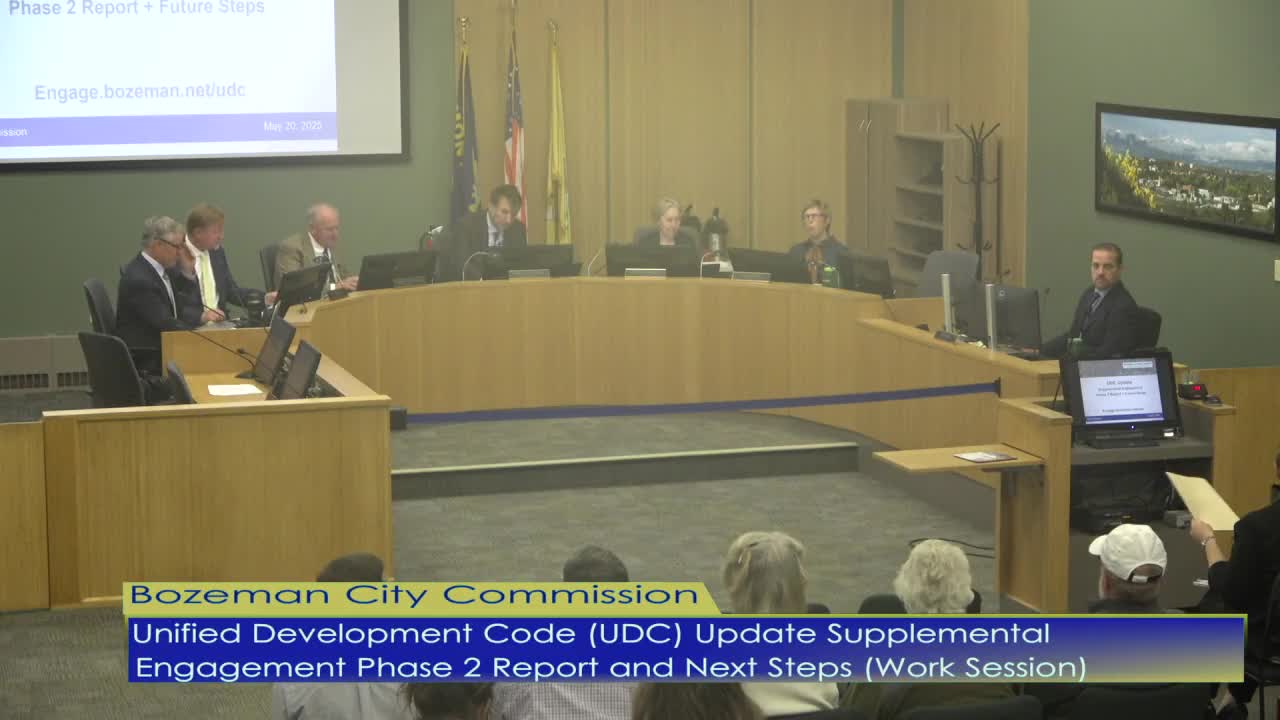
City of Bozeman staff on May 20 summarized the second phase of public engagement for a proposed Unified Development Code (UDC) revision and asked the City Commission to direct how to proceed with a set of requested zone map changes and which topics should be prioritized at an upcoming June 24 work session.
Erin George, director of community development, told commissioners the supplemental engagement effort ran from November through spring and included workshops, webinars, a survey and a "host your own" chat option. "No decisions are going to be made tonight and we're not writing code tonight," she said, framing the meeting as a progress report and an opportunity for direction.
Staff presented engagement statistics: roughly 491 participants at six workshops, about 230 online survey responses and close to 700 written comments received across the update project. Chris Saunders, a senior planner, summarized recurring themes including building mass and scale, zone edge transitions, parking, housing and environmental protections. He also noted statutory changes from the Montana Legislature and the new Montana Land Use Planning Act that affect local code content and procedures.
Key scheduling and procedural notes from staff: (1) the city must be compliant with the Montana Land Use Planning Act by May 17, 2026; (2) the growth policy must be reviewed in 2025 and any required changes adopted before the final UDC; and (3) staff proposed a timetable that would allow commission direction, additional drafting and later public hearings on the consolidated UDC.
A specific procedural question staff asked the commission to answer was whether recent public requests to change zoning on multiple parcels (ranging from small lots to larger areas) should be considered within the UDC update or processed as separate zone map amendment (ZMA) applications. Saunders explained the requests total approximately 152 acres citywide (about 0.7% of the city) and that two formal ZMAs had already been filed by applicants who did not wish to wait.
Public commenters and advisory‑board representatives urged a range of priorities. Several neighborhood groups (Centennial Park, Bon Ton and others) asked that their locally led rezoning proposals — recommended downsizing from R4 to RA in parts of those neighborhoods — be considered as part of the UDC update rather than deferred to separate ZMAs. "Please make the change to RA within the UDC for the Centennial Park neighborhood," said Christopher Spojis, a Centennial Park resident. Bon Ton neighbors and local historians highlighted the area’s historic homes, the neighborhood’s narrow streets and mature tree canopy and said RA would better preserve historic character.
Environmental groups asked staff to treat water resources and riparian functions as a cross‑cutting topic throughout the UDC. Lily McLean of Gallatin Watershed Council urged that "water resources explicitly be included on an advisory board’s or staff’s agenda for the remainder of the UDC process," noting that setbacks, wetlands and stormwater sit beyond Article 6 and need consistent treatment across the code.
Housing advocates and students urged more permissive rules for middle housing and conversions near Montana State University to increase housing supply and walkability. Forward Montana and others emphasized zoning changes that would allow smaller multi‑unit buildings and conversions of existing homes as a way to increase supply without pushing development to the urban fringe.
Several commissioners praised the breadth of outreach and said the commission should proceed deliberately. Commissioner Majid (Boddie) said that while he lamented not having a completed downtown creek plan to guide decisions, he found the current proposal an improvement over the existing parking lot but had concerns about encroaching on the 35‑foot setback. Commissioner Bodie supported continued engagement and suggested returning with graphics and examples to compare how measures such as floor‑area ratio, lot coverage and height would affect building mass and scale.
Staff sought three main directions: (1) should staff include neighborhood scale zone change requests within the UDC revision or require individual ZMA applications? (2) which specific topics should staff return to commission with detailed options at the June 24 work session (suggested topics included zone edge transitions, mass/scale metrics and the housing support options required by state law)? and (3) how should the UDC update be coordinated with concurrent initiatives (wetland code rewrite, integrated water resources plan, transportation master plan and the growth policy update)?
Commissioners set a follow‑up meeting on June 3 to continue the discussion and indicated they would provide staff with more detailed direction ahead of a June 24 work session. Staff also agreed to provide a concise matrix showing the submitted zoning change requests (size, whether they are single‑lot or multi‑lot, and whether they are formal ZMAs) to help the commission decide which requests to bundle into the UDC and which to process separately.