
Commission hears detailed renovation plan for former Haymarket building; state tax-credit letter requested
Get AI-powered insights, summaries, and transcripts
Subscribe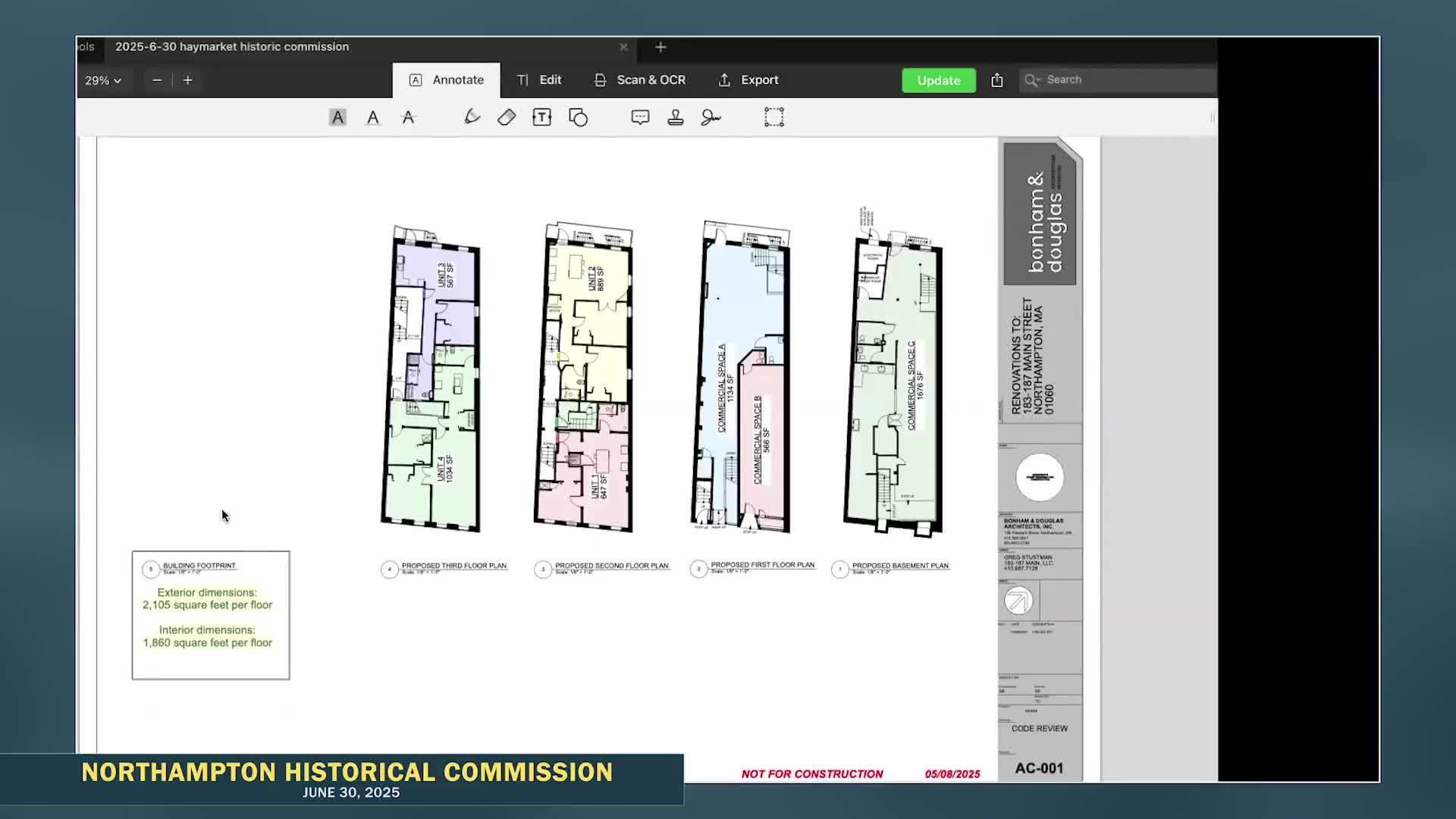
Summary
Architects and preservation consultants described a proposed historic rehabilitation of a downtown multiuse building that would add sprinklers, new windows, a rear accessibility ramp and tenant apartments; commission agreed to provide a letter of support for the state historic tax credit application by the August 30 deadline.
An architect presented detailed drawings and a preservation plan for the former Haymarket building in downtown Northampton during the Historical Commission meeting, describing proposals for apartments on the second and third floors, a restaurant/retail tenancy on the first floor and rehabilitation work designed to meet National Park Service standards.
The plan calls for sprinklers throughout the building, two new tenant apartments per upper floor, new wood–metal-clad windows on the front façade, a new exterior door to a mechanical room at the rear, and an accessible ramp into the rear basement entry. The presenter said the rear mechanical room will contain the building’s electrical service so an exterior door was needed “so we don't want someone to have to go down through the restaurant space to get into the mechanical room to serve it to, you know, flip a breaker or something like that.”
Why it matters: the project team is pursuing state and federal historic tax credits tied to adherence to National Park Service rehabilitation standards. Those credits significantly affect the project’s financing and which restoration choices are feasible, and the commission agreed to draft a letter of support for the state application deadline.
The presentation described interior work that the Park Service will primarily regulate on the second and third floors because the basement and first floor have been heavily altered over time. The team plans to retain and refurbish original casings, transoms and many doors and floors; where features are not salvageable they would be duplicated to match. The project proposes new mini‑split condensing units on the roof placed far enough back so they are not visible from street level.
Commissioners pressed the project team on accessibility and on how budget choices could affect preservation decisions. The presenter said the team is “sort of up in the air about the handicap accessibility requirements waiting on the amount of money that will be spent that will trigger handicap accessibility or not,” and staff clarified that apartments are not required to provide vertical access (an elevator) under the applicable building-code provisions for rental units in this structure. Commissioners asked whether a ramp could be achieved at the rear entry while preserving a brownstone lintel; the design team showed a ramp and an automatic door opener with handrails and indicated work around the mantle and masonry would be needed.
Historic‑tax-credit finance: the meeting included a discussion of tax credit percentages and eligibility. One preservation consultant explained the typical split: “For the state application, it's up to 20% of your qualifying expenditures. And for the federal, it is 20% of your qualifying expenditures,” a combination frequently used to make rehabilitation work financially viable. The consultant also said, in reference to project restrictions, that rental status is a condition of some credits: the property “has to be rental property” and that rental requirement applies for at least a defined period (discussed in the meeting as five years).
On approvals and next steps, the project team said they are in mid‑process with National Park Service reviewers and state reviewers and have responded to comments; they expect to follow required rehabilitation standards and to secure tax‑credit approvals. The team asked the commission for a letter of support for the state historic tax credit application (deadline August 30). Commissioners said they were supportive and requested a draft letter they could review at the July meeting.
The presentation also covered material choices and masonry work: the team said they will take mortar samples from the rear to laboratory test for lime content and sand so repointing can be color‑matched, and that cleaning of the front brick will follow Park Service guidance (gentle cleaning with soap and water rather than acids or pressure washing).
The commission did not take a formal vote at the meeting; members signaled general support and asked staff to circulate a draft letter for their review in advance of the next meeting.