Get Full Government Meeting Transcripts, Videos, & Alerts Forever!
Get email alerts on the Compensation And Pay Study topic
No spam. Unsubscribe anytime.
Aransas County hears Evergreen Solutions pay-study options; commissioners weigh phased increases
Summary
Evergreen Solutions presented options to address Aransas County pay compression and market lag, showing the county’s salaries sit below peers and offering three slotting options and a three-year phased approach for budget planning.
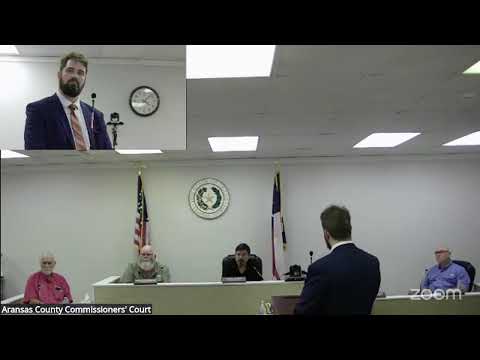
Project manager Mark Holcomb of Evergreen Solutions presented Aransas County Commissioners Court with the firm’s findings and three implementation options after a countywide compensation study, saying the county’s pay structure is market‑responsive but currently below peer averages.
Holcomb summarized the study’s goals and methods, saying the review examined internal equity (how positions relate within county job families) and external equity (comparisons with other local governments). “These are not … final recommendations,” Holcomb said. “We certainly have the ability to adjust these per your feedback and per what we hear from you today.”
The study sampled 80 benchmark positions and received usable market data from 14 peer organizations (nine counties and five cities). Holcomb said the county’s pay ranges are about 13% below market on average; when comparing actual incumbent pay the county’s employees were about 19% below peer take‑home pay. He also flagged that about 62% of county employees fall in the first quartile of their pay ranges, a distribution he said can increase turnover risk.
Holcomb recommended keeping the county’s existing step‑and‑grade structure (15 steps with 5% progression) but realigning pay grades to market benchmarks and then choosing how to slot employees into the revised ranges. He described three slotting options:
- “Bring to minimum”: adjust pay ranges to market and place employees on the nearest step without additional individual increases — the least costly but one that can increase compression between tenured and new employees.
- “Same‑step approach”: move each employee to the same step number in the new grade (so a person on step 7 remains step 7 after ranges move) — more costly but preserves relative placement and gives employees the full market adjustment.
- “Class parity (tenure) step”: slot employees into steps based on time in the position (for example, five years in the role → step 5) — the most expensive option but the most corrective for internal compression.
To reduce immediate budget impact, Holcomb presented a three‑year phased plan that combines grade realignment with annual adjustments (including a 3% estimated COLA in the model). The draft three‑year model showed an initial year cost in the mid‑hundreds of thousands of dollars (Holcomb’s slides modeled roughly $749,000 for a same‑step first year under one scenario), followed by further increases in years two and three to reach competitive placement under the consultants’ assumptions.
Commissioners and staff questioned peer selection and local context. Holcomb said peers were chosen to reflect local governments in the region and adjusted for cost of living; he noted the sample averaged about eight usable matches per benchmark position. Commissioners urged sensitivity to Aransas County’s tax base constraints and driving‑distance competitors. “We recognize we still need to pay our employees, you know, a reasonable salary, but it certainly constrains what we can offer,” a commissioner said, noting the county lacks a large industrial tax base other peers have.
Staff follow‑up items included updating the benefits comparison to reflect benefit changes that take effect in October and re‑running any peer responses that did not reply to the consultant’s survey. Holcomb also recommended rechecking the market each year and using HR calls to neighboring counties before committing year‑two or year‑three steps if the market shifts.
No formal action to adopt any of the pay options was taken at the workshop. Commissioners directed staff to use the study as a starting point for budget planning; county budget staff said they will have more concrete revenue figures at an August workshop and that any compensation changes would be considered as part of the 2026 budget process.
Votes at a glance
- Motion to discuss Evergreen Solutions compensation study (agenda item 1): motion made and seconded; discussion held; no policy decision enacted (procedural approval to present and discuss).
- Motion to adjourn: moved and seconded; roll call vote — Michael Cheney: yes; Michael Kasterlein: yes; Commissioner Russo: yes; Commissioner Dupnik: yes; Judge Garza: yes. Motion approved and meeting adjourned.
Holcomb and county staff will supply updated benefit comparisons and can rework the pay‑model scenarios for a different market percentile or a shorter phased timeline if the commissioners request revisions during upcoming budget workshops.