
TDLR general counsel presents abbreviated open‑government training to auctioneer advisory board
Get AI-powered insights, summaries, and transcripts
Subscribe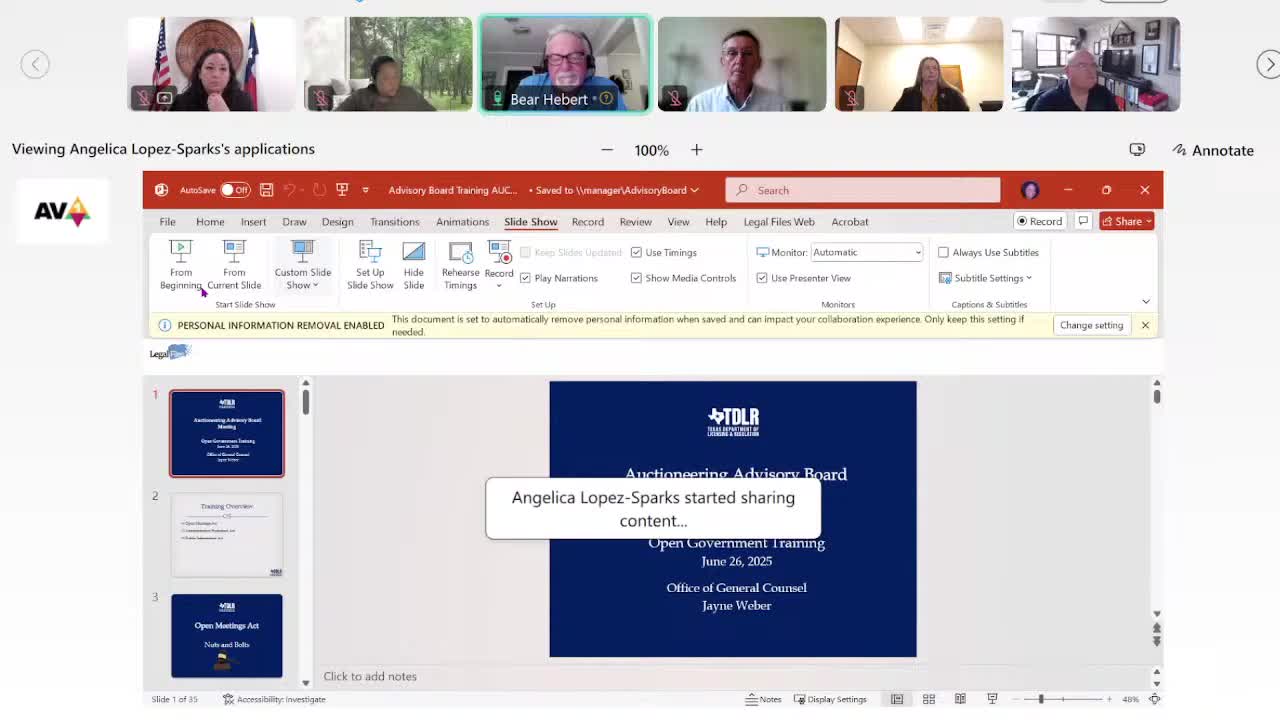
Summary
TDLR Assistant General Counsel Janie Weber gave an overview of open meetings, rulemaking and public‑information obligations — including notice requirements, walking‑quorum risks, and open‑records procedures — to the auctioneer advisory board.
Assistant General Counsel Janie Weber delivered a concise training on the Open Meetings Act, the Administrative Procedure Act (rulemaking) and the Public Information Act (open records) and explained common compliance pitfalls for advisory boards.
Weber explained that open meetings require public notice specifying time, place and subject and that the provisions "are to be liberally construed in favor of open government." She defined a quorum (a majority of members), explained that deliberation occurs when a quorum engages in discussion about public business, and warned members against creating a walking quorum through emails, texts, conference calls or social posts that effectively coalesce member views outside a noticed meeting.
On rulemaking, Weber described the Administrative Procedure Act’s purpose — to provide minimum uniform standards and public participation in rulemaking — and noted potential rule origins including legislative changes, advisory‑board input, agency staff, four‑year rule reviews and petitions from interested persons.
On open records, Weber summarized the Public Information Act’s presumption of disclosure, common exemptions (attorney‑client privilege, trade secrets, HIPAA), and the agency’s 10‑business‑day response window for open‑records requests. She advised that determinations about withholding typically involve the Texas Office of the Attorney General.
Why it matters: advisory‑board members who participate outside properly noticed meetings can create Open Meetings Act exposure for the agency and may trigger voidable actions or litigation; members should avoid substantive communications about official business outside noticed sessions.
Next steps: Weber pointed board members to agency resources and the general counsel’s office phone number for follow‑up legal questions; staff and members noted the slides would be provided in the meeting packet or emailed when technical problems occurred.