
Bowling Green council advances ballot measures, bonding plan to fund two fire stations and public safety equipment
Get AI-powered insights, summaries, and transcripts
Subscribe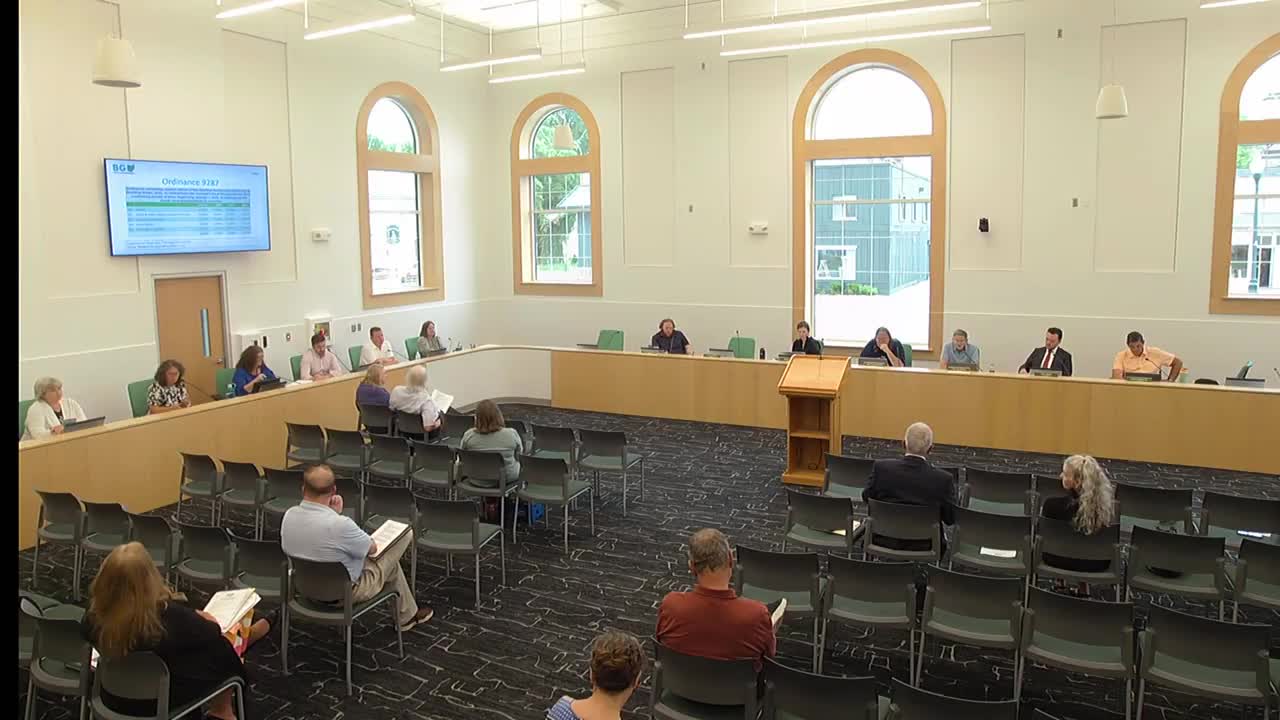
Summary
Councilors heard detailed briefings on a proposed 0.15% income tax ballot measure and related bond ordinances to pay for two new fire stations, a ladder truck and police-station renovations; officials said the measures would move to the November ballot if the council approves filing paperwork by the August deadline.
Bowling Green City Council members on the floor Monday reviewed a package of ordinances and a resolution that would put a 0.15% income-tax increase before voters to fund construction of two fire stations, purchase fire apparatus and support renovations to the police station.
The proposal includes a resolution to place the question on the November ballot and a set of bond ordinances that, if approved by voters, would authorize borrowing of up to $27,720,000 for fire-station work and up to $4,950,000 for a ladder truck and related fire apparatus. Municipal Administrator Miss Tredder told the council the administration recommends tabling certain bond ordinances until after the election and proceeding with some design work while the vote is pending.
Why it matters: City officials said the new tax and bond package is intended to create a dedicated funding stream for long-term capital costs in public safety, including two new fire stations and equipment; city leaders said those facilities are central to their plan for emergency-response capacity.
The ordinance package and timetable
Council heard the administration’s explanation of several items: Ordinance 9-2-86 (declarations of official intent for reimbursements under U.S. Treasury regulations), Ordinance 9-2-87 (redistribution of portions of the unvoted 1.5% income tax among capital funds), Ordinance 9-2-88 (placing an additional 0.15% income tax in the city code, contingent on voter approval), Resolution 3-885 (declaring the necessity of an election on the 0.15% levy), Ordinance 9-2-89 (authorizing up to $27,720,000 in bonds for fire stations and related site work), Ordinance 9-2-90 (authorizing up to $4,950,000 in bonds for a ladder truck and apparatus), and Ordinance 9-2-91 (authorizing contracting for design and construction services related to city fire facilities).
Municipal Administrator Miss Tredder explained the finance mechanics and said the administration recommends that the council pass some measures on second or third reading and table the actual bond ordinances until after the November vote so they can be taken off the table for immediate action if voters approve. "This allows us to include those engineering costs, for example, in the bond payment," Miss Tredder said when describing how the city may reimburse pre‑bond expenses.
Key fiscal details and contingencies
The administration presented an estimate that about $2,000,000 would be moved from the Water/Sewer Capital Improvement Fund (Fund 40-17) into the general capital improvement fund (40-18) and the street repair fund (40-29) during a multi-year phase beginning Jan. 1, 2026. Officials noted the water/sewer fund carries debt and that utilities would seek to recover about $1,500,000 of the transferred amount through an adjustment to utility rates.
Council President (unnamed in the transcript) framed the package’s stakes plainly: "This 0.15% is necessary if we're going to build two fire stations. And that if this is voted down by the voters in November, we will not be building two new fire stations." That statement was recorded during council discussion and framed subsequent procedural questions.
The proposed income-tax increase is written as a continuing levy in the city code but, per the administration, the bond payments for the fire stations would be structured over a 26-year repayment period. If voters approve the measure, staff would work with the county Board of Elections to meet the filing deadline (the administration cited an August 6 paperwork deadline).
Council discussion and next steps
Council members asked about contingency plans if the election margin required a recount or certification delay. Administration and legal staff advised options include tabling and later reintroducing the ordinance or, if timing allows, holding a special meeting. The administration also outlined that, should the ballot measure pass, design work for the fire stations and the next phase of police-station design would proceed in parallel; the city plans to use one new fire station as temporary space for police operations during the police-station renovation.
No final borrowing ordinances or the ballot resolution had an enacted outcome at the meeting; several items remain on second reading and the resolution to place the issue on the ballot was presented as part of the discussion. Council was asked to consider third readings on July 21 and to consider tabling bond ordinances until after the November election.