
Council reviews housing cooperation agreement for TOD Opportunity Center; no vote taken
Get AI-powered insights, summaries, and transcripts
Subscribe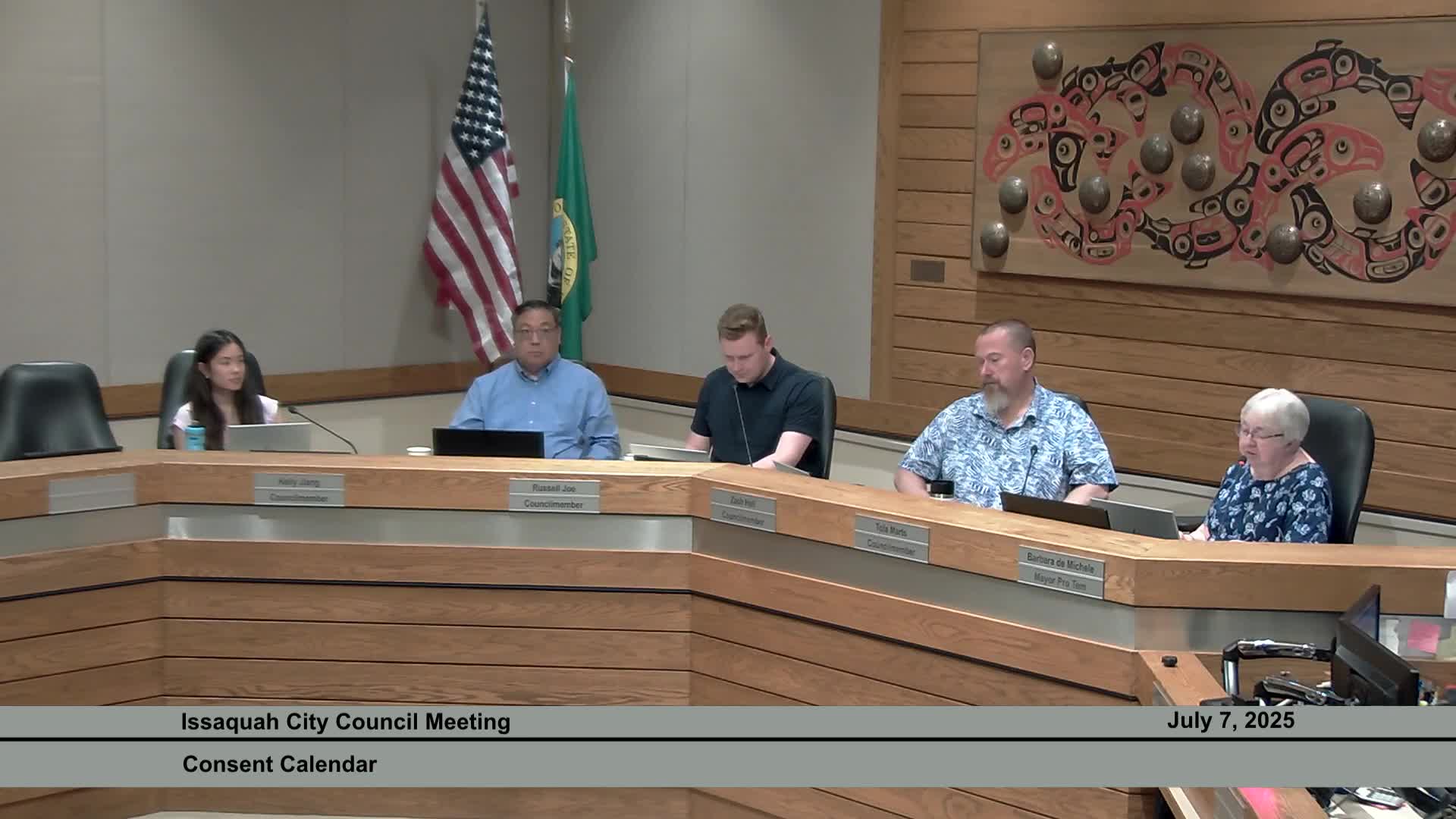
Summary
Issaquah City Council members reviewed proposed revisions to the Housing Cooperation Agreement for the Transit‑Oriented Development Opportunity Center at their July 7 meeting, considering waivers on tree retention, reduced transparency rules for facades facing natural areas, bike room glazing exceptions, and applying the fifth‑floor stepback exemption to the market‑rate building; no formal action was taken.
Issaquah City Council members reviewed proposed revisions to the Housing Cooperation Agreement (HCA) for the Transit-Oriented Development Opportunity Center (TOD OC) at their July 7 meeting, considering waivers and design changes intended to help the project move forward without formal action.
The administration presented a set of changes it is asking the council to endorse as part of the HCA, including: allowing both buildings on the site to forgo the code-required fifth-floor stepback so the affordable and market-rate buildings will match visually; waiving the requirement to retain 25% of tree caliper within the site’s developable area; reducing facade transparency requirements where buildings face natural areas (proposed minimums of about 20–30% instead of the existing 50%); and permitting indoor bike storage that has limited exterior glazing because of security and rack placement needs. Andrea Snyder, deputy city administrator, said the goal in negotiations has been to “maintain as many units of affordable housing within this project as possible,” and that those goals guided tradeoffs the administration was proposing.
Dan Landis, vice president of development for the King County Housing Authority (KCHA), introduced consultants who addressed design, sustainability, and feasibility questions. Carissa Iris, the project sustainability consultant, said the affordable building will follow the state’s Evergreen Sustainable Development Standard (ESDS) and explained why the team prefers ESDS over adding a second certification. “We remain with ESDS because it’s already state required. So we don’t have an option. We have to pursue that pathway,” Iris said.
Architect Maggie Carson and KCHA’s team told council members that requiring retail on the ground floor of the market‑rate building poses financing and design challenges in this location. Carson said retailers typically seek frontage with cross-traffic and clustered retail; “putting some sort of commercial use fronting on Newport ... wouldn’t have a lot of cross traffic necessarily,” she said, and the 15-foot minimum clear height the code requires for retail would consume residential floors above, reducing unit yield and harming the project’s financial feasibility.
Project staff and the developer team detailed tree, glazing, and mechanical issues that motivated the requested HCA additions. The design team said the site’s wetlands and adjoining Tibbets Park create “natural context” zones for the west and south facades; Issaquah’s land‑use code currently requires 50% transparency for facades that face natural context. The consultants explained that typical affordable multifamily projects in the region achieve about 20–25% glazing, and Washington’s energy code generally limits glazing in ways that make a 50% requirement difficult and costly. Maggie Carson said doubling glazing raises costs for higher-performance triple-pane windows, creates mechanical layout challenges for intake/exhaust locations, and can weaken structural shear walls where additional openings are required. The team proposed a 20% minimum for west facades and 30% for the south facade that faces the park while noting the market-rate building might voluntarily provide slightly more transparency.
On tree retention, Carson said the code’s 25% retention requirement applies only to trees in the site’s developable area (excluding wetlands and right-of-way). She said the current plan would remove 13 trees within the developable area but add 52 new trees elsewhere on the site, and preserve older trees in the wetland area to retain the site’s established canopy.
Public commenters addressed program priorities for the ground floor and overall housing needs. Chris Richley, chair of the Economic Vitality Commission and an Issaquah resident, told the council that while retail is needed in the area, this specific site “is not practical” for retail and that a daycare or childcare facility near transit would better serve families. Jim Hayes, a resident, urged more housing and said density that increases affordability would help keep multigenerational families in town.
Council members generally voiced support for the administration’s approach while flagging a need to review sections of Issaquah’s land‑use and building codes. Council member Hall and Council President Walsh emphasized that the 50% transparency figure and the relationship to the state energy code merit a broader code amendment process rather than ad hoc changes. Council members Martz, Cenk, Joe, and others expressed urgency to move the project forward and supported aligning the market-rate building’s design with the affordable building to improve feasibility. Several council members said they want a comprehensive, community-informed code update rather than piecemeal fixes; staff said planning committees will compile potential amendments and return them for deliberation.
No formal vote was taken on the HCA at the July 7 meeting; the item was presented for feedback only. Staff indicated the Administration expects to request a building permit next May, start construction thereafter, and place the buildings in service in early to mid‑2028 if the schedule holds. The council indicated the revised HCA would return on the July 21 agenda (consent or regular business) after the council’s further review and committee discussions.
Ending: The council’s discussion highlighted tradeoffs between code standards (tree retention, glazing and retail height requirements, and energy code constraints) and the project’s goal of maximizing affordable units. Staff will bring the HCA back with any changes the administration adopts after council feedback; a Safety Services & Parks Committee meeting on the Opportunity Center was also scheduled to provide more detailed review.