
Council approves several rezonings, rejects one mobile-home zoning change
Get AI-powered insights, summaries, and transcripts
Subscribe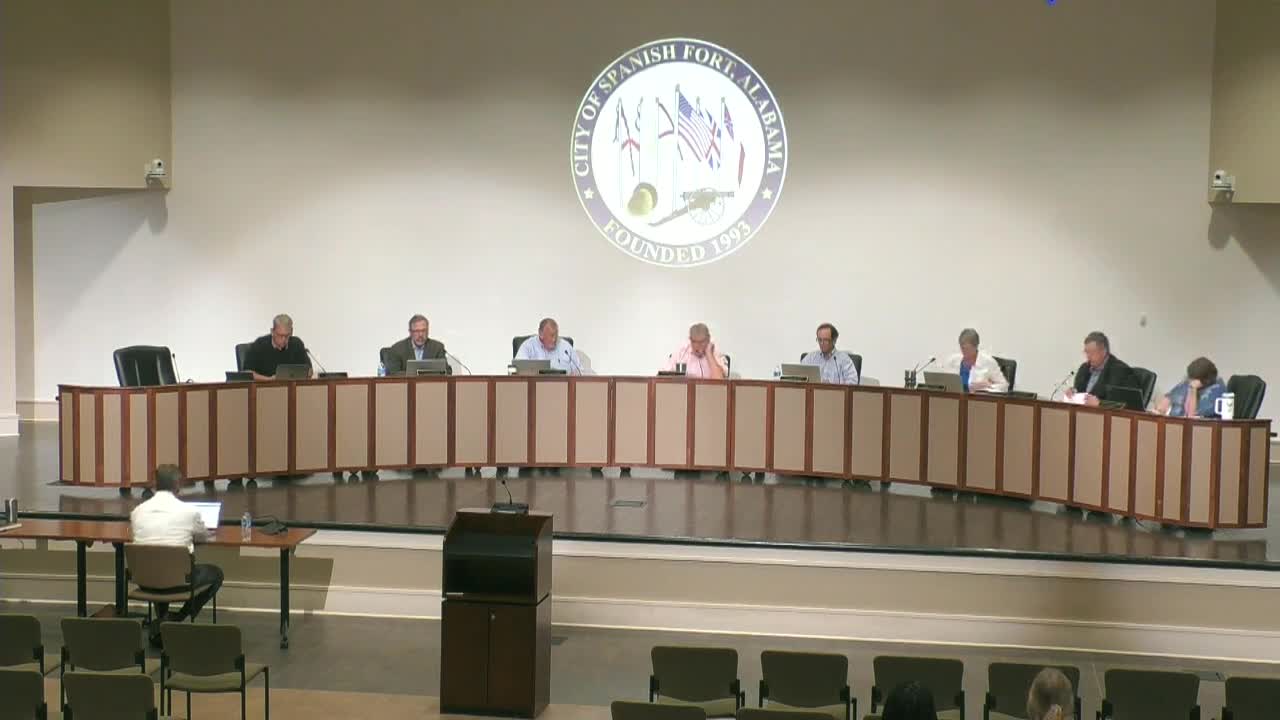
Summary
The Spanish Fort City Council approved multiple zoning ordinance amendments and one rezoning failed after a negative planning-commission recommendation and public comment opposing the change.
The Spanish Fort City Council considered and voted on several zoning matters, approving most requests and rejecting one rezoning petition after public comment and a negative planning-commission recommendation.
City staff member David Connor presented the ordinance amendments and rezoning requests. The council adopted an ordinance amending the zoning code to allow temporary construction-related uses on the causeway for the Tensaw River Bridge replacement project (ordinance 7092025). Connor said the planning commission had recommended the change.
The council also approved rezoning for a property at 30752 Amber Lane (R-1 to B-2) and a property at 10021 U.S. Highway 31 (R-1 to B-1) after public hearings and planning-commission recommendations.
One application — to rezone 30901 Spanish Oaks Drive West from R-2 to R-4 to allow placement of a manufactured/mobile home — received a negative recommendation from the planning commission. A nearby resident, Lorraine Sebastian, spoke in opposition. Council members asked how to record their intentions; after a motion to approve the ordinance, the roll-call vote recorded Smith — no; Gustafson — no; Perry — no; Wynne — no; Brabner — no, and the motion failed and the rezoning did not pass.
Another rezoning request for a parcel adjacent to U.S. Highway 31 (tax parcel described in the agenda) that the owner said could accommodate a convenience store was approved following a positive planning-commission recommendation.
Why this matters: zoning changes alter allowable land uses and can change neighborhood character, traffic and commercial development. Several of the approved rezonings were near commercial nodes and the Eastern Shore Center, which council members also discussed in a separate agenda item.
Council action: The council voted on each ordinance by roll call; votes were recorded on the official record. Where the planning commission recommended approval, the council generally followed that recommendation; where the commission recommended denial, the council denied the rezoning.
Next steps: Adopted ordinances become part of the city’s zoning code and will be reflected in the city’s planning maps and permitting process. The failed application remains at its existing zoning classification unless the applicant submits a new request.