Get Full Government Meeting Transcripts, Videos, & Alerts Forever!
Get email alerts on the Radio Encryption topic
No spam. Unsubscribe anytime.
Montgomery County police say full radio encryption is needed to protect privacy and officer safety
Summary
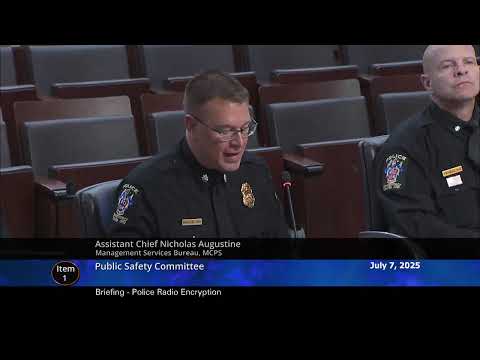
Montgomery County Police officials told the County Council Public Safety work session on July 7, 2025, that the department is completing full encryption of its radio system for dispatch and patrol channels to protect sensitive personal information and officer safety.
Montgomery County Police officials told the County Council Public Safety work session on July 7, 2025, that the department is completing full encryption of its radio system for dispatch and patrol channels to protect sensitive personal information and officer safety.
Department leaders said the measure is intended to reduce incidents such as swatting, blunt the spread of unverified information in real time and meet FBI Criminal Justice Information Services (CJIS) requirements for transmitting protected records. Chief Mark Yamada, chief of police, said the move toward encryption "has become a necessity for law enforcement, not just regionally, but nationally."
The decision follows a phased approach the department described at the meeting. Assistant Chief Nicholas Oggstein, chief of the Management Services Bureau, said Montgomery County Police has been able to encrypt tactical channels since 2016 and is now in a final phase to encrypt dispatch and vehicle radios. "Radio encryption is securing our transmissions via a key across the department and limiting the ability for public or outside users to listen to those transmissions," Oggstein said. He added that many law enforcement agencies in the National Capital Region and elsewhere have used encryption for years.
Officials outlined three reasons they gave the Council: safety of first responders, protection of individuals’ personally identifiable information transmitted over the air, and compliance with FBI/CJIS rules when CJIS information is shared with officers. Oggstein noted that dispatch transmissions can include dates of birth, names and other unverified details that, when public, can lead to identity exposure or reputational harm. Yamada and other speakers cited recent incidents in which real-time radio monitoring or automated apps were used to follow responses and escalate dangerous behavior.
Council staff and police discussed transparency and public access. County staff member Susan Farag told the committee that recorded transmissions will continue to be available through Maryland Public Information Act (MPIA) requests and that the department is expanding its public information capacity. "Our transmissions will still be recorded, and they will still be available through MPIA request," Oggstein said, and the department has advertised to increase decentralized public information officers to provide faster, official updates.
Officials said the encryption rollout will include municipalities that use the county radio system and that no additional equipment cost is expected because radios already have encryption capability. The department said vehicle encryption work is underway and that interoperability with neighboring jurisdictions has been addressed: "We identified a shortcoming, and we've now gotten that agency on board with the technology they need," Assistant Chief Darren Frank said.
Council members asked about legal claims invoked during the presentation. Farag and the county attorney clarified that HIPAA does not impose obligations on local police; encryption was described as a privacy and operational safety step rather than a HIPAA-driven legal compliance action. Legal counsel present confirmed CJIS access requires encryption for CJIS-protected transmissions.
The department summarized next steps as completing vehicle encryption, expanding PIO staffing, and monitoring MPIA demand for redaction work. Officials said recorded radio traffic will remain auditable and available through established public records procedures.
Supporters at the work session framed the change as aligning Montgomery County with regional practice and protecting victims, civilians and responders; those who raised concerns sought assurances about timely public information and equitable access to records via MPIA requests. Police said the combination of encryption with active PIO updates and MPIA access is intended to balance operational safety with transparency.