
Superintendent urges partnership, not independent charter, for proposed Museum School
Get AI-powered insights, summaries, and transcripts
Subscribe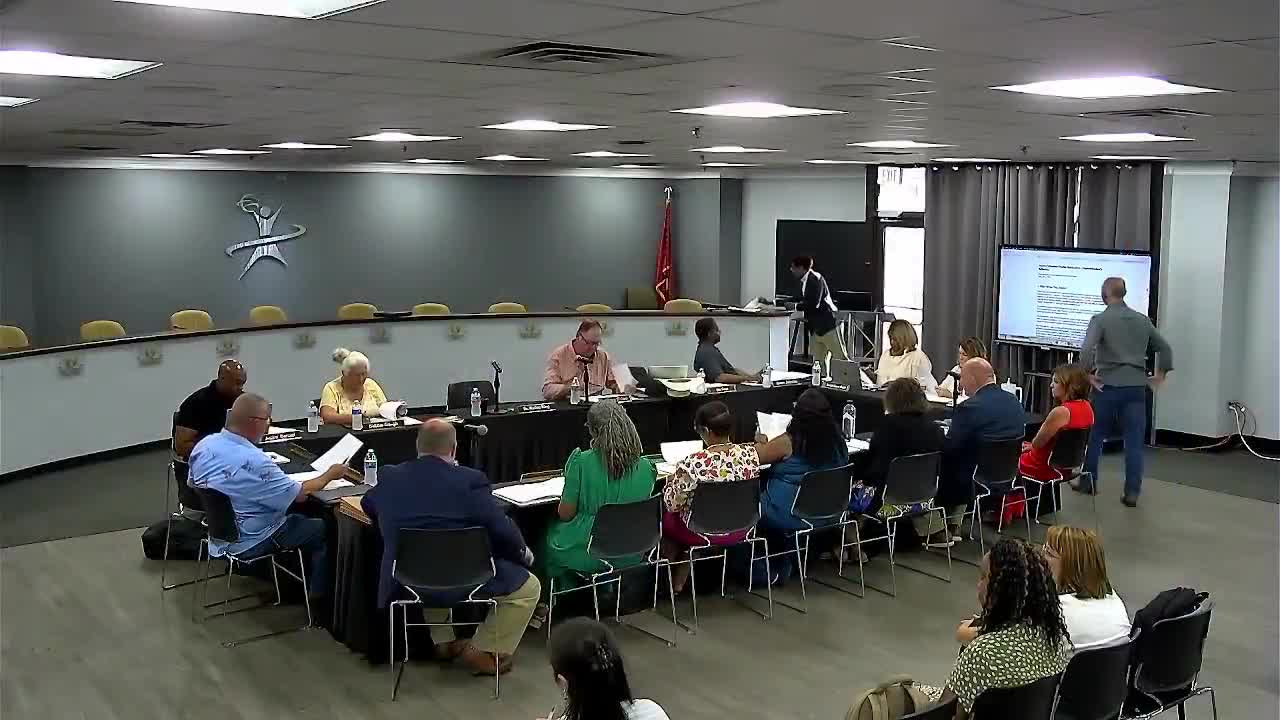
Summary
Jackson-Madison County School Superintendent Doctor King recommended the board not approve the Jackson Museum Schools application as an independent LEA, citing concerns about staffing, transportation, budgeting and special-education provisions and proposing a school-within-a-school partnership instead.
Doctor King, superintendent of Jackson-Madison County Schools, told the board he could not recommend approving the Jackson Museum Schools application as a stand‑alone local education agency and instead proposed a partnership model that would make the museum program a “school within a school.”
King said the amended charter application met many state evaluation criteria but left “significant areas of concern,” highlighting a flat $50,000 starting teacher salary in the application while Jackson‑Madison County has raised its starting salary to about $51,000, limited transportation plans, sparse benefit and technology allocations and budget assumptions that rely heavily on unsecured grant and federal funding. “Choice is powerful only when it’s the right choice,” King said.
The board’s academic review team, represented in the meeting by Doctor Williams, reported that most domains in the state rubric were met or exceeded but that academic‑plan, operations and financial sections still “partially met” standards. The review raised questions about the museum school’s proposed use of place‑based education, an intervention/enrichment rotation described as a 20‑minute rotation that reviewers said does not meet response‑to‑intervention requirements, and unclear plans for specialized services and staffing timelines (some positions not funded until years three to five).
King noted specific line items in the application — a $150 per‑student technology allowance and a teacher benefit figure listed as $500 — and said those amounts appear inconsistent with typical costs. He also flagged curriculum concerns after comparing the museum school’s literacy scope and sequence to the district’s adopted reading programs. The review team said the application sometimes assumes students will enter with emergent literacy skills and pointed to risks of teaching higher‑level decoding skills too early.
King recalled the board’s prior experience with charter approvals: the board denied Madison Classical Academy in 2023 and the State Charter Commission later overruled the district; that school voluntarily terminated its agreement on June 23, 2025. Citing that history and the application’s gaps, King recommended denying independent LEA status while offering district support: “What I can do is I would definitely work with [the museum] and figure out the best space that it can be in in our system,” he said, describing a pathway similar to the Star Academy partnership the district previously established.
Board members discussed oversight limits for stand‑alone charters and the risk that a state approval would make the state the LEA and remove district control. Several trustees said the district must protect students, transportation access and wraparound services (meals, support for homeless students) before endorsing a stand‑alone charter. Doctor Williams and review staff described fiscal assumptions in the application that appeared to rely on 100% of students qualifying for Title I or English‑learner funding — an approach the reviewers called unrealistic and likely to inflate revenue projections.
No final vote occurred during this discussion; Doctor King said the district will present a recommendation for the board vote at the upcoming meeting. He also stated that if the board denies independent LEA status, he and his team will engage with the museum applicants to pursue a school‑within‑a‑school arrangement, connect them with partners that funded Star Academy and explore incubator funds.
The board indicated the charter application will be on the agenda for the board’s Thursday meeting along with other items. The record shows extensive, specific staff concerns about budget realism, special‑education implementation, transportation and staffing plans that the board said must be resolved before it could support independent charter status.