Get Full Government Meeting Transcripts, Videos, & Alerts Forever!
Get email alerts on the Medicare Savings Program topic
No spam. Unsubscribe anytime.
Senior advocates press committee to expand Medicare Savings Program, raise MassHealth asset limits and stop improper QMB billing
Summary
Mass Senior Action and others urged the Joint Committee on Healthcare Financing to expand Medicare Savings Program eligibility, raise MassHealth asset limits for seniors, and create state enforcement against improper billing of Qualified Medicare Beneficiary (QMB) recipients.
Mass Senior Action members and beneficiaries told the Joint Committee on Healthcare Financing that recent expansions of the Medicare Savings Program (MSP) improved seniors' financial security but that remaining gaps—MassHealth—s low asset limits and improper billing of QMB beneficiaries—continue to harm low-income older adults.
Why it matters: Witnesses said MSP expansion reduced out-of-pocket costs for many beneficiaries, but MassHealth asset limits for long-term care (cited as $2,000 for individuals and $3,000 for couples) were last updated in 1989 and force some seniors to "spend down" savings or sign away life insurance to qualify for care.
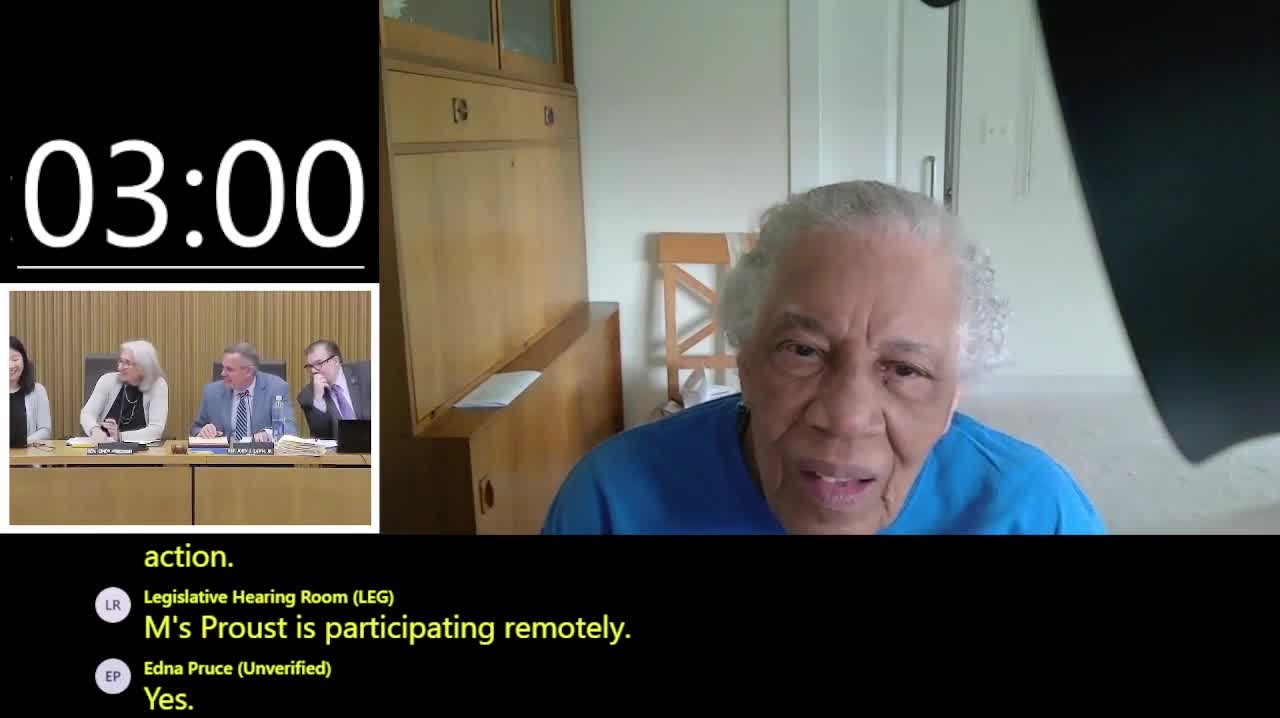
Edna Proust, president ex officio of Mass Senior Action, described her personal urgency—"I was 80 when I first testified before this committee, and I am now 92 years young"—and urged passage of House Bill 14 14 and Senate bills argued to slightly raise asset limits. She and others said life insurance is currently counted as liquid assets under MassHealth rules, they asked the legislature to disregard small life insurance policies from asset calculations, and to increase the asset threshold.
Panelists also asked the committee to add state-level enforcement for federal protections that prohibit providers from balance-billing QMB beneficiaries. George Teshew, a QMB beneficiary, described how QMB coverage "covers my $185 monthly Part B premium" and that, despite federal law barring balance billing, many beneficiaries still receive improper bills. He and others urged House Bill 14 15 and Senate Bill 883 to create a state penalty to deter improper billing and encourage provider system fixes.
Administrators and advocates noted the MSP expansion has enrolled tens of thousands of people: testimony said MSP enrollment grew from roughly 20,000 to more than 65,000, with more than 54,000 in the QMB program, and that this leverage of federal dollars helps stabilize seniors— access to prescriptions and other services. Witnesses asked the committee to consider expanding MSP eligibility to 300% of the federal poverty level to better protect older adults from a looming federal Medicaid funding debate.
Committee process: Committee chairs noted fiscal constraints and asked advocates for more detailed written fiscal estimates. No formal votes were taken. The committee will continue to accept written testimony through the posted deadlines.
Ending: Advocates framed their requests as incremental, low-cost changes to protect low-income seniors' dignity and prevent avoidable medical debt and hardship.