
South El Monte Planning Commission receives Brown Act and conflict-of-interest refresher
Get AI-powered insights, summaries, and transcripts
Subscribe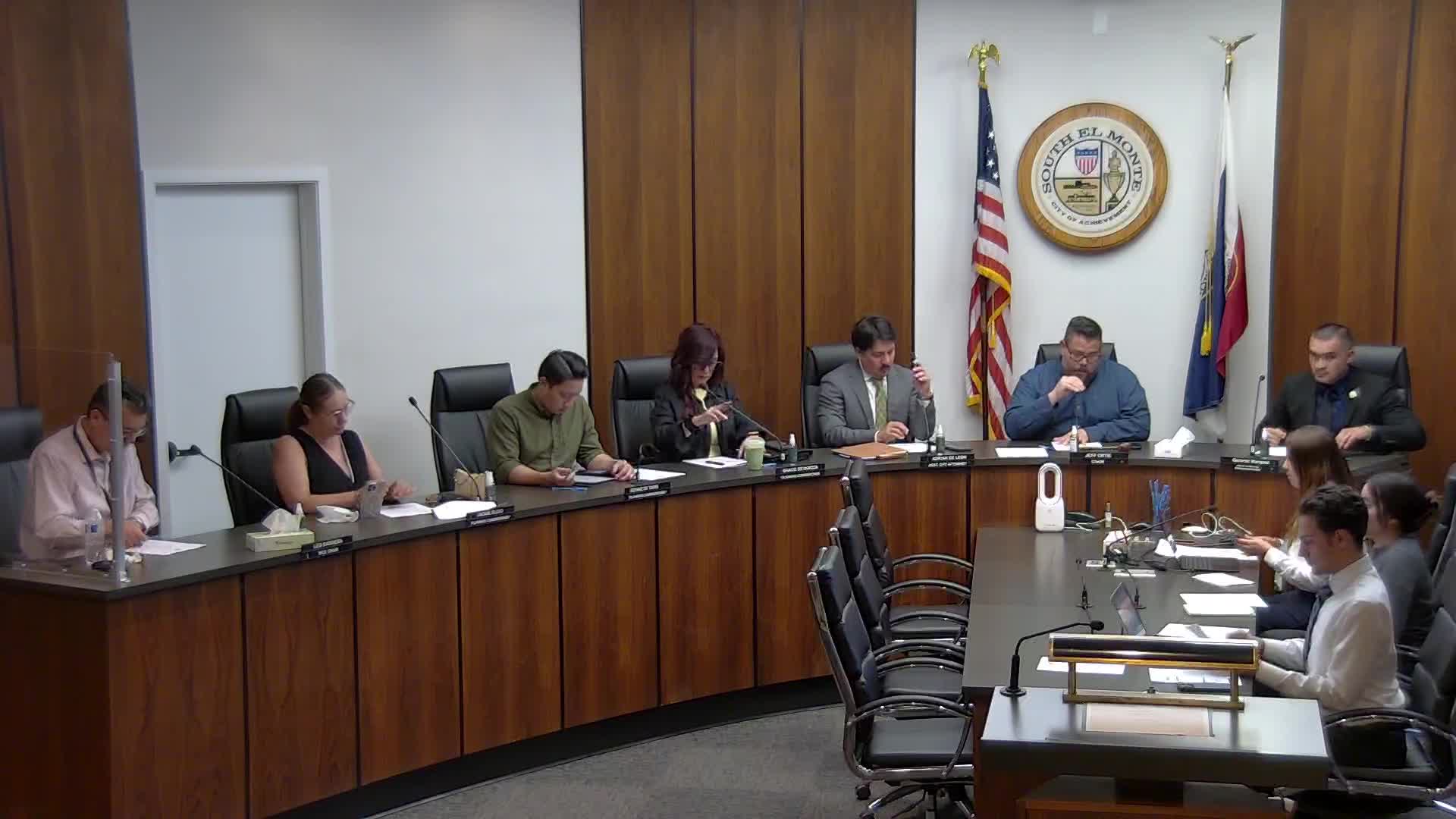
Summary
City Attorney's Office staff led a roughly 30-minute Brown Act and Political Reform Act training for the South El Monte Planning Commission on June 24, covering open-meeting rules, recusal tests and filing requirements; commissioners asked procedural questions and staff said training materials will be provided.
South El Monte Planning Commission members received a Brown Act and Political Reform Act refresher during their June 24 regular meeting, City Attorney's Office staff said, outlining open-meeting rules, financial-disclosure requirements and recusal standards.
The training, introduced during the presentations portion of the meeting, was led by Adrian de Leon and Manny Cruz of the City Attorney's Office. The presenters told the commission the session would take about 30 minutes and covered the Brown Act's public-participation and notice requirements as well as conflict-of-interest rules under the Political Reform Act and related disclosure and enforcement mechanisms.
Adrian de Leon said the “golden rule here is that all meetings of a legislative body of a local agency shall be open and public,” explaining that the Brown Act prohibits undisclosed gatherings of a quorum and requires agenda-based notice so the public knows what will be discussed. He warned commissioners to avoid serial communications—email chains, group calls or social-media exchanges—that could amount to deliberations outside a publicly noticed meeting.
Manny Cruz outlined the Political Reform Act duties, including filing Form 700 and recusal obligations. He walked commissioners through the four-part test he said officials should ask themselves before participating: whether a decision would affect personal finances, whether the effect is significant, whether the effect is different from the general public, and whether the official is using their role to influence the outcome. Cruz said, “If you're ever unsure about a potential conflict, it's okay to reach out to [the FPPC] directly or through the city attorney.”
Presenters summarized several statutory thresholds discussed in the session: a presumptive disqualifying interest for property within 500 feet of a project site; reportable income of $500 or more from a source within the previous 12 months; gift-reporting that becomes disqualifying when cumulative gifts exceed $630 in 12 months; and a direct or indirect investment or business position over $2,000 that may require recusal. Cruz noted the Fair Political Practices Commission (FPPC) enforces the Political Reform Act and that its statute-of-limitations is typically five years, subject to tolling if concealment is suspected.
Commissioners asked procedural questions about common scenarios. One commissioner asked whether general increases in property values affecting all homeowners would require recusal; de Leon replied that a benefit indistinguishable from the general public normally does not create a disqualifying interest, but the 500-foot rule can create a presumption of a conflict. Another commissioner asked about private social invitations; staff said context and any connection to city business determine whether disclosure is needed.
The presenters told the commission the slideshow could be shared and that the city attorney plans to prepare a handbook of guidance for commissioners. No formal action resulted from the training itself. The commission then approved the meeting agenda and the minutes of the May 27, 2025 meeting by roll-call vote, with Chair Ortiz, Vice Chair Barrera, Commissioner Retamosa, Commissioner Rubio and Commissioner Tang recorded as voting yes.
The meeting adjourned at 6:28 p.m.; the next regular Planning Commission meeting is scheduled for July 22, 2025.