
Vallejo advisory board receives training on Brown Act, public records and conflicts ahead of surveillance reviews
Get AI-powered insights, summaries, and transcripts
Subscribe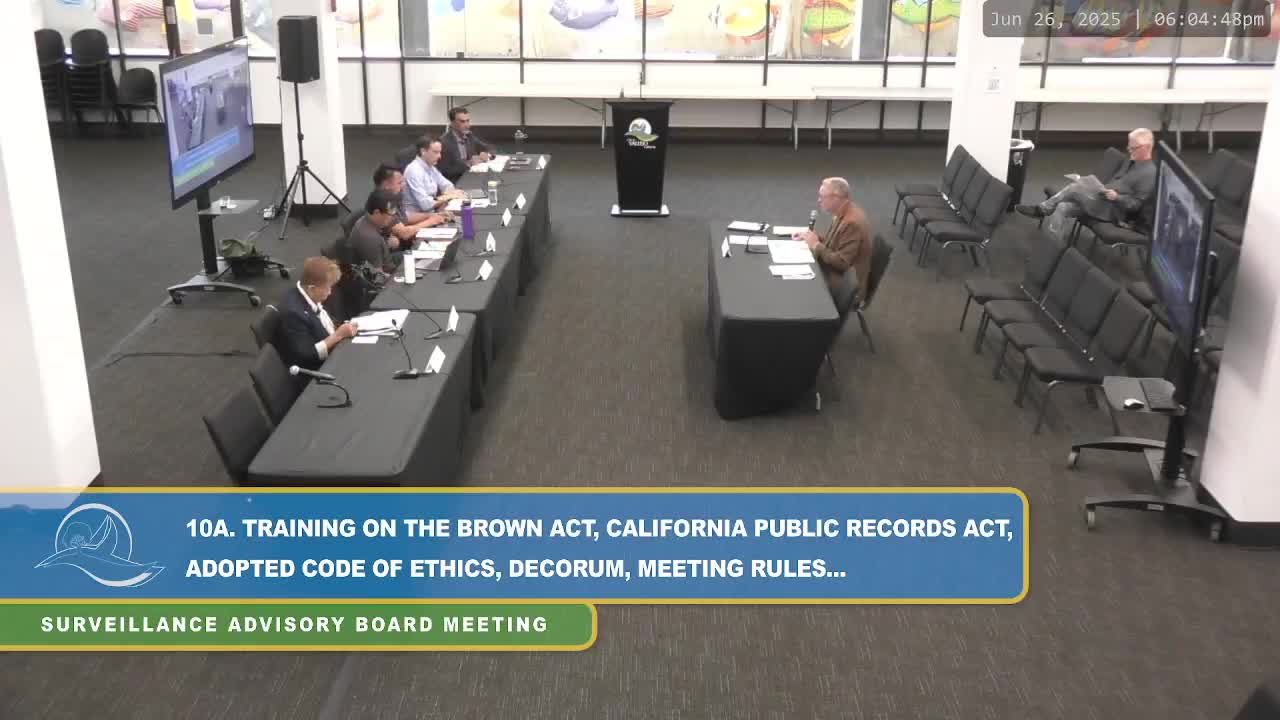
Summary
City Attorney Reisner briefed the Vallejo Surveillance Advisory Board on the Brown Act, California Public Records Act and conflict rules, outlining members’ meeting responsibilities, public‑records obligations for private accounts and the board’s advisory duties under Vallejo municipal code.
City Attorney Reisner gave a training on open‑meetings, public‑records and conflict‑of‑interest rules to the Vallejo Surveillance Advisory Board during a regular meeting, focusing on how state law constrains board deliberations and what the board must consider when advising on surveillance technology.
Reisner framed the Brown Act as a foundational transparency law. “The people of this state do not yield their sovereignty to the agencies which serve them,” Reisner read, then summarized key obligations: agendas that provide effective notice, the prohibition on serial meetings, and the limited exceptions that permit closed sessions.
The training covered practical rules members must follow: a “meeting” under the Brown Act occurs when a majority convenes to discuss city business; individual contacts and attendance at conferences are typically allowed so long as members avoid creating a serial communication; and public comment must be permitted. Reisner cautioned that members may attend community events but should avoid committing to votes outside a posted meeting.
Reisner described remedies and timelines for alleged Brown Act violations: an interested person must give a notice (a “cure” letter) within 90 days of the alleged violation and the agency typically has 30 days to cure by re‑hearing the item. He also noted that criminal prosecutions are rare but possible in cases where officials intentionally deprive the public of information.
On the California Public Records Act, Reisner emphasized that “writings of public officials and agencies shall be open to public scrutiny,” and reviewed recent court holdings that broadened disclosure obligations. He explained the California Supreme Court’s San Jose decision finding that communications about public business on private accounts can be subject to disclosure, and he warned board members that private emails, text messages and social‑media posts touching on board business can be responsive to PRA requests.
Reisner said the city relies on member affidavits when private accounts are searched, and that failure to search or an untruthful affidavit can create legal risk. He recommended that members maintain a separate account for board business to reduce search burdens and privacy exposure.
The training also covered workload and practical costs the city faces when processing records requests: staffers and a dedicated attorney review searches and redactions, the city uses software (NextRequest) to log requests, and large requests can require substantial staff time. Reisner cited the Getz decision discussed in court rulings about the burdens of searching large data sets and noted that body‑worn camera footage often requires expensive redactions under state law.
Reisner reviewed conflict‑of‑interest standards under the Political Reform Act and the FPPC process for advisory letters. He summarized reportable economic interests (real estate, sources of income, gifts) and explained that receipt of certain gifts or a financial interest reasonably foreseeable to affect a decision requires disclosure and, when necessary, recusal. “If you think for any reason that you have a conflict of any kind, bring that question to me or to Naveed,” Reisner said.
The attorney outlined the Surveillance Advisory Board’s powers under the Vallejo municipal code (chapters 2.26 and 2.27): the board is to advise the city and city council on acquisition, deployment and policy for surveillance technology; collect public input; seek expert testimony; submit recommendations within 45 days of a request; and draft model legislation for council consideration. Reisner said emergency uses by departments may proceed but should be reported to the board no later than 30 days after deployment.
Board members asked procedural questions, including whether the Brown Act is state or federal law (a resident, Ron Tess, asked “Is the Brown Act federal or is that state?”; Reisner answered, “State law”), and about remote participation rules, attendance limits, and whether the board could hold town‑hall style meetings or hire experts. Reisner said remote attendance is possible in limited circumstances but requires additional notice and a public physical location for the member, and that hiring paid experts would require council approval.
No policy or ordinance was adopted at the meeting; the only formal action recorded was approval of the consent calendar minutes. Board members requested printed copies of the municipal code and Rosenberg’s rules materials for a future meeting.
The training concluded with staff pledges to provide requested printed materials and to make department reports available at the next meeting so the board can proceed with surveillance reviews.