
Vallejo rolls out sidewalk-vending ordinance but enforcement and food-safety gaps worry vendors and businesses
Get AI-powered insights, summaries, and transcripts
Subscribe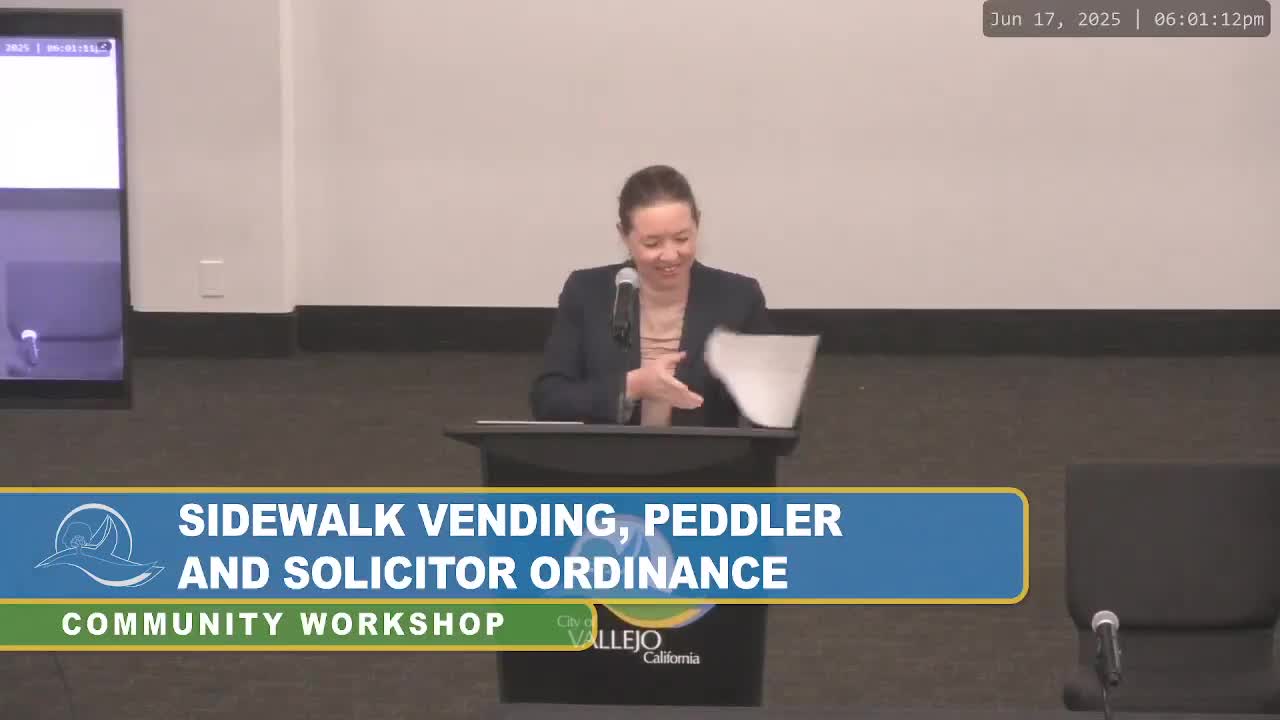
Summary
City of Vallejo’s sidewalk-vending ordinance took effect April 16, but city staff and Solano County Environmental Health said enforcement will be complaint-driven, county health cannot permit unenclosed street tents, and sweeps to impound unpermitted vendors happen only 4–6 times a year.
The City of Vallejo’s sidewalk-vending ordinance, approved by the city council in December 2024 and effective April 16, is now in the education phase while city staff and county health officials work to scale enforcement, officials said at a public workshop.
Laura Solomon, with the City of Vallejo planning division, summarized the ordinance’s purpose and basic rules, saying the measure is intended “to ensure public safety and accessibility, promote fair vending practices, protect public health, and comply with state and local law.”
The ordinance requires vendors to hold a one-year city permit and to wear a city-issued badge while operating. Solomon said applications must include name, address, business details, valid identification (driver’s license, Social Security number or Individual Taxpayer Identification Number), a California seller’s permit, and — for anyone selling food — a Solano County health permit. The current City of Vallejo application fee is $458.04, Solomon said.
Solano County Environmental Health staff explained how county public-health rules intersect with the city ordinance. “Anything that’s meant for human consumption, environmental health regulates,” said Jania Miguel, supervisor for the consumer protection team at Solano County Environmental Health. Miguel said the county will not issue health permits for unenclosed street tents serving prepared food; the county issues permits only for brick-and-mortar facilities, special-event vendors within designated event zones or farmers markets, mobile food facilities such as trucks and push carts, microenterprise home kitchen operations (limits apply) and cottage food operations (baked and shelf-stable items).
That distinction matters for enforcement and food-safety tracing. Miguel said the county runs unpermitted-vendor sweeps about four to six times per year, coordinated with local police or sheriff’s offices, public-works trailers and city staff. During those operations the county may issue notices, cite vendors, impound equipment and, where necessary, dispose of unfit food.
City staff and county health officials told attendees enforcement is currently complaint-driven. Cesar Orozco, planning manager for the city, said code enforcement will prioritize locations with repeated complaints and that the city is building a list of problem sites. “If we see a constant, constant process that they’re setting up every Thursday, Friday, Saturday, Sunday,” Orozco said, “then at that time…it’ll be up to the code enforcement manager” to assign overtime or otherwise deploy officers.
Residents and local business owners at the workshop pushed back, saying enforcement resources are insufficient and that unpermitted vendors harm brick-and-mortar restaurants. One resident said vendors sell food “after hours” and mocked warnings, asking, “Why do I have to do your job? Isn’t it the fact that they’re putting people’s lives in danger by selling food that’s not under any permit?” Another attendee described repeated encounters in which impounded vendors returned the next day.
City planning and code-enforcement staff described operational rules in the ordinance: vendors must maintain 40 inches of sidewalk clearance, must be at least 100 feet from traffic signals, signs and driveways, and must not block vehicular traffic. The ordinance prohibits open flames and attaching equipment to public property, bans sales of alcohol, tobacco and live animals, and requires a trash container on the vending unit; food vendors must use gloves for handling food. Location-based rules include: residential zones allow roaming vendors between 9 a.m. and 6 p.m. but do not allow stationary vending; vending is restricted in city parks when concession agreements exist; vending is prohibited inside event zones or farmers markets unless part of the market; and vending is not allowed within 250 feet of schools during the start and end of class periods, Solomon said.
Solano County staff stressed that, because county health cannot issue a permit for an unenclosed street tent that serves prepared food, the county’s role is enforcement and response when a foodborne-illness complaint can be traced to a vendor. Miguel said the county gathers evidence and provides public records to complainants or investigators when the county can identify the operator, but she acknowledged that in some cases investigators cannot determine the food source.
City staff said they plan more outreach — including additional workshops and visits to farmers markets — and asked residents to submit complaints and locations by email so the city can build a list of repeat sites for targeted enforcement. Orozco and Solomon said they are coordinating with the Vallejo Police Department to get on-call support for after-hours enforcement, but staff said no firm schedule or timeline for sustained after-hours enforcement has been set.
The public comment period at the workshop included questions about translated materials and how to reach staff; planning staff said applications, flyers and business cards are available at the meeting and that staff can provide services in Spanish, Tagalog and other languages on request. Solano County Environmental Health provided a website path (solanocounty.gov → Government → Resource Management → Environmental Health) and office location at 675 Texas Street, Fairfield, Suite 5500 for permit information.
The workshop ended with staff asking attendees to email complaints and locations to the planning division so the city can prioritize enforcement. Staff said the workshop is part of an ongoing education phase rather than a completed enforcement program; the city has not announced a final enforcement start date for routine after-hours patrols.
Clarifying details and application materials remain available from the City of Vallejo planning division and from Solano County Environmental Health; staff left printed application packets and business cards at the meeting for follow-up.