Malletts Bay School highlights literacy gains, math intervention routines and preschool quality work
Loading...
Summary
Jordan Burke, principal at Malletts Bay School, presented the school's 2023-24 annual report to the Colchester School District Board of Directors on May 20, highlighting updated explicit word-study instruction, a district-aligned math intervention "menu," strong YouthTruth survey results and preschool quality-improvement work under Vermont's STARS program.
Jordan Burke, principal at Malletts Bay School, told the Colchester School District Board of Directors on May 20 that the school's spring report shows targeted changes in literacy and math instruction and positive student feedback from district surveys.
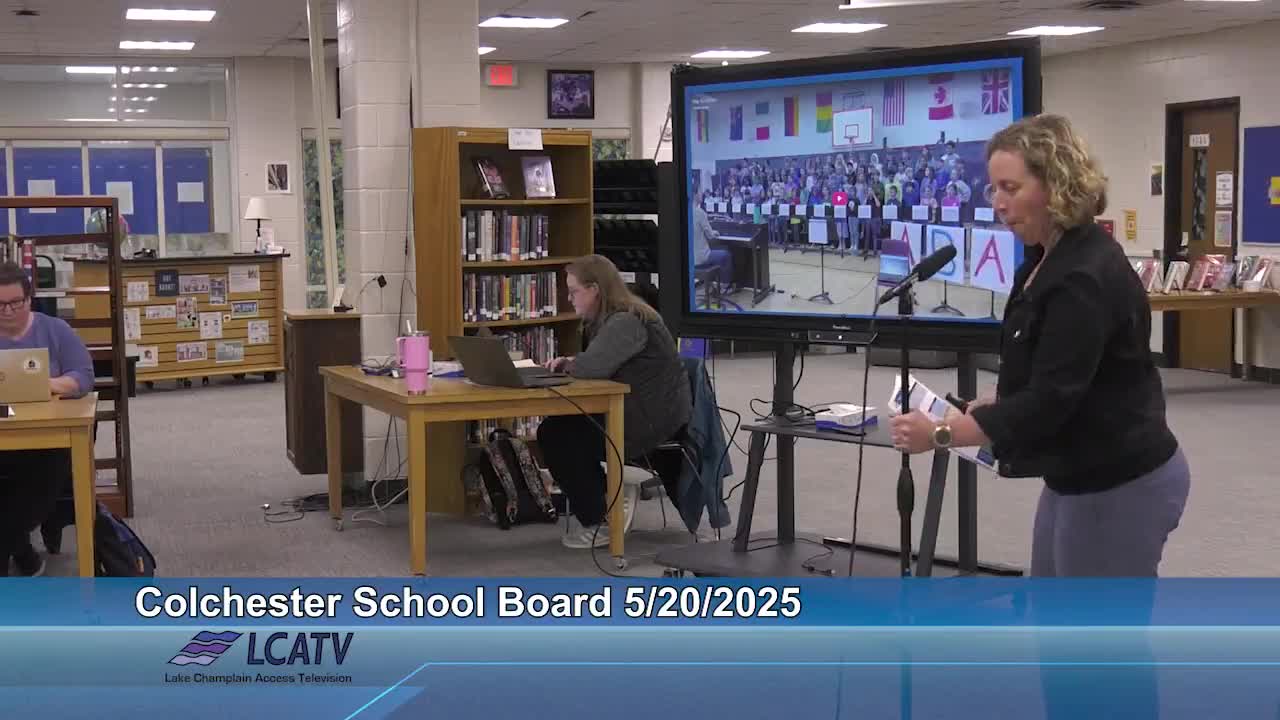
Burke said much of the data in the presentation comes from the 2023-24 school year but included photos and short videos from spring 2025. "This is the 23-24 school year report," Burke said, noting a few 2025 updates. He described a shift in upper-elementary instruction toward explicit word study that includes vocabulary, Greek and Latin roots and building words as part of a 10- to 20-minute portion of a 90-minute literacy block. "There is a lot of evidence base around the importance of explicit instruction in vocabulary," Burke said.
The principal said third grade uses the Phonics to Reading program and that fourth and fifth grades have been working on updated word-study routines. Burke showed a brief classroom clip from a suffix lesson taught by third-grade teacher Catherine Lamoreaux to illustrate students learning to build words.
Burke also described a two-block daily approach to math: an hour-long grade-level math block and a later "math intervention" block where teachers and specialists pull small groups for support. He said the school formalized a "math menu" routine so teachers, interventionists and special educators deliver aligned interventions and enrichment. "While kids are working on the math menu, teachers are pulling small groups of kids," Burke said.
On school climate, Burke shared YouthTruth survey results for grades three through five from 2023-24. He said Malletts Bay ranked in the 90th percentile for school safety, the 80th percentile for belonging and the 82nd percentile for school culture compared with other YouthTruth-participating schools. "I think it's reflective of a lot of the PBIS work that we've done," Burke said, referring to the school's positive behavior interventions and supports framework built around three expectations: safe, respectful and responsible.
Burke described the school's social-emotional learning programs, including Second Step for preschool through grade five and a token-based recognition system. He credited a recent artist-in-residence hip-hop program and the Dream mentoring partnership, which brings high school mentors to work with elementary students once a week.
Nancy Smith, preschool facilitator and an endorsed early childhood special educator, described the program's continuous quality improvement work under Vermont's STARS (Step Ahead Recognition System). "We are in year two of it," Smith said. She said STARS now evaluates responsive practices, adult-child interactions (measured by the CLASS classroom assessment) and youth and family engagement. Smith said the preschool was grandfathered in as a five-star program but CLASs observations suggested the program would score a four without recent changes. One action step, she said, was raising the level of teacher questioning to five higher-level questions per session and posting sentence-starter prompts in classrooms to support that practice.
Smith noted two operational limitations that affect preschool improvement goals: the program is two hours and 45 minutes per session (she said the district meets Act 166's 10-hour weekly requirement) and the district does not provide transportation for preschoolers. "We're a hard program to access because it's less than a half a day ... We don't offer transportation, which is challenging for families," Smith said.
Smith also described family-engagement steps: a home-and-school learning bag with literacy and math activities and a ParentSquare newsletter series in families' home languages. She said the team piloted volunteer opportunities and used family feedback to adjust distribution timing of the learning bags.
The board and presenters discussed barriers to connecting academics to real-world problems, with Burke identifying transportation as a key constraint to some planned activities. Board members praised the presentation and asked clarifying questions about preschool logistics and the STARS goals.
The presentation concluded with a brief list of school traditions and events the presenters said help build culture: a mystery-singer celebration tied to PBIS goals, a spring fun run supported by the PTA, a fifth-grade talent show and field day. Burke and Smith thanked the board and noted they would consider a fuller future presentation on the Dream mentoring partnership.
Ending: The board did not take a vote on the school report. Presenters said the presented instructional and program changes will continue into the 2025-26 school year and that staff will return with additional progress updates.