
Committee questions fiscal estimate, eligibility as Alaska considers address confidentiality program
Get AI-powered insights, summaries, and transcripts
Subscribe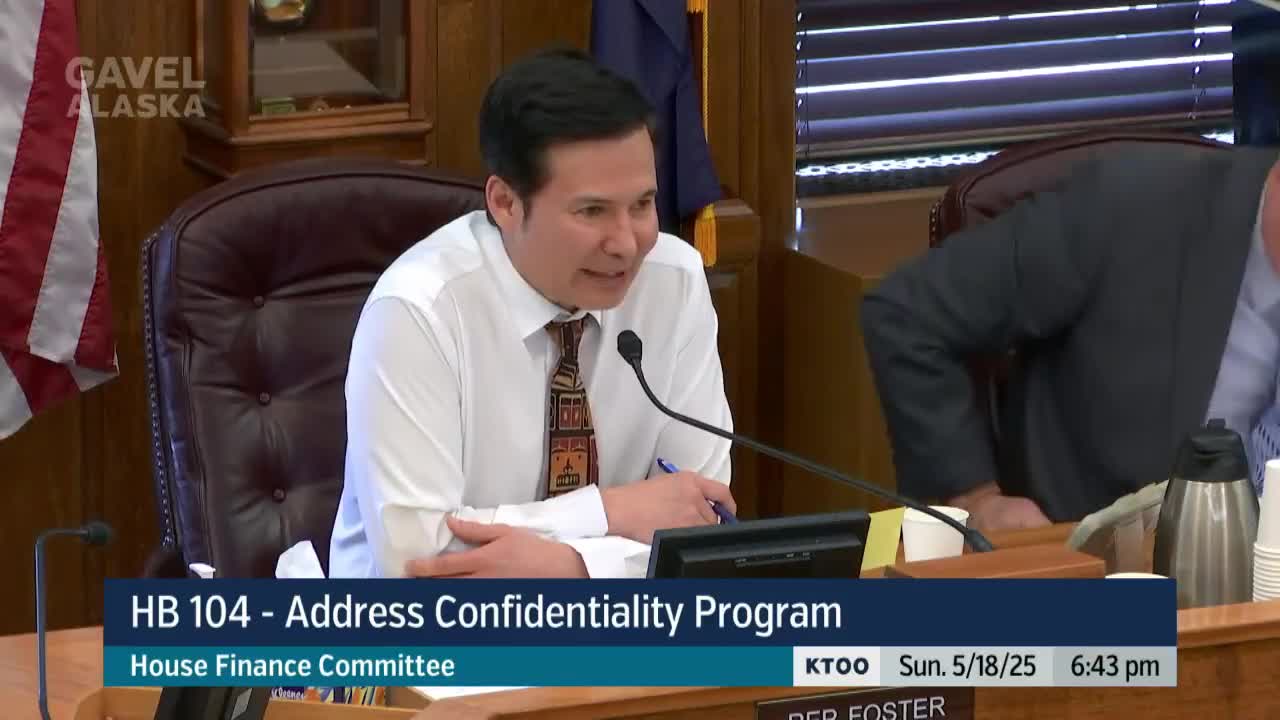
Summary
The House Finance Committee heard an extended discussion Sunday on HB 104, a bill to establish an address confidentiality program for victims of domestic violence, sexual assault and stalking and for certain peace officers.
The House Finance Committee heard an extended discussion Sunday on HB 104, a bill to create an address confidentiality program to help victims of domestic violence, sexual assault and stalking keep their physical addresses private. Sponsor Representative Donna Mears said the bill would make Alaska the 40th state to offer such a program and would provide an anonymized post‑office box and related protections for qualifying participants.
"HB 104 will bring us to be the fortieth state that provides a vital level of privacy to victims of domestic violence, sexual assault, and stalking, by providing an anonymized post office box for folks that are under a number of different protective orders and safety plans to keep their location private from their perpetrators," Representative Donna Mears said.
Committee members focused on the bill's fiscal note and on who would be eligible. Representative Jimmy Galvin, Representative David Bynum and others pressed for clarity after a revised fiscal note increased projected costs; Bridal Anderson and committee staff said a new fiscal note had been filed earlier in the week. Representative Galvin asked whether the Department of Administration or other states had been contacted to explain how Alaska's estimate was developed.
Nancy Mead, general counsel for the Alaska Court System, told the committee the court system had not requested to be included in the statute and that inclusion of judges or court officers would be a policy choice for the committee. "If judges were included, I can imagine a handful might take advantage of such an option," Mead said, adding that enrollment can create delays in mail delivery and is a time‑consuming administrative process.
Talia Ames, testifying from Montana's program experience, told the committee Montana runs a small program with two part‑time staff at a cost of about $22,000 per year and that other states scale differently. "The state of Washington had 5,497 participants with a budget of $766,308; dividing that by the number of participants comes out to about $153 per enrollee," Ames said. She also calculated that the current Alaska fiscal note would amount to roughly $650 per enrollee under the committee's assumed maximum enrollment.
Representative Bynum asked whether a narrower pilot — for example, establishing the legal mechanism without immediately funding full mail forwarding services — had been considered. Representative Mears said mail forwarding is a small component of the bill and estimated the pool of potentially eligible peace officers and corrections staff at roughly 1,500 across the Department of Public Safety and the Department of Corrections, but she and other witnesses said actual enrollment was likely to be much smaller.
Committee members also raised implementation details. Representative Tomczewski asked how the mail forwarding would work; Mears responded that only mail that would generate a public record (for example, school correspondence) would be forwarded to the anonymized PO box, while personal mail such as a letter from family would go directly to participants. Representative Jimmy asked about criminal penalties in the bill for unauthorized disclosure of a participant's confidential address; counsel and sponsors said the penalty is intended for those operating the program who improperly disclose confidential information, not for family or friends of participants.
The committee set an amendment deadline of 5 p.m. Monday, May 19, 2025, and recessed without a vote on the bill; committee staff said if no substantial amendments are filed the committee could reconvene quickly to act. Representative Mears and multiple committee members requested further follow‑up on the fiscal note and the number of likely enrollees before final action.